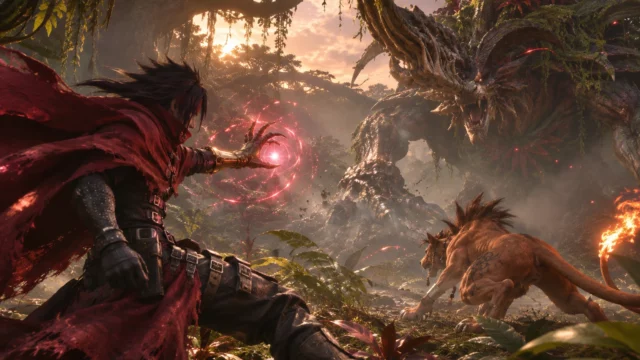
More power does not always make a role-playing game more enjoyable. In fact, giving players one overwhelmingly effective ability can make every other combat option feel unnecessary. That is the problem FF7 Revelation combat is trying to avoid, even as Square Enix prepares the most ambitious team attacks in its remake trilogy.
Director Naoki Hamaguchi has confirmed that three characters will be able to combine their strength in spectacular Synergy Attacks. However, there is an important restriction. These moves will not become another ability players can activate whenever they please. Instead, they are being reserved for moments when the story reaches a particularly dramatic point.
FF7 Revelation combat puts variety ahead of maximum damage
During an interview with PlayStation Access, Hamaguchi explained that he discussed the new mechanic with battle director Teruki Endo. Their concern was straightforward: an attack involving three characters would naturally sit above the game’s existing offensive options.
Players already have regular abilities, synchronized techniques and Limit Breaks at their disposal. Introducing an even stronger attack without restrictions could create an obvious dominant strategy. Rather than experimenting with different combinations, players might simply wait for their most destructive option to become available.
Square Enix has therefore chosen to make these attacks part of specific gameplay experiences. Hamaguchi indicated that they will appear during emotionally significant or cinematic moments, rather than functioning as universally accessible commands. The director’s explanation suggests that combat variety matters more than constantly increasing the damage ceiling.
A mechanic that began with Yuffie now serves a bigger purpose
The decision becomes more interesting when looking at how cooperative attacks have evolved throughout the remake project. Episode INTERmission introduced coordinated combat through Yuffie and Sonon’s partnership. That smaller system established an important idea: characters could fight as a unit instead of behaving like completely independent combatants.
Final Fantasy VII Rebirth expanded this philosophy with Synergy Abilities involving different party members. Those techniques were not simply visual spectacles. They encouraged players to explore combinations and made relationships between characters visible during battle.
Revelation takes that concept further by involving three fighters simultaneously. Nevertheless, the biggest change is not necessarily the additional participant. It is the decision to connect the most powerful teamwork to specific narrative situations. A move that represents the entire active party acting together could carry greater emotional weight when it appears at a decisive moment.
This approach also creates a distinction between regular teamwork and exceptional story sequences. Players can still appreciate the established combat systems, while three-character attacks have the potential to become memorable highlights rather than routine shortcuts.
Why limiting player control could make the finale stronger
There is a genuine trade-off here. Players who enjoy mastering complex combat systems may prefer to activate every ability themselves. Restricting three-character Synergy Attacks removes some freedom, particularly for anyone hoping to experiment with unusual party combinations or optimize damage against difficult enemies.
On the other hand, unrestricted access creates its own problem. If the strongest move becomes the obvious solution to every challenging encounter, weaker abilities can gradually lose their appeal. That would undermine the tactical variety Square Enix has developed across three games.
There is also a storytelling advantage. The Final Fantasy VII remake project has consistently treated battles as extensions of character relationships. A spectacular attack involving three allies could reinforce an important turning point without relying exclusively on dialogue or a traditional cutscene.
However, execution will determine whether this restriction feels rewarding. If players encounter these attacks naturally during major confrontations, they could become genuine highlights. If their appearances feel overly scripted, some may question why such an exciting mechanic offers so little direct control.
That distinction is especially important for an adventure expected to last more than 100 hours. With so much time spent fighting, exploring and developing characters, the underlying battle system must remain engaging without depending on its rarest spectacle.
A 100-hour adventure with two expansions already planned
Final Fantasy VII Revelation will conclude the trilogy that began with Remake and continued through Rebirth. Its scheduled release date is April 8, 2027, with versions planned for PlayStation 5, Xbox Series X|S, Nintendo Switch 2 and PC through Steam.
The multiplatform launch is another significant part of Square Enix’s strategy. Players entering the series on Xbox can already discover the beginning of the trilogy through Final Fantasy VII Remake Intergrade’s arrival on Game Pass. Consequently, the final chapter will reach an audience spread across several gaming ecosystems rather than being associated with only one console.
Hamaguchi has also indicated that completing the adventure could require more than 100 hours. That figure points toward a substantial RPG, although individual playtimes will naturally depend on exploration, optional activities and how thoroughly players approach the available content.
Furthermore, Square Enix has confirmed two post-launch story expansions. One will focus on Sephiroth, while another will explore Vincent Valentine and the Turks. A Story Expansion Pass is already listed on Steam, establishing plans to continue exploring these characters beyond the main campaign.
The broader content strategy offers an interesting contrast with the combat restriction. Square Enix is expanding the overall experience while deliberately limiting access to one of its most spectacular mechanics. In other words, more content does not automatically mean giving players every possible advantage.
This emphasis on meaningful character experiences also connects with Square Enix’s wider RPG portfolio. For example, Final Fantasy XIV’s upcoming Evercold expansion illustrates another approach to extending a familiar combat experience through new roles and a fresh narrative direction.
Ultimately, FF7 Revelation combat faces a challenge that raw spectacle cannot solve: making a massive adventure remain satisfying from its opening encounters to its final confrontation. Three-character Synergy Attacks could help achieve that goal precisely because players cannot rely on them constantly. Whether that restraint feels exciting or frustrating will depend on how naturally Square Enix integrates those moments into the story.
Source: Naoki Hamaguchi’s interview with PlayStation Access, as reported by GamingBolt.

Creator of the website, Pokemon trainer by nature. Trying to report on everything related to the world of video games, series and movies. Yu-Gi-Oh is my weakness, collecting cards since the dawn of time.