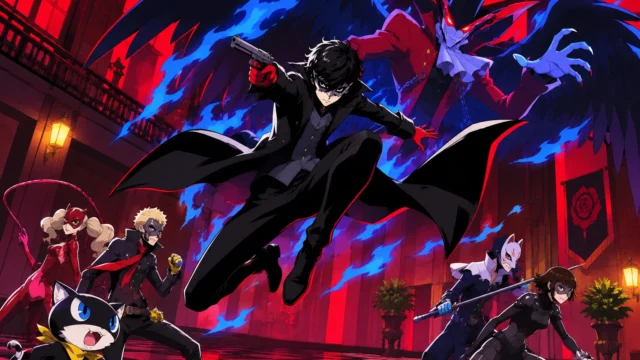
For years, Persona 3 and Persona 4 helped define Atlus’s reputation among RPG fans. Yet one generation of Phantom Thieves has transformed the commercial picture. The latest Persona 5 sales figures show how dramatically the balance has shifted, with the fifth numbered entry now accounting for roughly half of the franchise’s reported lifetime sales.
That achievement is not simply about one successful role-playing game. Instead, it reflects a broader strategy built around expanded editions, spin-offs and different ways of keeping players connected to the same characters.
Persona 5 sales show the value of an expanding universe
According to Sega Sammy’s Integrated Report 2026, the Persona 5 series reached 15.5 million units worldwide as of March 31, 2026. Its previous integrated report listed 13 million, meaning the reported cumulative total increased by 2.5 million units between editions.
That represents growth of approximately 19.2% over the previously reported figure. However, the comparison does not establish precisely when every additional copy was sold. These are cumulative figures published in successive reports, rather than a detailed breakdown of sales during a specific twelve-month period.
Importantly, the total includes five releases: Persona 5, Persona 5 Royal, Persona 5: Dancing in Starlight, Persona 5 Strikers and Persona 5 Tactica. Therefore, 15.5 million should not be interpreted as sales of the original game alone. In September 2025, Atlus had already confirmed that Persona 5 and Persona 5 Royal together had exceeded 10 million units.
Why Persona 5 has pulled ahead of earlier generations
The comparison with earlier installments makes this achievement especially striking. Figures reported in September 2026 placed the Persona 4 series at 5.7 million units and the Persona 3 series at 5 million. Meanwhile, the entire Persona franchise had reached 30 million copies sold by June 2026.
On that basis, Persona 5’s reported 15.5 million represents approximately 51.7% of the 30 million franchise benchmark. There is an important qualification: the Persona 5 figure covers sales through March, whereas the franchise-wide total extends through June. Consequently, this percentage is an approximate comparison using different reporting cutoffs, not an exact same-date market share.
Even with that distinction, the contrast is substantial. Persona 5 has accumulated a much larger reported total than either of its immediate predecessors. Its striking visual identity, accessible standalone story and memorable Phantom Thieves also offer a recognizable foundation for different kinds of games.
Those qualities help explain why Atlus can continue building around the same cast without asking every returning player to experience another traditional, lengthy JRPG.
Spin-offs have become part of Atlus’s long-term strategy
Persona 5 Royal revisited the original adventure with additional content and improvements. Persona 5 Strikers subsequently took its characters into action-oriented combat, while Persona 5 Tactica explored tactical battles. Persona 5: Dancing in Starlight offered something different again through rhythm gameplay.
These releases serve different audiences and play styles. More importantly, they give established fans additional opportunities to revisit a familiar world. Someone who enjoys the original turn-based adventure might also be interested in a tactical spin-off, even without wanting another full-length campaign.
Still, the combined sales figures do not reveal how many individual customers purchased multiple titles. Nor do they establish which spin-off contributed most to the latest increase. What they demonstrate is that Persona 5 has grown beyond a single release into a commercially significant collection of games.
For Atlus, that distinction matters. A recognizable cast and setting can support several products over time, while new releases can also encourage interest in older adventures. It is a model that may influence how the publisher approaches future Persona projects, although the report itself does not announce any new Persona 5 installment.
A 30-year legacy raises questions about Persona’s future
The latest figures arrive during an important anniversary year. Persona began in 1996, making 2026 its thirtieth anniversary. Curiously, the English edition of Sega Sammy’s report incorrectly identifies 2002 as the franchise’s starting year. Its Japanese counterpart provides the correct date, 1996.
Meanwhile, attention has returned to the earliest installment. Alleged remake footage circulated over the weekend, renewing discussion about whether Atlus could modernize the RPG that launched the series. Battle4Play recently examined the Persona 1 remake leak and its unanswered questions. However, Atlus has not authenticated the video or announced such a remake.
The commercial success of Persona 5 makes that conversation particularly interesting. Older entries could potentially reach players who discovered the franchise through the Phantom Thieves. Nevertheless, successful sales alone cannot confirm which projects Atlus will approve or how its development resources will be allocated.
Ultimately, Persona 5 sales reveal more than an impressive milestone. They show how one RPG generation has become the strongest commercial pillar of a thirty-year-old franchise. The next challenge for Atlus is whether future entries can build similarly lasting audiences without relying entirely on the Phantom Thieves. Could Persona 6 eventually achieve the same longevity?
Source: Sega Sammy Integrated Report 2026.

Creator of the website, Pokemon trainer by nature. Trying to report on everything related to the world of video games, series and movies. Yu-Gi-Oh is my weakness, collecting cards since the dawn of time.