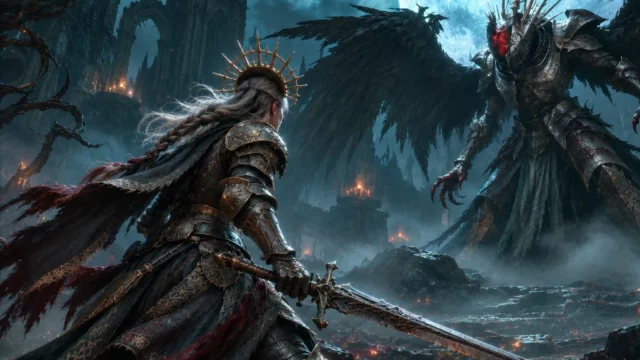
For CI Games, 2027 is becoming much more than another release year. The Polish publisher has placed considerable financial expectations on its next dark fantasy adventure, and Lords of the Fallen II funding now offers a clearer picture of what is at stake. With the sequel’s launch financed, attention can shift from securing resources to delivering a game capable of meeting those expectations.
The important detail is not simply how much money the company has obtained. It is how that financing connects the game’s commercial performance to a repayment deadline later in 2027. Consequently, the next few months could prove decisive for both the franchise and its publisher.
December could become the turning point for Lords of the Fallen II
The next major milestone is already approaching. CI Games plans to announce the Lords of the Fallen II release date in December 2026, ahead of its expected arrival in 2027. That announcement should give players a more precise idea of when they can return to the series’ unforgiving fantasy world.
The sequel is planned for PS5, Xbox Series X|S, Nintendo Switch 2 and PC. Reaching several platforms gives the publisher access to different audiences, although each version will also need to meet player expectations. At present, the financing announcement does not establish technical performance targets or guarantee identical features across systems.
More importantly, the release-date reveal will provide a clearer timeline for the marketing campaign. Once a specific day is confirmed, CI Games can organize its promotional activity around a fixed launch window. For players following upcoming action RPGs, our coverage of Crimson Desert’s latest playable trial also illustrates how opportunities to experience a major fantasy adventure can influence purchasing decisions.
The original game’s 2.5 million sales explain the ambition
There is a commercial foundation behind this investment. According to CI Games, Lords of the Fallen (2023) surpassed 2.5 million copies sold and reached its investment break-even point at the end of February 2026. Those figures help explain why the company sees another installment as a significant business opportunity.
However, reaching break-even and generating substantial profits are different achievements. The first means that the investment has been recovered under the company’s accounting assessment. It does not automatically reveal how much profit a sequel will generate or how quickly its development costs can be recovered.
Furthermore, a recognizable franchise provides an advantage without guaranteeing a successful follow-up. Returning players will expect improvements, while newcomers need compelling reasons to enter a demanding action RPG. For comparison, the return of Resonance of Fate to modern platforms highlights another approach to attracting audiences through an established RPG identity.
Lords of the Fallen II funding comes with a deadline
On October 30, 2026, CI Games signed a €28.6 million syndicated credit facility with Erste Bank Polska and Bank Ochrony Środowiska. The arrangement supports the completion of Lords of the Fallen II, its worldwide marketing campaign and its release. It also allows the company to refinance existing bank debt.
Another important participant is KUKE, Poland’s state export credit agency, which guarantees 80% of the facility. This guarantee provides substantial protection for the lenders, although it does not eliminate the publisher’s repayment obligations.
The loan matures on August 31, 2027. CI Games expects sales of its upcoming sequel to provide the main source of repayment. This creates an important distinction: securing the money needed to launch a game is not the same as proving that its eventual sales will meet financial expectations.
Indeed, the arrangement adds a measurable commercial objective to the release. If the game performs strongly, its revenue could help the company satisfy its obligations while supporting future projects. Conversely, weaker sales could require CI Games to rely more heavily on other financial resources or arrangements. Neither outcome can be determined before launch.
Why avoiding new shares matters for CI Games
One of the most notable aspects of the agreement is the absence of newly issued shares. CI Games obtained this financing without diluting existing shareholders through a new share issue. As a result, current investors retain their proportional ownership of the company under this transaction.
Marek Tymiński, President of the Management Board and the company’s largest shareholder, has also committed to retaining his entire shareholding throughout the facility’s term. The official filing additionally identifies a registered pledge over 6.5 million shares in favor of KUKE as part of the guarantee arrangements.
Tymiński has presented the agreement as evidence of lender confidence in the project’s quality and commercial prospects. Nevertheless, confidence from financial institutions should not be confused with a guarantee of market success. The company has secured the resources it needs, but players will ultimately judge the finished adventure.
That distinction is especially relevant for a self-published release. CI Games can retain greater control over its launch strategy, while also carrying responsibility for delivering the game and coordinating its commercial rollout.
Further details of the financing are available in CI Games’ official October 30 financial filing.
Ultimately, Lords of the Fallen II funding removes an important obstacle from the sequel’s path, but it also underlines the importance of its commercial reception. December’s release-date announcement will be the next milestone. The bigger question is whether this ambitious return can build on its predecessor’s success and turn financial confidence into lasting momentum for the franchise.

Creator of the website, Pokemon trainer by nature. Trying to report on everything related to the world of video games, series and movies. Yu-Gi-Oh is my weakness, collecting cards since the dawn of time.