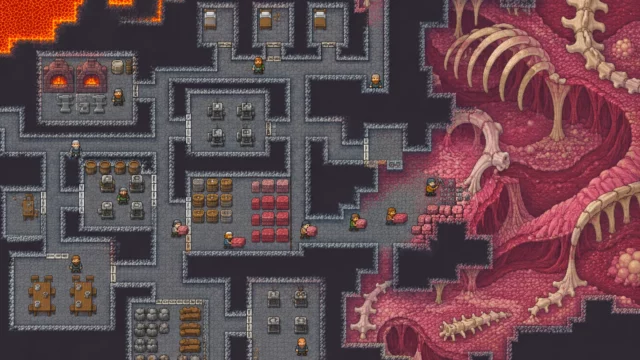
In Dwarf Fortress, digging deeper usually means finding valuable minerals, hidden dangers and occasionally something best left undisturbed. However, the planned Dwarf Fortress meat biome could introduce a much stranger possibility: an underground environment where the landscape itself is made of flesh.
Bay 12 Games co-founder Tarn Adams has confirmed that this unusual biome is being planned. Yet its most interesting feature might not be its disturbing appearance. Instead, the ability to mine organic terrain could give fortress builders another reason to reconsider what lies beneath their settlements.
Dwarf Fortress meat biome could make mining feel completely different
Mining is already central to Dwarf Fortress. Players carve rooms into mountains, establish underground industries and search for materials to keep their growing colonies alive. Each excavation also creates opportunities for unexpected discoveries, especially in a world generated with its own geography and history.
Now imagine breaking through an ordinary rock formation and encountering walls of vertebrae instead. According to Adams, the proposed environment would feature muscle, bone, sinew, sphincters and other flesh-based terrain. It would most likely appear underground, although its final location has not been established.
Crucially, players would be able to mine the meat for resources. That detail separates the concept from a purely visual novelty. Organic surroundings could become another part of the fortress economy, although Bay 12 has not explained which materials players would obtain or how they could use them.
This distinction matters. Dwarf Fortress works because its environments interact with practical decisions. A new biome becomes more compelling when players have reasons to excavate, exploit or avoid it. For now, however, any specific production chains or survival advantages remain unconfirmed.
A living nightmare without rivers of blood or zombie flesh
There is something wonderfully unsettling about the idea of building a dwarven settlement beside a wall resembling a gigantic spine. Nevertheless, Adams has already clarified several limits to this particular vision.
First, there will be no meat trees. Despite the possibilities offered by procedurally generated environments, the developers are not planning forests of organic vegetation for this biome.
Similarly, players should not expect rivers of blood or other unusual liquids. Bay 12 is not introducing new fluids specifically for this environment. Such additions would depend on a separate, long-discussed overhaul of the game’s fluid systems, which has no confirmed arrival date.
One particularly bizarre concept was previously considered: attaching maple-syrup-style taps to vertebrae walls to extract something described as cosmic spinal fluid. It sounds perfectly at home in Dwarf Fortress, but this harvesting mechanic is not part of the game.
And what about animated chunks of zombie flesh? Adams indicated that ordinary meat cannot currently be animated through the relevant systems. Consequently, writhing pieces of undead meat appear unlikely, at least under the present technical limitations.
These restrictions reveal an important distinction between the game’s extraordinary possibilities and its actual development plans. An unsettling environment does not automatically mean every imaginable biological mechanic will become playable.
Why the magic overhaul matters more than the strange new terrain
Although the Dwarf Fortress meat biome naturally attracts attention, Bay 12 Games is currently concentrating much of its development effort elsewhere. The larger priority involves changes to the procedurally generated magic system.
Specifically, the developers are examining how arcane knowledge is classified, transmitted between individuals, preserved across generations and eventually forgotten. This approach fits a defining characteristic of Dwarf Fortress: its worlds possess histories that exist beyond the immediate actions of the player.
Unlike management games where the environment primarily serves as a backdrop, Dwarf Fortress generates civilizations, creatures and historical events before a fortress even begins. Consequently, the way magical knowledge survives or disappears could influence the identities of different generated worlds.
That creates an interesting contrast. A meat-filled cavern would offer a tangible discovery beneath the ground. Meanwhile, changes to magical knowledge could affect the broader historical systems that make each world distinctive.
Bay 12 is also developing a crystal biome, suggesting that environmental variety remains part of its longer-term plans. However, neither biome currently has a confirmed release window.
What players should expect from future Dwarf Fortress updates
The latest information comes directly from Tarn Adams, also known as Toady One, through the official Future of the Fortress discussions. These conversations allow the community to ask questions about development and receive answers from one of the game’s creators.
Still, they should not be confused with a formal update announcement. There is no confirmed release date, no dedicated trailer and no guarantee that every described feature will reach the finished game unchanged.
For players discovering this unusual colony simulator, Battle4Play’s PC gaming coverage also follows the wider range of simulation, strategy and survival experiences available on computers.
The developers’ broader approach remains particularly interesting. Rather than simply adding another hostile underground location, Bay 12 is exploring environmental concepts alongside systems that determine how entire civilizations develop.
Players can follow official progress through the Bay 12 Games development updates, which include ongoing reports and references to community discussions.
Ultimately, the Dwarf Fortress meat biome could become memorable for more than its grotesque visuals. Its real potential lies in making an unfamiliar underground landscape useful to the dwarves who discover it. Whether that idea becomes a substantial gameplay feature or a smaller environmental curiosity remains to be seen. Would you mine a cavern made of flesh, or seal its entrance and never return?

Creator of the website, Pokemon trainer by nature. Trying to report on everything related to the world of video games, series and movies. Yu-Gi-Oh is my weakness, collecting cards since the dawn of time.