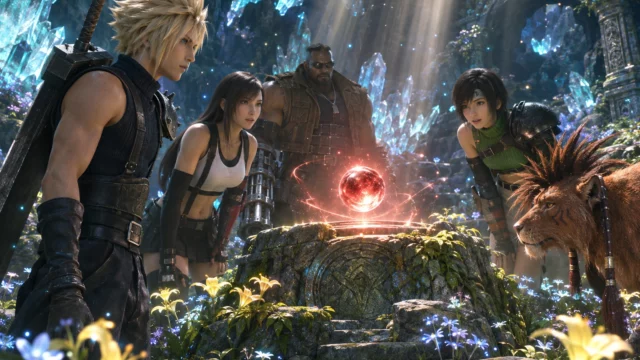
Finding something worthwhile in a massive RPG world should feel like a discovery, not another task to cross off a list. That distinction appears to be driving FF7 Revelation exploration, with Square Enix rethinking how players encounter summons, unlock locations and experience character stories in the final chapter of its remake trilogy.
Director Naoki Hamaguchi discussed these changes with Philippine outlet One More Game during Gamescom Asia x Thailand Game Show 2026. His comments suggest that Final Fantasy VII Revelation wants to address one of Rebirth’s most divisive design choices: the gap between having plenty to do and having a compelling reason to do it.
FF7 Revelation exploration makes discovery worth the journey
One of the clearest examples involves summon materia. In Final Fantasy VII Rebirth, many summons were obtained through Chadley’s virtual reality simulator. Although this provided a structured way to acquire powerful allies, some players disliked having such memorable rewards separated from the actual world.
Revelation takes a different approach. Summon-related content will exist within the environments players explore, allowing them to obtain the corresponding materia through activities connected to those locations rather than relying exclusively on simulations.
Hamaguchi considers this closer to the spirit of the original Final Fantasy VII. More importantly, it changes the motivation behind exploration. Instead of treating the landscape primarily as a place to complete objectives, players will have another reason to investigate what lies beyond their immediate destination.
Knights of the Round becomes more than a materia reward
Perhaps the most intriguing example is Knights of the Round. Hamaguchi confirmed that its materia will be associated with an original storyline connected to Gilgamesh. Consequently, obtaining this summon will involve more than simply collecting an item.
The director did not reveal how that storyline unfolds or what players must accomplish to secure the materia. Nevertheless, connecting a major summon to a dedicated narrative creates an opportunity for its acquisition to feel like an adventure in its own right.
This distinction matters because the reward and the journey leading to it can reinforce each other. If the surrounding story gives players a reason to care about what they discover, the summon becomes more than another addition to their combat options.
Chocobo upgrades and the Highwind reshape how the map opens up
Revelation is also reconsidering movement across its world. Chocobos will have a more meaningful progression system, with improvements gradually allowing players to reach previously inaccessible areas. Upgrading a chocobo will therefore influence where exploration can take you, rather than serving only as an isolated progression activity.
Meanwhile, the Highwind introduces another dimension. Where Rebirth emphasized horizontal exploration, the airship will expand vertical possibilities while also providing fast travel. Players will still be able to travel by chocobo, so the two methods will serve different preferences and situations.
Hamaguchi sees fast travel as a quality-of-life feature. He does not want getting somewhere to become unnecessarily time-consuming or stressful. The challenge should come from what players find after arriving, including environmental obstacles, narrative events and character interactions.
That combination could make FF7 Revelation exploration feel more purposeful. Chocobo progression encourages gradual discovery, while the Highwind offers a convenient way to move around. The important question is no longer simply how far players can travel, but what makes each destination worth visiting.
Side quests will carry more of the story, including Cloud’s answers
Traversal is only part of the redesign. Following criticism of Rebirth’s checklist-style activities, Revelation’s optional content will place greater emphasis on storytelling. Players can concentrate on the main campaign or spend more time exploring secondary activities, although some minimum requirements will still apply to progression.
This approach also extends to the trilogy’s central mysteries. Rather than delivering every explanation through lengthy scenes, the game will reveal many answers through gameplay itself. Cloud’s continuing examination of his identity will play an important role in that process.
Specific locations will also help develop individual characters. Wutai will provide opportunities to explore Yuffie’s story, while Rocket Town will offer further insight into Cid. These places are therefore being positioned as narrative destinations, not merely additional stops on the map.
There is an interesting connection between these decisions. Summon discoveries, character-focused locations and more substantial side quests all point toward a world where exploration and storytelling are designed to support one another. That could be a meaningful response to players who found Rebirth’s optional activities too disconnected from its central adventure.
Combat changes and multiplatform development complete the picture
Beyond exploration, Hamaguchi addressed the FITS system and rejected the suggestion that it was introduced because Aerith might not be playable. According to the director, its origins lie in lessons learned while developing Rebirth’s combat.
That explanation places FITS alongside the broader effort to refine existing mechanics rather than simply add features. Battle systems are also evolving in other ways, as covered in our report on Final Fantasy VII Revelation’s three-character Synergy attacks.
Hamaguchi also discussed development across multiple platforms. PlayStation 5 and PC serve as the base versions, while a dedicated porting team handles optimization for the other platforms. He maintains that this process has not required sacrificing the overall experience.
Final Fantasy VII Revelation launches April 8, 2027, on PS5, Xbox Series X|S, Nintendo Switch 2 and PC. It will conclude Square Enix’s three-part remake project, bringing its narrative mysteries and gameplay systems toward their final resolution.
Ultimately, the most promising aspect of FF7 Revelation exploration may not be the Highwind, a larger sense of freedom or even the return of memorable summons. It is the possibility that finding something interesting and experiencing something meaningful will become the same activity. Whether that ambition succeeds will depend on how naturally these systems come together.
Source: One More Game’s interview with Naoki Hamaguchi, published October 31, 2026.

Creator of the website, Pokemon trainer by nature. Trying to report on everything related to the world of video games, series and movies. Yu-Gi-Oh is my weakness, collecting cards since the dawn of time.