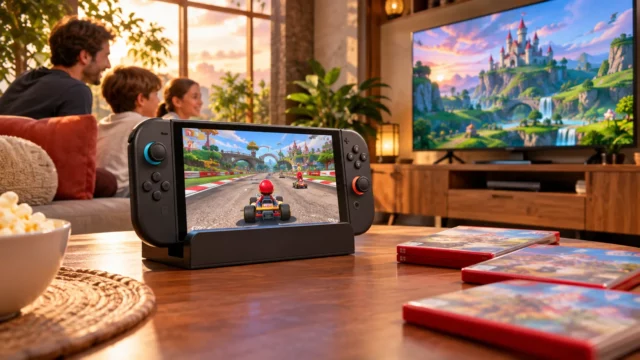
Switch 2 sales have reached 26.35 million consoles worldwide, but Nintendo’s latest financial results reveal a second story worth watching. Despite the newer system’s expanding audience, original Switch games continue to sell in remarkable numbers.
During the six months ending September 30, 2026, Nintendo sold substantially more Switch software than Switch 2 software. That contrast offers a clearer picture of the company’s current position: one console is building its audience, while the other still has an enormous library attracting buyers.
Switch 2 sales are growing while the original Switch keeps selling games
According to Nintendo’s official worldwide hardware and software sales figures, Switch 2 reached 26.35 million consoles and 73.21 million games sold by September 30, 2026.
Between April and September alone, the newer platform added 6.49 million hardware units and 24.49 million software units. These figures show that Nintendo continues expanding its latest console audience while building a dedicated game library.
However, the original Nintendo Switch remains commercially relevant. Its lifetime totals now stand at 157.20 million consoles and 1,593.87 million games. During the same six-month period, it sold another 1.27 million systems and 65.73 million software units.
That is the most interesting contrast in Nintendo’s report. Switch 2 sold more hardware during the period, yet the older console recorded considerably higher software sales. Rather than viewing the two systems as a simple replacement story, the figures suggest that Nintendo is currently benefiting from both audiences.
Mario Kart World leads the Switch 2 library by a considerable margin
Hardware adoption is only part of the equation. Nintendo also needs games that give customers a reason to use its latest system, and Mario Kart World currently occupies a particularly strong position.
In Nintendo’s official ranking of best-selling Switch 2 titles, Mario Kart World leads with 16.48 million copies. Donkey Kong Bananza follows at 5.05 million, leaving a substantial gap between the two games.
Pokémon Legends: Z-A – Nintendo Switch 2 Edition and Pokémon Pokopia each have 4.04 million reported sales. However, those figures require some context. Pokémon Legends: Z-A reaches 13.31 million copies when its original Switch version is included. Meanwhile, Nintendo’s Pokopia figure only covers sales outside Japan, where the company acts as publisher.
Other notable Switch 2 releases include Splatoon Raiders at 2.42 million, Kirby Air Riders at 1.94 million and Fire Emblem: Fortune’s Weave at 1.34 million. Super Mario Party Jamboree – Nintendo Switch 2 Edition has sold 1.28 million, rising to 12.01 million when combined with the Switch release. Star Fox completes the reported selection with 1.17 million.
These results highlight an important distinction. Mario Kart World is the standout individual Switch 2 seller, but Nintendo is also finding buyers across platform adventures, Pokémon experiences, party games and other established franchises.
New releases are giving both Nintendo generations reasons to remain active
Nintendo’s April-to-September release schedule provides another perspective on these sales figures. Switch 2 received Star Fox in June, Splatoon Raiders in July and Fire Emblem: Fortune’s Weave in September. Each title contributes to a growing catalogue beyond the platform’s biggest sellers.
At the same time, Nintendo continued releasing software for the original Switch. Tomodachi Life: Living the Dream, launched in April, reached 8.81 million copies, while July’s Rhythm Heaven Groove recorded 2.89 million.
Those numbers help explain why original Switch software remains so prominent in Nintendo’s half-year results. Customers are not relying exclusively on older catalogue titles; new releases are also contributing to activity on the established platform.
Meanwhile, Pokopia’s reported performance makes its continuing content plans especially relevant. Battle4Play has already covered Pokémon Pokopia’s December Dazzling Decorations expansion, which gives players another reason to revisit the game after its initial release.
For Nintendo, maintaining interest across both generations creates a broader software opportunity. For players, it means the original Switch still has notable releases even as Switch 2 becomes an increasingly important part of the company’s business.
Nintendo’s digital business is expanding alongside its console audience
Software sales are not the only figures showing momentum. Nintendo recorded 249.6 billion yen in digital sales during the first half of its fiscal year, representing a 60.5% increase.
That growth adds another dimension to the discussion around how players obtain their games. Digital purchasing is becoming increasingly significant to Nintendo’s business, although the financial results alone do not establish how individual customers divide their purchases between downloads and physical copies.
For collectors, that distinction remains important. Our previous examination of the future of Switch 2 physical game cards explores why the format of a retail release can matter just as much as whether a boxed edition exists.
Beyond gaming hardware and software, Nintendo’s intellectual-property-related business generated 62.7 billion yen, up 87.9%. The Super Mario Galaxy Movie was a major driver of that increase, demonstrating how Nintendo’s franchises can contribute to revenue outside traditional game sales.
Overall, the company reported 966.0 billion yen in net sales and 216.5 billion yen in operating profit, with operating profit increasing 49.1%. Despite these results, Nintendo kept its full-year financial forecast unchanged.
The combination is notable: growing digital revenue, contributions from entertainment activities and two active console libraries all form part of Nintendo’s current financial picture.
Upcoming releases will put Switch 2 sales and Nintendo’s two-generation strategy to the test
The next stage of Nintendo’s software schedule includes several recognizable names. Nintendo Switch 2 – The Legend of Zelda – 40th Anniversary Edition and Nintendo Switch Sports Resort launched in October, after the financial reporting period ended.
Looking ahead, The Legend of Zelda: Ocarina of Time is scheduled for November, followed by Metroid Ravenous in January. These releases provide further opportunities for Nintendo to sustain attention around its software catalogue.
Nevertheless, the current figures do not establish how many copies those games will sell or whether Nintendo will revise its forecasts later. Their significance lies in the continuing release schedule, rather than any guaranteed commercial outcome.
What makes Nintendo’s position particularly interesting is the different role each console currently plays. Switch 2 is adding hardware customers, while the original Switch continues generating substantial software sales. Moreover, digital purchases and entertainment-related activities are contributing to the wider business.
Switch 2 sales reaching 26.35 million is an important milestone, but the bigger story is Nintendo’s ability to support two active software markets at once. As its next releases arrive, the question is whether the newer platform will gradually account for a larger share of software purchases while the original Switch maintains its long-running appeal.

Creator of the website, Pokemon trainer by nature. Trying to report on everything related to the world of video games, series and movies. Yu-Gi-Oh is my weakness, collecting cards since the dawn of time.