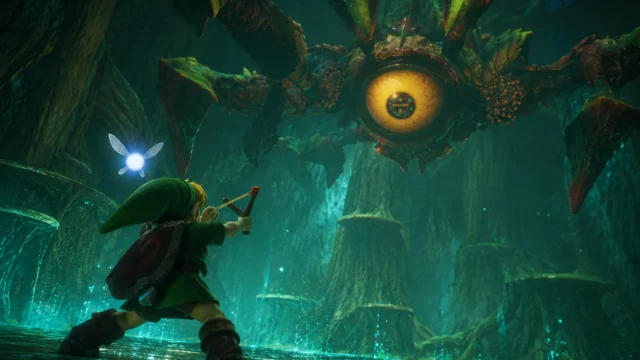
The original The Legend of Zelda: Ocarina of Time asked players to understand Hyrule through exploration, experimentation and occasional confusion. Nearly three decades later, its Nintendo Switch 2 remake is taking a different approach. The Ocarina of Time remake features aren’t simply about making a Nintendo 64 classic look prettier. Several changes could fundamentally alter how newcomers experience its world.
With the November 5, 2026 release approaching, Nintendo has published another official video highlighting eight previously announced additions. Importantly, this is a recap rather than a fresh reveal. Still, seeing these systems together makes the remake’s direction much clearer.
Ocarina of Time remake features make Hyrule easier to navigate
One of the original game’s defining characteristics was its movement system. Link automatically jumped when running toward certain edges, while the camera and controls reflected the limitations of Nintendo 64 hardware. Those mechanics became familiar to an entire generation, although returning to them today can feel restrictive.
The remake introduces a dedicated jump button, dashing and free camera control using the right analog stick. Together, these changes promise a more immediate relationship between players and their surroundings. Gyroscopic aiming adds another option, allowing weapons such as the slingshot to be aimed through motion controls.
However, the most interesting navigation improvement might have nothing to do with movement.
The Threads of Time introduces an evolving tapestry that records Link’s progress through the adventure. Players can consult it to understand how far the story has advanced and identify their next objective. Rather than replacing exploration with a completely different structure, this system offers guidance when players lose track of their journey.
That distinction matters. Ocarina of Time was built around discovering how locations, characters and different periods connect. A clearer sense of direction could make those connections more approachable without necessarily removing the pleasure of finding them.
A second reason to revisit dungeons after defeating their bosses
Nintendo is also addressing something that the original adventure offered relatively little incentive to do: revisit major encounters for reasons beyond progressing through the story.
The new Hall of Fallen Foes serves as a gallery of defeated enemies. It includes information about their backgrounds, appearances and locations, while also letting players inspect their character models up close.
More importantly, players can challenge previously defeated bosses again and attempt to improve their completion times. This adds a repeatable activity to encounters that were traditionally tied to specific moments in the campaign.
For returning fans, that could become one of the remake’s most appealing additions. Instead of starting another full playthrough to experience a favorite battle, players will have a dedicated way to revisit it.
It also gives enemy encounters a second purpose. Their designs, lore and combat mechanics become things worth examining after the immediate danger has passed.
Playing the ocarina becomes a real-world interaction
Perhaps the most unusual modernization involves the instrument that gives the game its name.
In the 1998 release, players performed melodies through controller inputs. The remake preserves traditional controls but introduces another possibility: using the Nintendo Switch 2’s built-in microphone to hum or play learned songs.
Once the system recognizes the appropriate melody, Link performs it within the game. Consequently, an iconic mechanic can become a more physical interaction between the player and Hyrule.
Nintendo is extending that concept beyond the software. HORI is preparing compatible physical ocarinas, including an electric model. These accessories give players another way to interact with the microphone-based system.
Meanwhile, the broader presentation has received substantial attention. Reimagined visuals, fully voiced and expanded cutscenes, additional dialogue, refreshed sound effects and orchestral music aim to make familiar scenes feel more cinematic.
The world itself is changing, too. The day-night cycle continues even in towns, while certain areas previously used as backgrounds can now be explored. Faster loading and smoother performance should also help maintain the adventure’s rhythm.
These details suggest Nintendo wants Hyrule to feel less constrained by the technical boundaries that shaped its original design.
Why Nintendo’s 40th anniversary makes this remake different
The timing is significant. The Legend of Zelda celebrates its 40th anniversary in 2026, and Nintendo is surrounding the remake with hardware, collectibles and companion features.
A special Nintendo Switch 2 The Legend of Zelda 40th Anniversary Edition console launched on October 29. Additionally, the Nintendo Switch App is expanding with ZELDA NOTES, offering daily play records, a virtual ocarina and a quiz containing more than 2,000 questions about the adventure.
New Young Link and Young Zelda amiibo are scheduled for 2027. Both will unlock masks inspired by retro graphics, connecting the remake’s modern presentation with its original identity.
Collectors following the anniversary celebrations can also explore Battle4Play’s coverage of free Zelda designs in Animal Crossing. Meanwhile, our earlier report on Zelda amiibo release date speculation shows how anticipation developed before Nintendo confirmed its launch plans.
Behind the project, series producer Eiji Aonuma has acknowledged feeling nervous about its reception. Speaking to Japan Today, he credited younger developers, including team members unfamiliar with the original game, with contributing fresh ideas.
That perspective helps explain the remake’s philosophy. Rather than preserving every limitation for nostalgia’s sake, Nintendo appears willing to reconsider how a classic adventure should function for today’s audience.
The game launches exclusively on Nintendo Switch 2 on November 5, 2026, priced at $59.99 digitally and $69.99 physically in the United States. The initial physical print run includes special textured foil cover artwork while supplies last.
Players can find additional official information on Nintendo’s Ocarina of Time product page.
Ultimately, the most important Ocarina of Time remake features may not be the ones that immediately stand out in screenshots. Better navigation, optional musical interaction and repeatable boss encounters could change how players spend their time in Hyrule. Whether those improvements preserve the original adventure’s sense of discovery is the question that matters most as launch day approaches.

Creator of the website, Pokemon trainer by nature. Trying to report on everything related to the world of video games, series and movies. Yu-Gi-Oh is my weakness, collecting cards since the dawn of time.