Nintendo’s original Switch still has room for old-school aerial combat. While the latest Star Fox revival has drawn attention to newer hardware, Wild Blue Skies offers a Star Fox alternative for players who haven’t upgraded. More importantly, it brings back a style of arcade shooting that rarely gets the spotlight today.
Available since October 28, 2026, this colorful adventure costs $14.99 in the United States. However, its appeal goes beyond the low price. The real attraction is the opportunity to chase high scores, discover alternate routes and revisit missions without committing to another enormous open-world game.
Why a Star Fox alternative makes sense on the original Switch
For years, Star Fox 64 has remained a reference point for players who enjoy fast aerial combat, memorable squadmates and tightly designed missions. Its straightforward approach feels different from modern flight games, which often emphasize complicated controls, extensive customization or realistic simulation.
Wild Blue Skies deliberately embraces that older philosophy. Instead of asking players to master a flight simulator, it puts them into a series of carefully directed encounters where quick reactions matter more than navigation.
The timing is particularly interesting. Following the arrival of a remastered Star Fox 64 experience on Nintendo Switch 2 in June 2026, owners of the original console now have another way to enjoy a similar formula. Wild Blue Skies is not a Nintendo production or an official Star Fox successor, but its inspiration is unmistakable.
There’s also a meaningful connection behind the scenes. Chuhai Labs, a label associated with Kyoto-based VITEI Backroom, is led by Giles Goddard. His career includes programming work on the original Super Nintendo Star Fox and Super Mario 64. Consequently, this project has a genuine historical link to Nintendo’s early experiments with 3D gaming.
The arcade design rewards skill rather than endless progression
At the center of the adventure is Bowie Stray, a canine pilot commanding the Blue Bombers. His teammates include a deer, a lizard and a bull, forming a colorful squadron determined to stop the enemy forces threatening their world.
Their personalities emerge through radio conversations during missions. Sometimes, wingmates also lend a hand in combat. That detail matters because squadron chatter was one of the elements that made classic aerial shooters feel like adventures rather than disconnected shooting galleries.
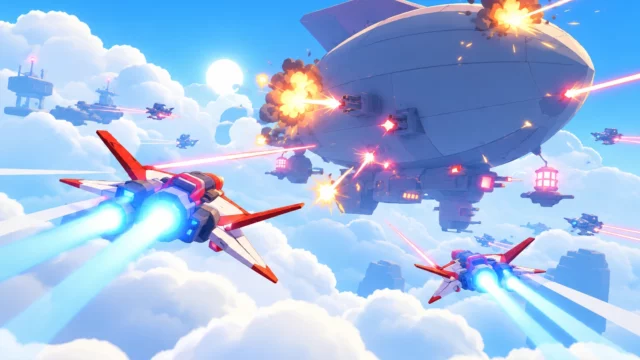
Gameplay follows an on-rails shooting system. Your fighter advances along a predetermined route while you concentrate on aiming, firing different types of shots and performing evasive rolls. Enemy formations arrive in waves, and enormous bosses interrupt the journey with more demanding encounters.
Meanwhile, the scenery changes between open oceans, desert ridges, cloud-filled skies and dangerous caves. The anime-inspired presentation gives these locations a brighter identity than the polygonal environments that defined many 1990s shooters.
Yet the most important feature may be the mission structure. Branching paths and a score-based progression system encourage repeat attempts. Finishing a level is only one objective; improving your performance and finding alternative routes provide additional reasons to return.
That distinction is essential when evaluating its value. Wild Blue Skies isn’t trying to compete with sprawling adventures through sheer content volume. Instead, its design depends on how satisfying each individual flight feels.
A familiar Nintendo formula with an important difference
Nostalgia alone doesn’t guarantee a great game. Although Wild Blue Skies clearly understands the appeal of classic rail shooters, its reception on Steam has been mixed.
Some players appreciate having an affordable game that recalls Star Fox’s aerial battles. Others have criticized rough edges that make the experience less polished than they expected.
Those reactions highlight an important consideration for potential Switch buyers. Capturing the atmosphere of a beloved classic is not necessarily the same as matching its execution. Controls, enemy readability and the rhythm of encounters are especially important in games built around repeated attempts.
For that reason, players looking for a flawless recreation of Star Fox 64 should approach this release with measured expectations. On the other hand, those interested in a modern independent interpretation may find its distinctive visual style and replay-focused missions appealing.
There is another difference worth considering: Wild Blue Skies has its own cast, locations and identity. Rather than following Fox McCloud and his familiar crew, players meet a new squadron with its own conversations and enemies.
In other words, this is best viewed as a separate arcade adventure inspired by Nintendo’s legacy, not a replacement for Nintendo’s series.
Price, platforms and soundtrack: what players should know
Developed by Chuhai Labs and published by Balor Games, Wild Blue Skies first arrived on PC through Steam, PlayStation 5 and Xbox Series X|S on August 13, 2026. Its Nintendo Switch release followed on October 28.
The original Switch edition is available digitally for $14.99 in the US. This gives players who still use Nintendo’s previous-generation hybrid console access to the adventure without needing to purchase newer hardware.
Music also plays a significant role in the experience. Composer Marc Junker created a soundtrack featuring 20 original tracks, accompanied by five bonus tracks in the soundtrack release.
For listeners who want the music separately, the digital soundtrack is available on Steam for $4.99. Additionally, a special-edition vinyl can be pre-ordered from The Yetee for $35. These are optional music purchases, separate from the Switch game itself.
Players interested in the publisher’s official description can visit Balor Games’ Wild Blue Skies page. Meanwhile, Battle4Play’s Nintendo Switch news coverage follows other releases and developments affecting Nintendo players.
Ultimately, Wild Blue Skies makes its strongest case as a Star Fox alternative for anyone who misses compact, replayable aerial shooters. It may lack the refinement associated with Nintendo’s classics, but its accessible price and old-fashioned arcade ambitions give it a clear audience.
Would you rather revisit Star Fox 64, or try a new squadron built around the same high-score-chasing spirit?

Creator of the website, Pokemon trainer by nature. Trying to report on everything related to the world of video games, series and movies. Yu-Gi-Oh is my weakness, collecting cards since the dawn of time.