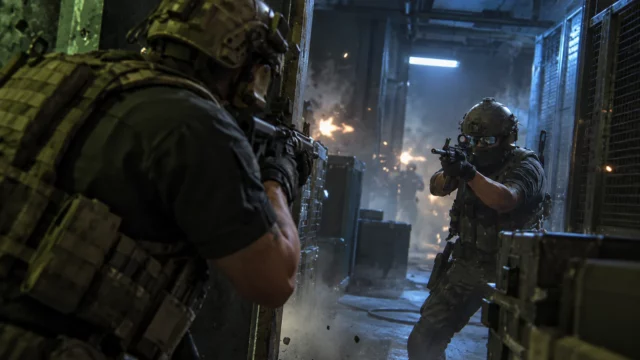
A multiplayer match can run at 60 frames per second and still leave one player reacting later than another. That is the uncomfortable reality behind Modern Warfare 4 input lag on Nintendo Switch 2. The console has received a remarkably complete Call of Duty conversion, yet its slower controller response could make winning close-range encounters harder against PlayStation and Xbox opponents.
The issue is particularly relevant because Call of Duty: Modern Warfare 4 supports crossplay. Nintendo players are no longer separated from the wider console multiplayer ecosystem. However, sharing the same battlefield does not necessarily mean competing under identical technical conditions.
Modern Warfare 4 input lag reveals a hidden crossplay disadvantage
Digital Foundry’s October 30 technical review measured how long the game takes to respond to controller inputs. On PlayStation 5, using a 60Hz display and a wireless DualSense controller, the recorded latency was just 49.1 milliseconds.
By comparison, Nintendo Switch 2 reached 80.7ms in docked mode with a wireless Pro Controller. That represents approximately 64% more input latency than PS5, despite both versions allowing players to participate in the same online matches.
The difference becomes more pronounced when playing away from a television. In handheld mode, Switch 2 averaged 100ms of input latency, approximately twice the PS5 result. Moreover, response times varied considerably, ranging from 83ms to 125ms during testing.
These figures do not mean every Nintendo player will automatically lose against someone on PlayStation. Skill, positioning, connection quality and anticipation still matter. Nevertheless, when two opponents react at nearly the same moment, an additional 31 to 51 milliseconds of measured delay can become another obstacle for the Switch 2 player.
Why a 60fps shooter can still feel slower than expected
There is an important distinction between frame rate and input latency. Frame rate describes how frequently a game produces new images. Input latency measures the delay between a player’s action and its visible result.
Consequently, reaching 60fps does not guarantee that aiming, firing or changing direction will feel equally immediate across different systems. A game can display smooth movement while taking longer to register and show the result of a button press.
This explains why Digital Foundry’s findings deserve attention beyond conventional performance comparisons. Modern Warfare 4 generally maintains its 60fps multiplayer target on Switch 2. However, demanding firefights, thick smoke and views through a riot shield visor can push performance into the 50s, occasionally reaching the high 40s.
Variable refresh rate can make those fluctuations appear smoother on supported displays. Still, VRR should not be confused with a solution to the measured input delay. Handheld mode also experiences more frequent frame-rate dips, making consistency another concern for competitive players.
For a broader examination of visual compromises, resolution scaling and frame-rate targets, Battle4Play previously explored Modern Warfare 4’s Switch 2 performance and DLSS implementation. The new latency measurements reveal a separate problem that graphics settings alone cannot explain.
What extra milliseconds mean during real multiplayer encounters
Consider a typical close-range confrontation. Two players round opposite corners, spot each other and immediately attempt to fire. Their success depends on several factors, including awareness, weapon handling, aiming accuracy and the responsiveness of their systems.
If one version introduces noticeably more input delay, the player using it has less immediate feedback when correcting aim or responding to an unexpected movement. That does not establish the outcome of any individual gunfight. However, it can influence encounters where timing is particularly tight.
The handheld results introduce another complication: inconsistent responsiveness. A stable delay is something players may gradually accommodate through practice. When latency varies between 83ms and 125ms, predicting how quickly an action will appear becomes more difficult.
This distinction matters in a shooter built around rapid engagements. Players can learn map layouts, improve their accuracy and develop better positioning. Yet practice cannot directly eliminate delays introduced by the game’s input processing.
There is also a wider competitive fairness question. As Battle4Play recently reported, Modern Warfare 4’s new anti-cheat protections aim to reduce unfair information advantages. Input latency is a different problem entirely, but it demonstrates that fair competition involves more than preventing cheating.
Can Activision fix the delay without sacrificing portability?
The frustrating aspect of these findings is that the Switch 2 conversion succeeds in several areas. Digital Legends has brought Infinity Ward’s latest shooter to Nintendo hardware without removing its major game modes or cross-platform multiplayer.
The October 23 launch also marked Call of Duty’s return to Nintendo consoles for the first time since Ghosts arrived on Wii U in 2013. Dynamic smoke, real-time weather and modern global illumination remain part of the experience. Meanwhile, dynamic resolution and NVIDIA DLSS help accommodate the hardware’s limitations.
Nevertheless, impressive visual engineering does not automatically translate into responsive controls. The campaign operates at 30fps, while DMZ offers a 40fps mode on compatible 120Hz displays. Those lower frame-rate targets introduce additional latency considerations during aiming, driving and other situations requiring quick reactions.
Could an update improve the situation? Potentially, although Digital Foundry’s measurements do not establish exactly which parts of the input pipeline are responsible. Rendering, frame scheduling and other processing stages can all contribute to perceived responsiveness.
As of October 31, neither Activision nor the developers involved have publicly acknowledged the latency issue. No corrective patch has been confirmed, and there is currently no evidence that a particular controller setting can eliminate the measured gap.
Players who prioritize competitive multiplayer may therefore want to consider the difference between docked and handheld responsiveness before choosing how to play. Docked mode performed better in these tests, although it still trailed PS5 significantly.
Ultimately, Modern Warfare 4 input lag highlights an unusual weakness in an otherwise impressive Nintendo conversion. Switch 2 players can access the same battles, maps and opponents, but their controls do not yet respond as quickly. The question now is whether Activision and Digital Legends can narrow that gap before it becomes a lasting frustration for competitive players.
Source: Digital Foundry, Modern Warfare 4 Switch 2 technical review, October 30, 2026.

Creator of the website, Pokemon trainer by nature. Trying to report on everything related to the world of video games, series and movies. Yu-Gi-Oh is my weakness, collecting cards since the dawn of time.