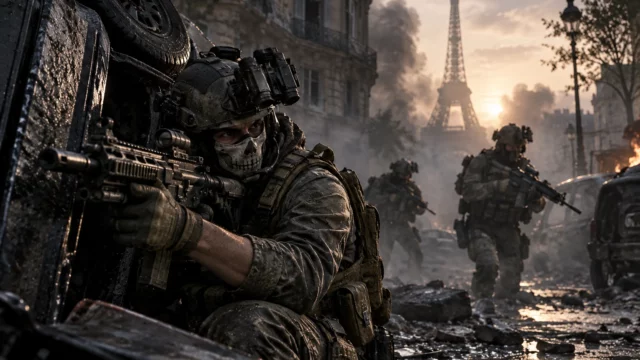
Nintendo Switch 2 players are getting something that seemed unlikely a few years ago: a full, day-one Call of Duty release alongside PlayStation, Xbox and PC. However, Modern Warfare 4 performance reveals an interesting trade-off. Rather than trying to match every visual feature, Infinity Ward has prioritized keeping the gameplay systems that matter across platforms.
That decision sits at the heart of Digital Foundry’s technical analysis, published on October 30, 2026. Its assessment is broadly positive, although competitive players may notice compromises that screenshots cannot show.
Why Modern Warfare 4 performance matters beyond graphics
Call of Duty: Modern Warfare 4 arrived on October 23, 2026, for PS5, Xbox Series X|S, PC and Nintendo Switch 2. For Nintendo players, that simultaneous release is significant. The franchise had been absent from Nintendo hardware since the Wii U generation, leaving more than a decade without a new entry.
This return is also more ambitious than a simple adaptation of an older game. The Switch 2 edition is a native build, developed by Infinity Ward alongside Barcelona-based Digital Legends. Activision acquired the Spanish studio in 2021, and its experience includes work on Call of Duty: Warzone Mobile.
The important distinction is what the developers chose to preserve. Cross-platform multiplayer requires consistent gameplay mechanics, even when hardware capabilities differ. Accordingly, the Switch 2 version retains demanding systems such as smoke simulation, glass destruction and the new global illumination technology.
That approach has a practical benefit. Players should not encounter fundamentally different environmental mechanics simply because they are using Nintendo hardware. Nevertheless, equivalent systems do not automatically mean equivalent responsiveness.
The multiplayer compromise is more important than resolution
For competitive players, frame rate can matter more than a sharper image. Modern Warfare 4 targets 60fps in multiplayer on Switch 2, but Digital Foundry observed occasional drops into the 50s and even the high 40s.
These fluctuations do not necessarily make multiplayer unplayable. However, they can affect how consistent aiming and movement feel, particularly during intense encounters. A game that varies between 60fps and the high 40s may feel less predictable than one maintaining a steady target.
The campaign takes another approach. It runs at 30fps and generally holds that target, although an occasional drop appears during a firefight in Paris. Pre-rendered cinematics also exhibit hitches, a problem that Digital Foundry reports on other console versions.
Meanwhile, the DMZ extraction mode offers an unusual middle ground: a stable 40fps when using a 120Hz display. This is a meaningful distinction because 40fps divides evenly into 120Hz, allowing more consistent frame presentation than it would on a conventional 60Hz screen.
Still, lower frame-rate caps bring additional input latency compared with higher frame rates. For players who prioritize quick reactions, that may be more noticeable than reduced texture quality.
This is particularly relevant to Modern Warfare 4’s competitive ecosystem. As Battle4Play previously covered, Modern Warfare 4’s anti-cheat measures address another important part of maintaining fair online matches.
Technical parity and competitive integrity are different challenges, but both influence whether cross-platform multiplayer feels trustworthy.
DLSS or SMAA T2X: which Switch 2 image option makes sense?
Modern Warfare 4 offers two anti-aliasing options when Switch 2 is docked. Interestingly, the default solution does not produce the same result as NVIDIA’s DLSS.
With SMAA T2X, the game targets a dynamic 1080p resolution. Selecting DLSS instead means a dynamic 900p target, with resolution potentially dropping to 450p in particularly demanding situations.
On paper, that might make SMAA T2X appear the obvious choice. Yet resolution alone does not determine perceived image quality. Digital Foundry found that DLSS delivers a slightly softer picture while handling motion and visually busy areas more effectively.
Consequently, players who dislike shimmering or unstable image detail during movement may prefer DLSS. Those who prioritize a sharper presentation may want to compare the default SMAA T2X option.
Handheld mode presents a tougher challenge. Its dynamic resolution targets 720p but can fall to 360p during especially intense missions. Such drops could become more apparent in scenes filled with distant enemies or fine environmental details.
There are substantial visual reductions elsewhere, too. Switch 2 uses lower-resolution textures, simpler shadows and reduced transparency quality. Screen-space reflections and bump mapping are absent, while level-of-detail transitions can make objects appear more abruptly.
Additionally, some environments contain less grass, and the campaign’s player character does not cast a self-shadow. Nevertheless, the large crowds in the New York mission remain, alongside the smoke and destruction effects that help define the game’s action.
In other words, the developers have reduced presentation quality without stripping away every technically ambitious feature.
What Nintendo players actually gain from this version
The Switch 2 edition offers advantages that go beyond portability. According to the official Modern Warfare 4 Nintendo information, supported features include handheld play, Pro Controller compatibility, Joy-Con 2 mouse-style aiming, motion controls and HDR.
These control options create a different proposition from playing on a conventional console. Mouse-style aiming could be especially appealing to players who prefer more direct aiming input, although the technical analysis does not establish whether it provides a measurable competitive advantage.
There is also an important requirement: online multiplayer needs a Nintendo Switch Online subscription.
For DMZ players, the 40fps mode is another factor worth considering before choosing where to play. Performance consistency matters in extraction gameplay, where a single encounter can determine whether equipment is lost. Meanwhile, recent DMZ balance changes involving the Possum mechanic and self-revive show how gameplay adjustments can influence that experience independently of graphics.
Ultimately, this is not a version designed to win a direct visual comparison with PS5, Xbox Series X|S or PC. Its appeal is being able to participate in the same Call of Duty release while benefiting from Nintendo’s portable format and alternative controls.
Modern Warfare 4 performance on Switch 2 therefore tells a more interesting story than resolution figures alone. Digital Foundry’s positive assessment suggests the developers made sensible technical priorities, but frame-rate limitations remain important for competitive play. Would you accept reduced visual fidelity and occasional multiplayer dips in exchange for a portable Call of Duty?

Creator of the website, Pokemon trainer by nature. Trying to report on everything related to the world of video games, series and movies. Yu-Gi-Oh is my weakness, collecting cards since the dawn of time.