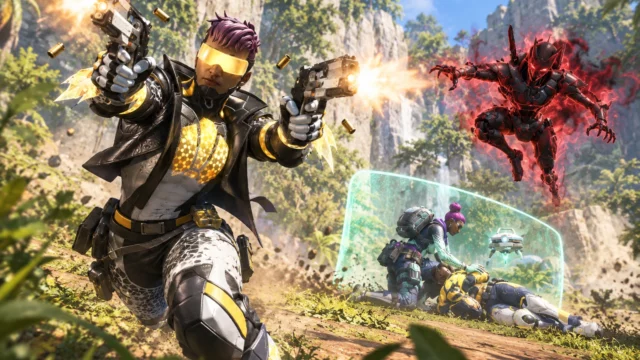
Knowing where an enemy squad is hiding has always been valuable in Apex Legends. However, the Apex Legends Crypto rework arriving on November 3, 2026, could change what teams actually do with that information. Season 31, officially named Cipher, combines a more aggressive surveillance specialist with contested loot opportunities and a ranked system that can remove familiar characters before a match begins.
For players, the interesting part isn’t simply having more abilities or another weapon. It’s how these changes could reward squads that act quickly, communicate clearly and adapt when their usual strategy stops working.
Why the Apex Legends Crypto rework changes team fights
Crypto has always offered a distinctive advantage: the ability to investigate dangerous areas without exposing himself. Unfortunately, that approach comes with a familiar problem. While Crypto is operating his drone, his teammates may be fighting without him. Respawn acknowledges this frustration in its design explanation, making the character’s new direction particularly significant.
Thanks to firmware developed by his sister Mila, Crypto’s Surveillance Drone now operates through a battery-based system instead of its previous cooldown. Players can retrieve and redeploy it without waiting through a lengthy reset. Once positioned, the device activates Sentry Mode, automatically identifying visible enemies for the entire squad. Meanwhile, his EMP Ultimate can be activated with a single button press.
These changes encourage a different rhythm. Crypto can establish surveillance, return to combat and exploit the information alongside his teammates. Instead of treating reconnaissance as a separate activity, squads may integrate it directly into an attack. That distinction matters especially during third-party encounters, when a few seconds spent away from the fight can determine whether a team survives.
Strongholds turn valuable loot into a dangerous decision
Season 31 also introduces Strongholds, an evolution of the game’s high-value loot encounters. Inside, squads can obtain powerful weapons, corrupted attachments and EVO benefits for everyone. Yet collecting those rewards isn’t straightforward: opening a Stronghold takes time and triggers an alarm that exposes the team’s position to nearby opponents.
Consequently, getting better equipment becomes a tactical gamble. One squad might secure the area before opening a Stronghold. Another could wait for someone else to activate the alarm and attack during the looting process. Built-in cover and Hardlight glass provide defensive options, although neither removes the danger of attracting attention.
This is where Crypto’s revised abilities become especially interesting. A deployed drone could help monitor approaches while teammates prepare to claim the rewards. Equally, an attacking team could use information to identify a vulnerable squad. These are potential strategies rather than guaranteed advantages, but they show how two separate seasonal additions could interact.
Meanwhile, the Akimbo Wingman introduces dual-wielded revolvers designed to combine precision with heavy firepower. Its actual competitive value will depend on how reliably players can land their shots and how it performs against established weapon choices.
Diamond ranked matches will demand backup plans
Perhaps the most consequential competitive adjustment is the arrival of Legend Bans in Diamond lobbies and above. Every player votes for one character to ban, with additional votes increasing that Legend’s chance of being excluded from the match.
Unlike a straightforward balance adjustment, this system changes team preparation before anyone enters combat. Players who rely entirely on one Legend may need a second or third comfortable option. Furthermore, squads will have to reconsider their combinations when a key defensive, reconnaissance or support character becomes unavailable.
There is also a broader distinction between legitimate tactical information and unfair visibility advantages. As Battle4Play recently explored in its coverage of Modern Warfare 4’s efforts to restrict wallhack information, competitive shooters depend heavily on what players are allowed to know. Apex Legends approaches that question from another direction: giving teams stronger legitimate intelligence tools while introducing more decisions about how to use them.
Legend Bans could therefore make higher-ranked matches less predictable. However, their effectiveness will depend on whether voting produces meaningful strategic variety rather than repeatedly excluding the same popular characters.
Revenant and Lifeline gain new ways to influence combat
Crypto isn’t the only Legend receiving attention. Revenant gains a shorter Ultimate cooldown and a faster Tactical ability, reinforcing his aggressive playstyle. His new upgrade choices can extend his Ultimate after knocking down enemies, silence nearby opponents following Shadow Pounce or automatically refresh that movement ability while an enemy remains marked.
Lifeline, meanwhile, receives a reduced D.O.C. cooldown and the ability to heal herself while gliding. Her upgrades include a shorter Ultimate cooldown, a protective shield during revives and improved flight mobility. Together, these changes could give teams more opportunities to recover from difficult engagements without abandoning an aggressive position.
The season also introduces Cryptic Core, a Mythic Volt SMG formed from a swarm of nanodrones. Its design incorporates a pixel-art PALS assistant, while Exotic Shards allow players to change its visual theme. The weapon can appear in Cipher Seasonal Packs, which are not offered in every region. Additional seasonal skins feature Crypto, Wraith, Gibraltar, Revenant and Horizon.
These cosmetic additions sit alongside a more important question for regular players: whether the new character upgrades create genuine alternatives to established team compositions. That will become clearer once Season 31 is live.
Kings Canyon Evolved shows Respawn is planning beyond Cipher
Season 31 arrives during a period of wider changes across Electronic Arts. Following the recently reported closure of BioWare, EA reaffirmed its commitment to several continuing franchises, including Apex Legends. Battle4Play examined that contrast in its report on BioWare’s closure and EA’s changing development priorities.
Respawn’s roadmap offers a concrete indication of what comes next. Season 32 will introduce Kings Canyon Evolved in early 2027, featuring a substantial redesign of the familiar battlefield with new, reworked and updated points of interest. This goes beyond a routine seasonal rotation and suggests that map design remains an important part of the game’s longer-term evolution.
For now, Cipher launches on November 3 across PS4, PS5, Xbox One, Xbox Series X|S, Nintendo Switch 2 and PC through EA app, Epic Games Store and Steam. Apex Legends remains free to play. Players can consult EA and Respawn’s official Season 31 update for the complete announced changes.
Ultimately, the Apex Legends Crypto rework may prove more important for how squads cooperate than for Crypto’s individual strength. Strongholds reward calculated risks, Legend Bans encourage flexibility and the new abilities create fresh possibilities during fights. Whether Cipher delivers a healthier competitive environment will depend on how these systems perform together. Will better information make Apex Legends more tactical, or simply make its battles even more intense?

Creator of the website, Pokemon trainer by nature. Trying to report on everything related to the world of video games, series and movies. Yu-Gi-Oh is my weakness, collecting cards since the dawn of time.