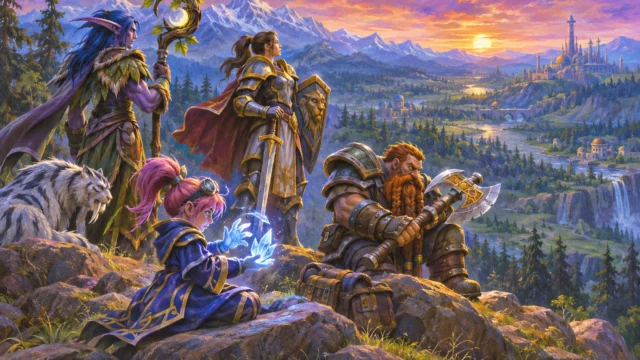
Choosing a main character is usually one of the first big decisions in a new MMORPG. However, WoW Forever class changes discovered just before release could make that choice considerably harder. Some of the builds players practiced during beta may no longer behave the same way when Blizzard opens the servers on November 4.
The problem goes beyond a few damage adjustments. Several talent trees have reportedly changed after testing ended, affecting leveling efficiency, raid utility and even the value of certain race combinations. For a game designed around long-term character investment, that uncertainty arrives at a particularly awkward moment.
Why WoW Forever class changes matter more in a permanent MMO
World of Warcraft: Forever is not another temporary Classic experiment. Blizzard is creating a permanent alternative to modern WoW and Classic, set in a reimagined Azeroth between Warcraft III: Reforged’s Forsaken Kingdom campaign and Molten Core. Characters will reach level 60, but the level cap will remain fixed as new content expands progression horizontally.
That design changes how players evaluate their characters. Instead of expecting every expansion to replace previous equipment, adventurers can pursue gear that remains useful for much longer. Consequently, talent efficiency and group utility could influence decisions across months or years, rather than a single leveling season.
As we explored in our earlier look at how WoW Forever connects Classic and Retail, Blizzard wants to preserve old-school social gameplay without abandoning modern conveniences. New equipment, expanded race-class combinations and the Legacy Points system all support that ambition. Legacy Points also reward established players by helping alternate characters become stronger earlier while leveling.
Yet there is an important difference between encouraging experimentation and forcing players to reconsider a build they already tested. According to changes identified in the game client, several classes now face precisely that situation. Blizzard has not released official patch notes detailing these particular adjustments, so their final launch behavior remains unconfirmed.
Druid and Mage builds face the biggest unanswered questions
Feral Druids illustrate why these discoveries matter. Their revised talent tree separates Cat Form and Bear Form gameplay more clearly, while Berserk has disappeared. Two new capstone talents, Primal Bite and Shifting Power, replace it. Although Primal Bite offers increased damage, its deeper position in the tree creates additional obstacles during character development.
Bear tanks appear particularly vulnerable because losing Berserk removes an important part of their previous toolkit. Furthermore, the reorganized talents could make both Cat and Bear builds less dependable before level 40. This does not automatically mean Feral will perform poorly at maximum level. Instead, the journey toward a complete build may become noticeably less comfortable, especially for players leveling primarily as tanks.
Balance Druids face a different problem. Moonkin Form’s critical-strike aura reportedly increases critical chance by 3% for both spells and physical attacks, rather than spells alone. That sounds beneficial. However, Leader of the Pack now provides the same effect, reducing the incentive to bring both Balance and Feral Druids for separate critical-strike bonuses.
Mages also have several reasons to reconsider their plans. Frost Blast has been removed from the spellbook, while Ice Lance gains damage at the cost of an eight-second cooldown. Critical Mass falls from 10% to 6% critical chance. Meanwhile, early Arcane talents have weakened, and Arcane Focus disappears entirely. Its former spell-hit benefit moves into Frost’s Precision talent, which can now provide up to 6% hit chance across all spells.
These Mage adjustments could alter more than individual rotations. Depending on final talent requirements, players may need to invest differently to secure reliable spell accuracy. As a result, familiar beta builds may require substantial revisions before they can deliver their expected performance.
Race bonuses and raid composition could change before day one
Not every adjustment concerns damage output. Hunters had already received significant nerfs, while Paladins are seeing changes across all three specializations. Warriors, on the other hand, are receiving adjustments intended to prevent low Rage generation from making their mid-game and endgame experience excessively restrictive.
Racial abilities introduce another layer of uncertainty. Earlier changes reportedly made Humans particularly attractive for Mage characters. Tauren, meanwhile, lose part of their previous Endurance advantage. Their racial now provides 5% additional health without the former supplementary bonus of either 1% hit chance or 2% critical damage.
For casual adventurers, these differences might seem relatively minor. However, WoW Forever emphasizes cooperation, dungeon groups and lasting character identities. In that environment, small statistical advantages can influence how players assemble parties, distribute responsibilities and approach demanding encounters.
There is also a distinction between numerical strength and practical usefulness. A specialization with excellent theoretical damage may still feel awkward during leveling. Likewise, a class that contributes less damage could remain valuable through utility, survivability or flexibility. Until players test these client-discovered changes in real encounters, declaring definitive winners and losers would be premature.
Blizzard’s November 4 launch leaves no room for another beta
The timing explains much of the frustration. WoW Forever’s beta began September 17 and wrapped up in late October, a little over a week ago. With worldwide release scheduled for November 4, 2026, at 3 p.m. PST, players have no remaining public beta window to evaluate these newly discovered class adjustments before launch.
Some community members are understandably unhappy about that situation. Their concern is not simply that Blizzard is balancing classes. Balance changes are expected in an evolving MMO. Rather, the issue is that important character decisions may now depend on information players cannot verify through normal gameplay before release.
Blizzard’s wider Warcraft strategy makes the contrast particularly interesting. Its experimental WoW Talebound free demo offers short, repeatable adventures where trying different approaches is central to the experience. Forever takes almost the opposite approach: persistent characters, lasting equipment and a world intended to reward long-term commitment.
That commitment makes communication especially important. Players do not necessarily need perfectly balanced classes on launch day. However, they benefit from understanding which abilities have changed, why particular talents were relocated and whether further adjustments are expected.
According to Blizzard’s official World of Warcraft announcement, Forever launches alongside existing versions of WoW and is included with an active subscription or Game Time. Optional Skyborne Heroic and Epic upgrade packs are also available. The new Skyborne race and combinations such as Undead Paladins expand character creation, although access to the Skyborne requires an eligible upgrade.
For players preparing to enter Azeroth, the sensible approach is to treat current talent predictions as provisional. Choose a class for its overall gameplay and group role, but avoid assuming every beta-tested build will remain intact. In a world without future level-cap increases, flexibility may prove more valuable than chasing an uncertain launch-day advantage.
Ultimately, WoW Forever class changes present Blizzard with an early test of player trust. A permanent MMORPG needs room to evolve, but it also needs players to feel confident investing in their characters. Will these adjustments improve Azeroth’s long-term balance, or will the lack of pre-launch testing overshadow its first days?

Creator of the website, Pokemon trainer by nature. Trying to report on everything related to the world of video games, series and movies. Yu-Gi-Oh is my weakness, collecting cards since the dawn of time.