



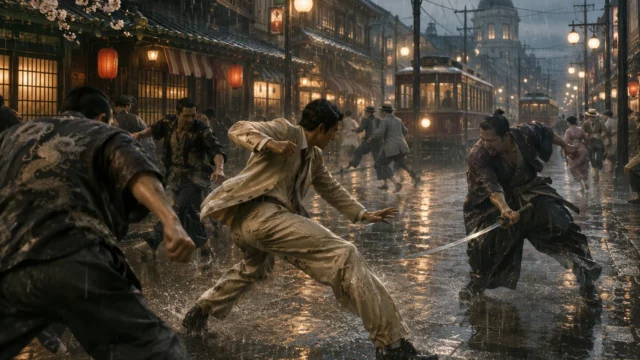
What happens when someone who has spent his childhood searching for acceptance finally finds a place to belong, but at a terrible price? The Stranger Than Heaven story is beginning to answer that question. SEGA’s newly released Act 2: Kure trailer places Makoto Daito at a turning point, where loyalty to a powerful yakuza figure threatens to erase the person he once was.
Rather than simply introducing another violent chapter, the footage gives new meaning to RGG Studio’s ambitious 50-year narrative. Makoto’s rise through organized crime may be inseparable from the discrimination, loss and displacement that shaped his early life.
Why the Stranger Than Heaven story makes Kure a turning point
In 1929, Kure is far more than another destination on Makoto’s journey. Located in Hiroshima Prefecture, this port city is home to Japan’s largest naval arsenal during the period depicted in the game. Its industrial importance creates a striking setting for a story about ambition, criminal influence and personal survival.
SEGA’s second story trailer, titled Act 2: Kure, introduces a particularly troubling development. Makoto swears loyalty to Iwaki Genzo and demonstrates his willingness to commit atrocities to advance through the yakuza hierarchy. Consequently, the young man who once sought refuge in Japan is now prepared to embrace its criminal underworld.
That contrast is what makes this chapter interesting. Kure’s military and industrial identity provides a backdrop of authority and power, while Makoto pursues influence through an entirely different organization. The trailer does not establish every consequence of his decisions, but it clearly presents a descent into violence rather than a straightforward heroic rise.
Makoto Daito’s childhood changes how we see his criminal rise
To understand the significance of Kure, it helps to return to San Francisco in 1915. According to the game’s official background, Makoto is the son of an American father and a Japanese mother. However, his Asian heritage makes him a target of persecution in the country where he was born.
After losing both parents, he secretly boards a ship bound for Japan. His destination is his mother’s homeland, although the journey eventually leads him toward a life that neither parent could have anticipated.
This beginning creates an important distinction from a conventional organized-crime narrative. Makoto does not initially travel to Japan seeking criminal prestige. Instead, his story begins with isolation and the hope of finding somewhere he can belong. By 1929, that desire has taken a disturbing direction.
His loyalty to Iwaki Genzo can therefore be read as more than a practical career decision. It raises the possibility that Makoto sees the yakuza as a source of identity, protection or purpose. That interpretation remains unconfirmed, yet it gives the new trailer an emotional dimension beyond its brutality.
How the Stranger Than Heaven story uses five eras to explore change
RGG Studio, known for Yakuza and Like a Dragon, is building this action-adventure around five historical periods and five Japanese cities inspired by real locations. Each setting represents a different stage in Makoto’s life, allowing the wider narrative to follow changes in both its protagonist and the society surrounding him.
The journey begins in Kokura, Fukuoka, in 1915, where a foundry town provides an industrial backdrop. The story then moves to Kure, Hiroshima, in 1929, a naval port with a strong yakuza presence.
From there, players will visit Minami, Osaka, in 1943, an entertainment district during wartime Japan. The fourth period takes place in Atami, Shizuoka, in 1951, when the seaside destination serves as a postwar tourist getaway. Finally, the saga reaches Shinjuku, Tokyo, in 1965.
These locations offer more than visual variety. They place Makoto’s personal decisions against industrial expansion, war, reconstruction and changing urban life. Although the complete narrative remains unknown, this structure gives RGG Studio room to examine how one man’s priorities might evolve across half a century.
That broader approach is already visible in other aspects of the project. Battle4Play previously explored how Tori Kelly’s Suzy Day performance brings music into the game’s historical setting. The contrast between creative expression and criminal violence could become especially meaningful as Makoto grows older.
What Act 2: Kure tells players before the January release
SEGA previously introduced Act 1: Kokura, making the Kure trailer the next major piece of its story-focused presentation. Together, these chapters establish an intriguing progression: the early circumstances of Makoto’s journey are now followed by a period in which he willingly commits himself to a dangerous organization.
There is also a gameplay question behind this darker direction. RGG Studio is known for dramatic confrontations, yet an extended narrative about moral compromise needs more than spectacular fights. How effectively will the finished game connect Makoto’s actions during combat with the person he becomes?
Players interested in the fighting systems can also explore our previous coverage of Stranger Than Heaven’s difficulty settings and optional combat assistance. Those features may help a wider audience experience the complete narrative, regardless of their familiarity with demanding action games.
Stranger Than Heaven launches January 15, 2027, on PlayStation 5, Xbox Series X|S and PC through Steam and the Microsoft Store. It will also be available through Game Pass. Steam displays January 14 in some regions because of time-zone differences.
Players who pre-purchase the Steam version will receive the Dosu: Kagekiri weapon. Further release information and purchase details are available on the official Stranger Than Heaven Steam page.
Ultimately, the Stranger Than Heaven story now has a compelling question at its center. Makoto arrived in Japan hoping to escape a life defined by rejection, yet Kure shows him embracing a world built on fear and obedience. Whether he eventually escapes that cycle, or spends the following decades trapped by his choices, could be the most fascinating part of RGG Studio’s new saga.

A Fortnite player since the very first storm: I jump off the Battle Bus with a plan (that rarely survives the landing), build faster than I think and never miss a live event on the island. Here I bring you every new season, collab and secret before the storm closes in.

