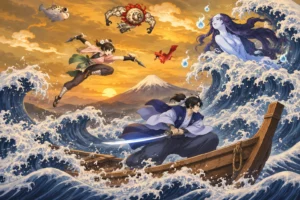
Stranger Than Heaven is beginning to look like more than a historical crime drama with elaborate street fights. Its Stranger Than Heaven music system could become one of the game’s most distinctive features, giving players a creative life beyond Makoto Daito’s violent encounters. A newly released performance featuring Tori Kelly offers another glimpse of that ambition.
Why Stranger Than Heaven music matters beyond the soundtrack
RGG Studio has built its reputation through the Yakuza and Like a Dragon series, where emotional storytelling, memorable characters and unusual side activities frequently share the spotlight. However, its upcoming adventure appears to be taking that combination in a different direction.
Rather than treating music as background entertainment, Stranger Than Heaven makes musical creativity part of Makoto’s journey. Players can collect sounds from their surroundings and eventually transform those recordings into original compositions.
That changes how exploration might feel. A passing train, an ordinary street noise or another unexpected sound could become useful material for a future performance. Consequently, locations may offer creative opportunities alongside familiar activities and criminal encounters.
The latest official video strengthens that idea by showing how musical performances fit into the fictional world. Instead of presenting another fight, SEGA and RGG Studio have chosen to highlight a character whose ambitions revolve around singing.
For a developer famous for balancing dramatic crime stories with eccentric diversions, this suggests an interesting possibility: music may be just as important to Makoto’s identity as his ability to survive a fight.
Tori Kelly’s Suzy Day gives postwar Atami its own voice
The new footage features Suzy Day, portrayed by American singer Tori Kelly, performing a song titled “Mr Bee”. Suzy is a talented aspiring vocalist who hopes to establish herself in the entertainment world.
Within the story, she creates the song alongside Makoto Daito during their time in Atami after World War II.
This setting is particularly meaningful. Postwar Japan was experiencing major social and cultural changes, while foreign influences increasingly became part of everyday life. Entertainment, fashion and popular music offered ways for people to encounter those changes.
By placing Suzy’s performance within that environment, RGG Studio gives the musical sequence a narrative purpose. Her aspirations belong to a society discovering new possibilities, rather than existing solely as an optional concert.
There is also a personal dimension. Makoto, born to an American father and a Japanese mother, has spent much of his life struggling with questions of identity and belonging. His connection with Suzy therefore offers an intriguing contrast to the hostility surrounding his earlier experiences.
The video does not establish how their relationship will develop. Nevertheless, their collaboration provides a small example of how the game could explore cultural exchange through individual characters.
How Stranger Than Heaven music could transform exploration
One of the most unusual aspects of the project is its enormous historical scope. Makoto’s story begins in 1915 and continues until 1965, covering five distinct periods of Japanese history.
Orphaned during childhood, he travels to Japan as a stowaway, hoping to find a place where he belongs. Over the following decades, his journey takes him through changing cities, criminal organizations and entertainment districts.
Each chapter introduces another version of the country. Industrial neighborhoods, wartime streets and postwar leisure destinations provide different environments for players to discover.
This is where the Stranger Than Heaven music system could become especially interesting. If players can gather sounds from different locations, each historical setting may contribute its own character to their compositions.
The possibilities extend beyond simply finding collectibles. Everyday noises could encourage players to pay attention to details they might otherwise ignore while rushing between objectives.
Moreover, Makoto’s musical talent develops into a broader entertainment career. He can discover performers, organize productions and prepare shows, connecting the act of composing music with the people he encounters.
That creates a fascinating contrast with the game’s other major activity: fighting.
A different kind of freedom from RGG Studio’s brutal combat
Stranger Than Heaven is not abandoning the physical intensity associated with RGG Studio. Its combat system gives players independent control over Makoto’s left and right limbs through the controller’s shoulder buttons and triggers.
The idea is to make individual attacks, defensive movements and counters feel more deliberate. Players must consider how opponents move instead of relying exclusively on familiar combinations.
At the same time, the studio has introduced ways to make these encounters more approachable. As Battle4Play previously reported, Stranger Than Heaven’s difficulty and combat assistance options allow players to experience the adventure without necessarily mastering every demanding defensive technique.
Together, these systems reveal an interesting design contrast. Combat asks players to react to danger, while musical activities encourage them to observe their surroundings and experiment.
Neither activity needs to replace the other. Instead, both could help communicate different sides of Makoto’s personality across a story spanning half a century.
For longtime Like a Dragon fans, the appeal may lie in seeing RGG Studio turn its familiar mixture of violence and entertainment into something more interconnected.
A January release with more than fighting to discover
SEGA plans to release Stranger Than Heaven on January 15, 2027, for PlayStation 5, Xbox Series X|S and PC through Steam. The game will also be available through Xbox Game Pass.
The official Stranger Than Heaven Steam page shows January 14, 2027 in some regions, one day ahead of the date announced for the launch.
The newly revealed performance does not tell us everything about the finished music mechanics. In particular, the extent of player freedom when composing songs remains something worth watching.
Still, Tori Kelly’s appearance as Suzy Day adds another piece to the picture. Stranger Than Heaven music is shaping up as more than a collection of memorable tracks: it could be one of the main ways players experience the changing culture of Makoto’s world.
The biggest question now is whether creating music will prove as satisfying as surviving the streets when RGG Studio’s next adventure arrives.

Creator of the website, Pokemon trainer by nature. Trying to report on everything related to the world of video games, series and movies. Yu-Gi-Oh is my weakness, collecting cards since the dawn of time.