



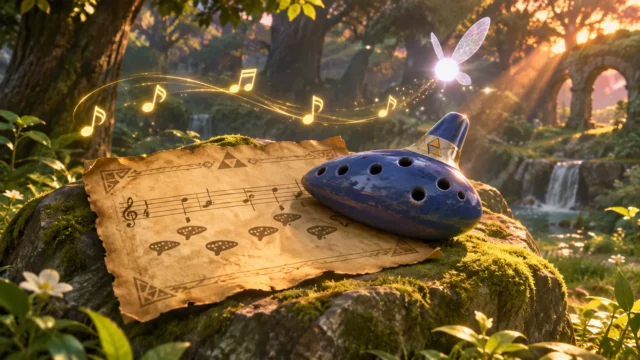
You don’t need to memorize every melody from Hyrule to start playing Zelda music yourself. Nintendo has published the official Ocarina of Time sheet music for all 12 ocarina songs, giving musicians a practical way to bring the soundtrack to life on real instruments.
The collection accompanies The Legend of Zelda: Ocarina of Time, which launched on Nintendo Switch 2 on November 5, 2026. Alongside the musical scores, Nintendo provides an ocarina fingering guide and recordings of how each melody sounds in the game.
Ocarina of Time sheet music is available directly from Nintendo
The easiest starting point is Nintendo’s official ocarina sheet music collection. Although the website is in Japanese, it provides visual musical scores that players can use with instruments such as piano or guitar.
Each melody has its own listening button, allowing you to hear the in-game version before attempting to play it. This is especially useful when learning an unfamiliar tune or checking whether your performance follows the intended melody.
For ocarina players, Nintendo also includes a fingering guide. Instead of relying exclusively on conventional notation, you can consult the finger positions while practicing.
All 12 Ocarina of Time sheet music songs are included
The official collection contains every one of the adventure’s 12 ocarina melodies. Here is the complete list using their English names:
- Zelda’s Lullaby
- Epona’s Song
- Saria’s Song
- Sun’s Song
- Song of Time
- Song of Storms
- Minuet of Forest
- Bolero of Fire
- Serenade of Water
- Nocturne of Shadow
- Requiem of Spirit
- Prelude of Light
One important warning applies to newcomers. Nintendo includes melodies learned later in the adventure, so browsing the entire collection may reveal information about your future progress. If you’re experiencing Hyrule for the first time, consider checking only songs you have already discovered.
For a simple practice routine, choose one familiar melody, listen to its official recording and follow the corresponding score. Then try playing it without the reference audio. Once you’re comfortable, move on to another song.
You can make Link follow your performance through voice input
The Switch 2 remake takes this musical connection further. When you play a melody into the Nintendo Switch 2 console’s microphone, Link can perform the corresponding ocarina tune alongside you in the game.
However, this feature has specific requirements. Before trying it, keep the following points in mind:
- Use the console’s microphone. Nintendo specifically describes playing toward the microphone built into Nintendo Switch 2.
- Learn the song in the adventure first. Voice input recognizes only ocarina melodies Link has already learned in-game.
- Be aware of external microphone limitations. External microphones may not be recognized correctly.
- Check your headset setup. A microphone-equipped headset connected to the Nintendo Switch 2 Pro Controller may also cause recognition problems.
- Use the official recordings for practice. Listening to a melody before performing it gives you a useful reference, although it does not guarantee voice recognition.
The crucial distinction is that having access to a song’s sheet music does not automatically unlock it inside the game. You can practice any published melody on a real instrument, but Link’s voice-input recognition remains tied to your adventure progress.
Nintendo also offers two ocarinas inspired by the adventure
Players interested in performing the melodies on a dedicated instrument have two official options inspired by Ocarina of Time. Nintendo offers an instrument-style ocarina through Nintendo Store, while HORI has created an electronic ocarina.
Both are designed to be used with the published fingering guide. Therefore, players who want an experience closer to Link’s own instrument can follow Nintendo’s instructions rather than adapting the melodies to piano or guitar.
Neither accessory is required to read the scores. If you already own a suitable musical instrument, Nintendo’s collection provides a starting point without requiring you to purchase a Zelda-themed ocarina.
The music guide gives returning players another way to explore Hyrule
The new musical resources fit into a remake that revisits several familiar elements of the original adventure. Battle4Play has already covered the remake’s English voice cast, another aspect of how familiar characters are presented on Nintendo Switch 2.
Meanwhile, players preparing to revisit the game’s more demanding locations can read about how the remake improves the Water Temple. Together, these changes and additions offer different reasons to rediscover the adventure.
What makes the official music collection particularly useful is its independence from the console. You can learn a melody away from the game, practice it on your own instrument and later try performing it alongside Link once you’ve unlocked the corresponding song.
Ultimately, Ocarina of Time sheet music turns a memorable part of Zelda’s adventure into something players can practice beyond Hyrule. Whether you start with Zelda’s Lullaby or tackle the complete collection, Nintendo has provided the reference material needed to begin.

Creator of the website, Pokemon trainer by nature. Trying to report on everything related to the world of video games, series and movies. Yu-Gi-Oh is my weakness, collecting cards since the dawn of time.


