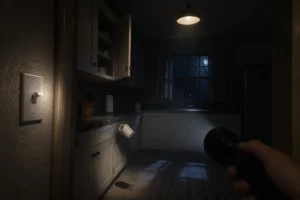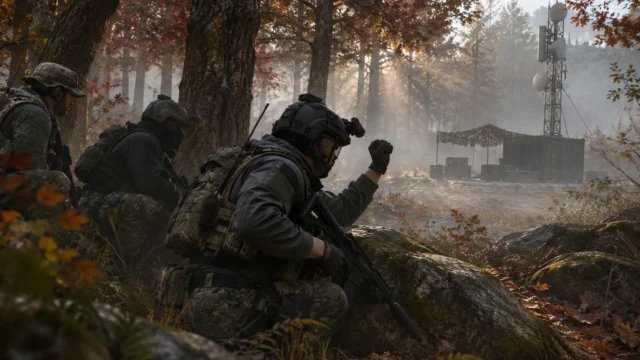
A quiet route through Hajin may finally stay quiet for longer. The latest MW4 DMZ UAV Towers changes target one of the biggest obstacles facing players who prefer careful movement over constant firefights. Instead of simply adjusting weapon damage, Infinity Ward is changing how easily squads can track each other across the extraction zone.
The November 2 update arrives just days before Season 1. Its biggest consequence could be a shift in how players approach objectives, avoid hostile Operators and decide when to risk carrying valuable equipment across exposed territory.
Why MW4 DMZ UAV Towers will be harder to predict
Until now, UAV Towers offered a relatively predictable surveillance network. Players could expect one at every point of interest, making these locations important for gathering intelligence and identifying nearby threats.
That consistency also had a downside. Once a squad activated a tower, other Operators could find themselves exposed simply because they were operating nearby. For a mode built around uncertain encounters and potentially costly extractions, reliable surveillance could undermine attempts to move unnoticed.
Infinity Ward has now reduced the number of UAV Towers by 40% and randomized their spawn locations. Furthermore, multiple towers can no longer appear within the same area. Players should therefore encounter fewer opportunities to establish overlapping surveillance coverage.
There is one deliberate exception. Deadtown retains its UAV Tower because players need it to advance their DMZ Orders. This distinction matters: the developer is reducing surveillance without blocking a required progression objective.
As explained in the official DMZ Deep Dive, these portable communications structures are generally defended by enemy forces. Activating one completes a Side Op, rewards DMZ Cash and produces a detection pulse that reveals nearby Operators and enemies.
Consequently, towers remain valuable. However, finding one is no longer something squads can take for granted at every major location.
The Sedative Inhaler buff changes the risk of crossing Hajin
The tower reduction is only half the story. Infinity Ward has also doubled the Sedative Inhaler’s duration from 60 to 120 seconds, extending the period during which players can avoid detection from UAV Towers.
For stealth-focused Operators, those additional 60 seconds could make a meaningful difference. Crossing an exposed area, approaching an objective or moving away from a hostile squad becomes more manageable when protection lasts longer.
Consider two teams approaching the same location. One activates a UAV Tower to identify threats, while the other attempts to pass through without revealing its position. Previously, the defending squad could rely on a dense network of possible surveillance points. Now, tower availability is less predictable, and the approaching team has a longer defensive window.
This does not make stealth completely safe. Enemy patrols, direct visual contact and ordinary combat encounters still demand caution. More importantly, the Sedative Inhaler currently has a known limitation.
Infinity Ward acknowledges that it does not properly conceal players from towers activated by enemy Operators equipped with the UAV Upgrade trait. The studio plans to address this interaction in a Season 1 update.
Therefore, players should not assume that using an inhaler guarantees protection against every enemy-controlled tower. Until the fix arrives, relying entirely on that item could lead to an unpleasant surprise.
Fewer towers could change how squads plan extractions
The most interesting consequence of this update is not necessarily that DMZ becomes easier. Instead, information may become more valuable because it is less consistently available.
A squad that discovers an active tower now has a potentially useful intelligence advantage. Meanwhile, another team may need to scout unfamiliar territory without knowing whether a surveillance point will appear nearby.
This introduces a different tactical decision. Is activating a guarded tower worth revealing your interest in that location? Should your team spend time securing intelligence, or avoid unnecessary fighting and continue toward extraction?
The answer will depend on equipment, mission priorities and the presence of rival Operators. Nevertheless, randomized tower locations should discourage squads from following exactly the same surveillance route every deployment.
There is also a broader balance question. UAV Towers offer information, but reaching and activating them involves risk. Reducing their availability could make those decisions more meaningful rather than simply removing an obstacle.
Another important adjustment supports a more flexible approach to encounters. The Truce Flag cooldown has fallen from 180 to 60 seconds. This gives players access to the mechanic more frequently, although the patch does not establish how often squads will actually use it.
For players interested in the technical side of extraction gameplay, Battle4Play has also examined Modern Warfare 4’s performance on Nintendo Switch 2. Frame-rate consistency is another consideration when survival depends on reacting quickly to unexpected threats.
Progression fixes and Multiplayer changes arrive before Season 1
Alongside the surveillance adjustments, Infinity Ward has addressed several problems that could interfere with DMZ progression.
UAV Tower objectives should now display their correct status after being recaptured or when the Extended Duration trait is active. Additionally, retired Active Duty Operators should save properly, while Bounty progress should no longer reset between deployments for affected players.
SAM Sites have received an important correction, too. Previously, players could encounter situations where a site became impossible to capture after another squad abandoned or failed its attempt. The update resolves that issue and closes several exploits.
These fixes matter because extraction modes depend on persistence. Losing progress or being unable to complete an objective can be frustrating even when a deployment ends successfully.
Outside DMZ, the patch introduces stability and crash fixes across all modes. Infinity Ward has also reversed a temporary movement restriction, restoring the 23% of intended dive velocity that had been removed to mitigate an exploit.
Meanwhile, the JOKR Launcher’s Infrared mode has been temporarily disabled because of an exploit.
Multiplayer receives an initial adjustment to spawn locations on Shipment, alongside fixes for out-of-bounds exploits on Sentry and Mumbai. Free For All now displays the Final Killcam rather than Best Play.
Other interface improvements include dimmer Death Skull icons and a clearer After Death Damage widget. Campaign players also benefit from a fix addressing cases where the Hits Different Finishing Move failed to unlock.
These changes underline the scale of Infinity Ward’s early post-launch maintenance. However, the developer is not presenting this update as the final solution to every balance or technical issue.
The next major milestone is Season 1, launching Thursday, November 5, at 9pm PT. Its patch notes are expected later this week. Separately, Infinity Ward has confirmed that a fix for the Sedative Inhaler detection problem is planned for a Season 1 update, although it has not specified whether that fix will arrive at launch.
Battle4Play has already explored how Warzone Season 1 will reshape progression and gameplay, providing another perspective on the changes surrounding Modern Warfare 4’s first season.
For now, the MW4 DMZ UAV Towers adjustment represents an interesting change in direction. Instead of making every area easier to monitor, Infinity Ward is giving uncertainty a larger role in the extraction experience.
Whether that produces more satisfying encounters will depend on how squads adapt. But one thing is clear: knowing where surveillance equipment might appear is no longer the same as knowing where it will be.
Will fewer UAV Towers encourage more careful extraction strategies, or simply make enemy encounters harder to anticipate?
Source: Infinity Ward — Modern Warfare 4 official launch patch notes, November 2, 2026.

Creator of the website, Pokemon trainer by nature. Trying to report on everything related to the world of video games, series and movies. Yu-Gi-Oh is my weakness, collecting cards since the dawn of time.