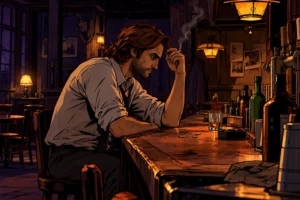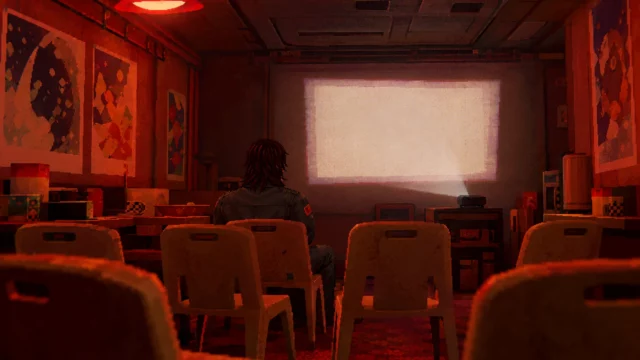
Some horror games are frightening because of what appears on screen. Others stay with players because of what they refuse to explain. The Mouthwashing movie faces a particularly difficult task: bringing a disturbing, fragmented story to cinemas without losing the uncertainty that made it memorable.
Sony Pictures has acquired the film rights to Wrong Organ’s acclaimed indie horror game. With Karyn Kusama directing, the project has an experienced creative team. However, its biggest challenge has little to do with recreating a spaceship.
Why the Mouthwashing movie cannot rely on conventional scares
Released in 2024 by Stockholm-based Wrong Organ and publisher Critical Reflex, Mouthwashing places five crew members aboard the stranded space freighter Tulpar. Food and other supplies are disappearing, rescue seems increasingly distant, and relationships deteriorate as paranoia takes hold.
Yet the game’s most unsettling quality comes from its storytelling. Events unfold out of order, surreal scenes interrupt reality, and players gradually confront questions about responsibility, denial and the abuse of power. Understanding what happened becomes part of the horror itself.
That creates an unusual problem for a film adaptation. A movie can reproduce disturbing imagery, but it cannot automatically recreate the experience of personally exploring an environment and assembling a broken timeline. Explaining everything too early could weaken the mystery. Conversely, withholding too much might leave viewers disconnected from the characters.
For Battle4Play, this is the central question surrounding the adaptation: can cinema preserve the discomfort of discovering a story rather than simply watching it unfold?
Karyn Kusama brings experience with psychological tension
The choice of director offers one reason for cautious optimism. Karyn Kusama previously directed The Invitation, Jennifer’s Body, Destroyer and Girlfight. Her work frequently examines strained relationships, emotional manipulation and characters whose decisions carry consequences.
Her television experience is relevant too. Kusama received two Primetime Emmy directing nominations for Yellowjackets, where she also serves as an executive producer. Earlier in her career, Girlfight earned her Best Director and the Grand Jury Prize at Sundance.
Meanwhile, Matt Manfredi and Phil Hay will write the screenplay. Their previous collaborations with Kusama include The Invitation and Destroyer, while their wider credits include Clash of the Titans and the Ride Along films. That existing creative relationship could be valuable when translating such an unconventional narrative.
Scott Derrickson, C. Robert Cargill and Vince Cheng are producing through Crooked Highway, which has an agreement with Sony’s Screen Gems label. As reported by Deadline on October 29, 2026, the acquisition brings the indie property into Sony’s feature-film pipeline. Wrong Organ subsequently confirmed the adaptation on X.
Nevertheless, no cast, release date or official film synopsis has been announced. Whether the screenplay follows the game’s events closely or rearranges them remains unknown.
A cult indie success is reaching a much wider audience
The timing is especially interesting because Mouthwashing is no longer confined to its original PC audience. The game has expanded to PS5, PS4, Nintendo Switch, Xbox Series X|S and Xbox One. Its Xbox debut also coincides with its arrival in Game Pass on console and PC.
As covered in Battle4Play’s October 2026 Game Pass Halloween lineup, subscribers can now discover the game alongside several other seasonal releases. This gives curious players a convenient opportunity to experience the original before any film reaches theaters.
Furthermore, Mouthwashing has sold close to one million copies since its debut. It earned Best Narrative and Players’ Choice at the Horror Game Awards, alongside Best Hidden Gem at the New York Game Awards.
Its online reach is even more striking. Related content has attracted approximately 63 million YouTube views and nearly one billion TikTok views. Those figures describe content exposure rather than unique players, but they help explain why this relatively small production has become recognizable far beyond its sales numbers.
Consequently, Sony is adapting a game with an established identity and an audience already invested in its characters. That attention creates an opportunity, although it also means creative changes could face considerable scrutiny.
What Sony must decide before the adaptation takes shape
There are several possible approaches to the Tulpar’s story. The filmmakers could retain its fractured chronology, adopt a more straightforward narrative, or shift emphasis toward individual crew members. None of these choices has been confirmed, and each would produce a different viewing experience.
Perhaps the most important decision concerns perspective. Mouthwashing uses the player’s incomplete understanding to challenge assumptions about its characters. A conventional cinematic viewpoint might make those relationships easier to follow, but it could also change how the audience interprets responsibility.
Meanwhile, Wrong Organ is already pursuing another distinctive horror concept. Its next project, Carcass Clad, is a cooperative tank horror game in which players divide responsibilities between commander, driver and gunner while escaping a war-torn city. It suggests the studio remains interested in unusual ways of creating tension through player roles.
For now, the Mouthwashing movie has a promising creative foundation but plenty left to prove. Its success may depend less on faithfully recreating every scene and more on preserving the original’s unsettling moral questions. Would you prefer a direct adaptation of the Tulpar’s story, or a film willing to experiment with its structure?

Creator of the website, Pokemon trainer by nature. Trying to report on everything related to the world of video games, series and movies. Yu-Gi-Oh is my weakness, collecting cards since the dawn of time.