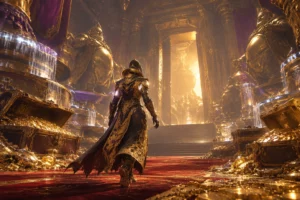
A game can win over almost everyone who tries it and still remain practically invisible. That is the unusual position facing Hubble Bubble co-op, a new Steam release with 94% positive user reviews but a surprisingly small audience. For a debut developed by just two people, those numbers tell two very different stories.
Released on October 23, 2026, Hubble Bubble turns a failing alien business into a multiplayer disaster waiting to happen. Yet its biggest obstacle might have nothing to do with gameplay. The real challenge is getting enough players to discover it.
A 94% Steam rating hides a much smaller success story
As of October 29, Hubble Bubble has earned a Very Positive rating on Steam, with 94% of its 119 user reviews recommending the game. That is an encouraging opening week for an unknown independent studio.
However, SteamDB records an all-time peak of just 566 concurrent players. Its active population frequently drops into double digits, suggesting that positive feedback has not yet translated into widespread visibility.
Those figures need some perspective. Concurrent player counts only measure how many people are playing simultaneously, not total sales or everyone who has tried the game. Likewise, 119 reviews represent an early sample rather than a definitive judgment of quality.
Nevertheless, the contrast is striking. Hubble Bubble appears to be satisfying its initial audience without attracting a much larger one. That makes its opening week an interesting example of how difficult discovery can be for smaller PC releases.
Hubble Bubble co-op turns ordinary jobs into space disasters
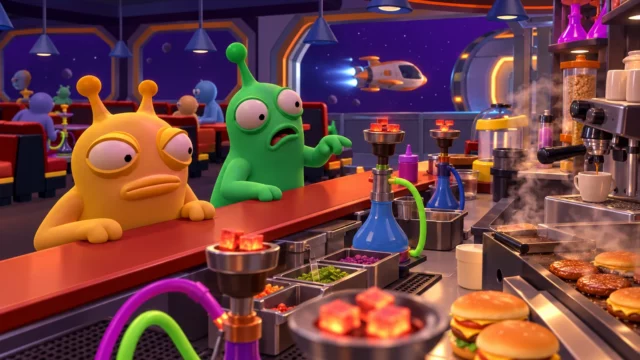
The premise begins with a particularly unfortunate business opportunity. You arrive at a space station without money, discover that the previous owner of Ghalyan’s Hookah Lounge has disappeared in a hurry, and inherit responsibility for keeping its alien customers happy.
Instead of managing everything through menus, players perform the work themselves. Preparing a hookah involves packing its bowl, stretching foil across the top, making holes and heating the coals. Meanwhile, customers demand coffee, Nebula shakes, sodas, burgers and sandwiches.
Every order must reach the correct alien before their patience runs out. Different customers have different requirements, while a drive-thru adds impatient spaceship pilots who expect service without docking.
Crucially, the physics system affects almost everything, including your character. Mishandle a burning coal and you might catch fire. Choose the wrong hatch and you could find yourself outside the station. A badly timed fall can end with an undignified collision against the floor.
Then there is the gravity generator. Its unpredictable failures send objects floating through the lounge, transforming routine deliveries into improvised rescue missions. Orders do not stop simply because the furniture has left the ground.
Built-in proximity voice chat makes these accidents even more entertaining. Friends can coordinate tasks, argue over missing orders or hear a teammate panic as another perfectly ordinary shift collapses.
Why its two-person development team matters
Behind the game is Parita Games, a two-person independent developer and publisher based in Istanbul, Turkey. Hubble Bubble is the studio’s first commercial release, and its ambitions are deliberately focused on shared experiences.
The developers want to create games that friends can enjoy together, whether sitting in one room or communicating remotely. Rather than relying entirely on scripted comedy, they use interactive systems to generate unpredictable moments.
That philosophy gives Hubble Bubble a recognizable identity. The objective is straightforward, but the journey between preparing an order and successfully delivering it can become the most memorable part of a session.
It also places the game alongside a broader interest in cooperative experiences built around social interaction. For example, Battle4Play recently explored how Humblets combines four-player exploration with a cozy adventure. Hubble Bubble approaches group entertainment from the opposite direction: less relaxation, more accidental catastrophe.
Despite its tiny workforce, Parita Games has already shipped several post-launch content updates and is releasing patches almost daily. The developers also handle player support directly, creating an unusually short distance between feedback and the people making changes.
A $6.39 launch deal gives curious players a reason to try it
Hubble Bubble normally costs $7.99 on Steam for Windows PC. However, a 20% introductory discount reduces its US price to $6.39 until November 6, 2026. Regional pricing may differ.
The game supports one to four players through online co-op, although solo play is available too. Earnings from successful shifts can be invested in improving the lounge, including paintings, rugs, an aquarium, an elevator and drive-thru facilities. Cosmetic outfits provide another reason to keep working.
Its appeal is therefore different from that of traditional cooperative action games. As our coverage of October’s cooperative gaming options on PlayStation Plus illustrates, multiplayer entertainment can revolve around combat and missions. Here, serving customers and surviving your own mistakes provide the excitement.
Interested players can find additional details on the official Parita Games website, including gameplay information and promotional material.
The launch discount offers a relatively inexpensive way to experiment with an unusual concept. Still, its strongest selling point is probably having friends willing to embrace the chaos.
Hubble Bubble co-op has already cleared one important hurdle: earning enthusiastic early feedback. Whether that translates into lasting success remains uncertain. With a responsive development team, a distinctive premise and room to grow, this tiny space lounge deserves attention from players looking for something different. Could word of mouth give it the audience it has yet to find?

Creator of the website, Pokemon trainer by nature. Trying to report on everything related to the world of video games, series and movies. Yu-Gi-Oh is my weakness, collecting cards since the dawn of time.