



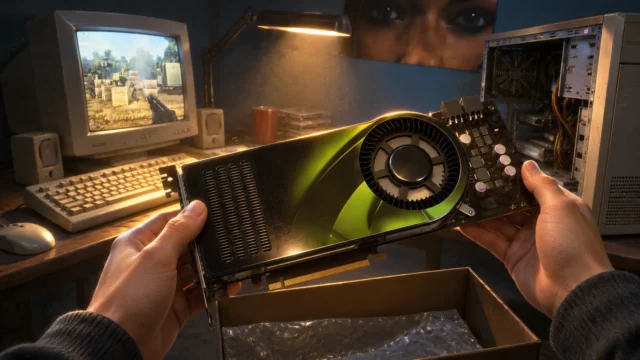
Twenty years ago, installing a new graphics card could feel like unlocking the future of PC gaming. Now, a free NVIDIA-supported experience recreates that moment, and it demands considerably more powerful hardware than the original ever did. GeForce 8800 GTX – 20 Years of a Legend is available on Steam, offering a nostalgic trip back to 2006 through modern RTX technology.
Released on November 5, 2026, this Windows experience is not a conventional game. Instead, it combines interactive hardware nostalgia with an ambitious graphics showcase. There is one important catch, however: despite being free, its minimum specifications put it beyond the reach of many gaming PCs.
GeForce 8800 GTX is free on Steam, but this anniversary comes with a twist
The anniversary project was created by Dylan Browne, an Unreal Engine artist and developer of Through The Ages, with support from NVIDIA. Rather than presenting a traditional museum-style retrospective, Browne lets players revisit the excitement of opening a high-end graphics card during the mid-2000s.
The setting is a PC gaming room inspired by 2006, complete with an era-accurate computer tower. The idea is simple: put players back in the shoes of someone experiencing a major GPU upgrade, while using current rendering technology to recreate that memory.
According to the official Steam listing for GeForce 8800 GTX – 20 Years of a Legend, the demo is free to download on Windows. Unlike a limited-time promotion, its listed availability is not tied to an announced weekend deadline.
That distinction matters for anyone following free PC releases. For example, Battle4Play’s coverage of the PAYDAY 3 free weekend on Steam concerns a temporary opportunity to play a commercial game. This NVIDIA-supported project, by contrast, is offered as a free standalone tech demo.
You can rebuild a small piece of PC gaming history inside the demo
The appeal here is not about completing missions or chasing high scores. Instead, the experience focuses on the physical ritual of upgrading a computer. For players who remember buying PC components in the 2000s, that approach may be more interesting than a conventional anniversary video.
Here is what you can do in the free demo:
- Explore a 2006-inspired gaming room and revisit the atmosphere of an earlier PC gaming era.
- Unbox the GeForce 8800 GTX as though you had just brought the legendary graphics card home.
- Inspect the GPU up close and appreciate its physical design.
- Install the graphics card inside a PC tower designed to reflect hardware from that period.
- Look for references to GeForce history scattered throughout the environment.
- Discover hidden easter eggs while exploring the nostalgic room.
- Experience modern RTX rendering applied to a setting inspired by technology from two decades earlier.
Importantly, this is a semi-interactive experience rather than a full PC-building simulator. Its purpose is to recreate a particular moment in hardware history, not to provide an extensive collection of assembly challenges.
That creative decision gives the project its identity. Instead of merely displaying specifications or old advertisements, it makes a familiar upgrade ritual the centerpiece of the celebration.
GeForce 8800 GTX helped change gaming long before modern RTX existed
The original graphics card reached stores on November 8, 2006. Built around NVIDIA’s G80 architecture, it featured 128 unified stream processors and 768 MB of GDDR3 memory connected through a 384-bit bus. Those specifications belong to another era, yet the architecture marked an important turning point.
Most significantly, the GeForce 8800 GTX was the first CUDA-capable graphics card. CUDA opened the door for developers to use GPU processing power for computing tasks beyond traditional graphics rendering. Consequently, the card’s legacy extends further than the games it helped power.
Its gaming reputation was equally memorable. Company of Heroes, BioShock and Crysis were among the titles associated with the hardware. When Crysis arrived in 2007, its demanding graphics helped popularize the question, “But can it run Crysis?” That phrase became a lasting part of PC gaming culture.
As detailed in NVIDIA’s official 20th-anniversary article, this new project connects that influential hardware generation with current rendering advances.
Built with Unreal Engine, the demo uses DLSS 4.5 with Dynamic Multi Frame Generation, Ray Reconstruction, path tracing and RTX Mega Geometry. These technologies serve different purposes, from generating additional displayed frames to improving reconstructed ray-traced imagery and handling complex geometry.
The contrast is what makes the anniversary particularly interesting. A graphics card that once represented cutting-edge PC performance is now being celebrated through techniques that would have seemed extraordinary in 2006.
For another example of how NVIDIA’s rendering technology is changing familiar digital environments, Battle4Play has also covered the Hogwarts Legacy neural rendering PC update. However, the anniversary demo has a different objective: showing modern graphics technology through a deliberately nostalgic setting.
The free download requires surprisingly powerful RTX hardware
Before downloading, checking the system requirements is essential. The original 8800 GTX may be the star, but the software is designed for modern GeForce RTX systems. In fact, the minimum graphics card listed on Steam is an RTX 4070, while the recommended card is an RTX 5080.
Minimum PC requirements:
- Operating system: Windows 10 build 1909.1350 or newer, 64-bit, with DirectX 12 support.
- Processor: Quad-core Intel or AMD CPU running at 2.5 GHz or faster.
- Memory: 32 GB RAM.
- Graphics card: NVIDIA RTX 4070.
- DirectX: Version 12.
- Storage: 30 GB of available space.
- Graphics driver: NVIDIA GeForce driver 621.12 or later.
Recommended PC requirements:
- Operating system: Windows 10 build 1909.1350 or newer, 64-bit, with DirectX 12 support.
- Processor: Quad-core Intel or AMD CPU running at 2.5 GHz or faster.
- Memory: 32 GB RAM.
- Graphics card: NVIDIA RTX 5080.
- DirectX: Version 12.
- Storage: 30 GB of available space.
- Graphics driver: NVIDIA GeForce driver 621.12 or later.
The main difference between the two published configurations is the GPU. Steam lists GeForce driver 621.12, but NVIDIA’s article says Game Ready Driver 621.14 or newer is required, so installing the latest driver is the safest option. Both specify 32 GB of RAM, a quad-core processor and 30 GB of storage. Therefore, having a modern graphics card alone does not guarantee that a system meets every listed requirement.
GeForce NOW could offer another way to try the demo
There is also a potential alternative for players without a suitable local PC. NVIDIA says the experience is coming soon to GeForce NOW for Ultimate members. However, no specific cloud release date has been confirmed, so Steam remains the available download option at launch.
Ultimately, GeForce 8800 GTX – 20 Years of a Legend offers something unusual among free Steam releases: a chance to revisit the excitement of a historic PC upgrade while seeing how far GPU technology has advanced. The hardware requirements may limit its audience, but for enthusiasts who remember the original card, the experience brings two very different generations of PC gaming together.

Creator of the website, Pokemon trainer by nature. Trying to report on everything related to the world of video games, series and movies. Yu-Gi-Oh is my weakness, collecting cards since the dawn of time.


