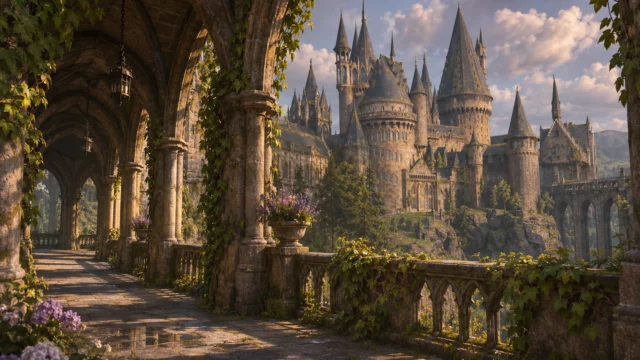
Returning to Hogwarts could feel surprisingly different this week. Not because of new spells, quests or locations, but because familiar surroundings are about to receive a visual transformation. Hogwarts Legacy Neural Rendering arrives on PC on November 5, introducing NVIDIA DLSS 5 technology to Avalanche Software’s open-world RPG.
Rather than simply sharpening an image or generating additional frames, this update changes how lighting and materials appear across the wizarding world. However, its most interesting feature may be something less obvious: developers can decide exactly how much AI changes the original artwork.
Why Hogwarts Legacy Neural Rendering focuses on atmosphere
Hogwarts Legacy already has a distinctive visual identity. Its nineteenth-century setting combines weathered architecture, detailed interiors and atmospheric outdoor environments. Consequently, improving its appearance involves more than increasing resolution.
With DLSS 5, NVIDIA introduces 3D-Guided Neural Rendering, which applies AI-driven lighting and material enhancements during the final stage of rendering. The technology works from the frame created by the game engine, preserving its underlying geometry, textures and lighting information.
This distinction matters. Instead of replacing the original scene, the system enriches its presentation while respecting boundaries established by artists. In practical terms, Hogwarts Legacy can gain additional visual depth without requiring Avalanche to redesign its environments.
Hogsmeade reveals where the biggest visual changes happen
The clearest examples appear in Hogsmeade, where small architectural details become more pronounced. According to NVIDIA’s official comparisons, moss covering rooftops stands out more clearly against individual shingles, giving aged buildings additional texture and definition.
Meanwhile, flower arrangements and window boxes benefit from more localized shadows. These changes may sound minor individually, yet their combined effect can make familiar streets appear more convincing. Around Hogwarts, stone archways gain stronger contact shadows, while cracks and recessed sections of walls show richer contrast.
Character presentation also receives attention. The update improves texture detail, shading, lighting and reflections. Nevertheless, Avalanche has deliberately emphasized environmental improvements rather than allowing AI enhancements to alter recognizable character identities.
That creative control is central to the implementation. Studios can adjust fine details such as ambient occlusion, reflections and subsurface scattering, alongside broader tonal changes. They can also use masks to apply stronger effects to scenery while limiting changes to characters.
Jose Villeta, Director of Software Engineering at Avalanche Software, explained that the studio collaborated with NVIDIA to refine environments, overall tone and skin structure while remaining faithful to its artistic vision. The team hopes these improvements encourage players to revisit the adventure.
Which graphics cards support the new visual upgrade?
The November 5 update supports all GeForce RTX 50 Series graphics cards, including desktop and laptop models. NVIDIA RTX Spark PCs and GeForce NOW Ultimate are also compatible.
Players only need to download the game update and enable the option labeled Neural Rendering in the graphics settings. Unlike the extensive controls available to developers, the player-facing feature works as a straightforward on/off setting.
NVIDIA additionally recommends combining it with DLSS Super Resolution, Multi Frame Generation and Reflex. Ray Reconstruction is recommended when ray tracing is active.
Performance figures are particularly striking at the high end. NVIDIA reports that a GeForce RTX 5090 can reach up to 300 fps at 4K with maximum settings, ray tracing, Neural Rendering, 6X Multi Frame Generation, Ray Reconstruction and Reflex enabled. At 1440p, the company reports up to 370 fps.
These are NVIDIA’s reported results for the specified feature combination, not a guarantee of equivalent performance across every compatible GPU. In particular, Multi Frame Generation contributes generated frames to the displayed frame rate.
The accompanying Game Ready Driver is scheduled for November 4 through the NVIDIA app. Readers following further PC graphics developments can also explore Battle4Play’s PC gaming news and technical coverage.
A smaller AI model makes this update more significant
Behind the visual improvements sits another important development. When NVIDIA introduced DLSS 5 in March 2026, the technology required two GeForce RTX 5090 graphics cards. Its latest implementation can operate on a single compatible card.
Hogwarts Legacy uses the October 2026 Neural Rendering model, which contains approximately 118 million parameters. Compared with its predecessor, this version is 24% smaller, requires 20% less VRAM at 4K and delivers twice the performance.
That efficiency improvement helps explain why the November release matters beyond one game. NVIDIA is also bringing DLSS 5 to War Thunder through Gaijin Entertainment’s Eagle’s Shadow update in mid-November. Meanwhile, Everstone Studio and NetEase Games will introduce support in Where Winds Meet on November 23.
These three releases demonstrate how developers can apply the same underlying technology to very different visual styles. For Hogwarts Legacy, however, the priority is preserving a recognizable fantasy world while improving its material richness and lighting.
With more than 30 million copies sold according to the reported figures, Hogwarts Legacy already has a substantial audience that may be interested in revisiting its nineteenth-century setting. The new rendering option offers a visual reason to return, although its appeal will ultimately depend on individual preferences.
Hogwarts Legacy Neural Rendering therefore represents more than another graphics setting. It offers an early example of how AI-assisted rendering can be shaped by artistic decisions rather than simply pursuing maximum realism. The question for returning players is whether those subtler environmental improvements make Hogwarts feel more magical.
For official comparisons and technical information, visit NVIDIA’s DLSS 5 announcement.

Creator of the website, Pokemon trainer by nature. Trying to report on everything related to the world of video games, series and movies. Yu-Gi-Oh is my weakness, collecting cards since the dawn of time.