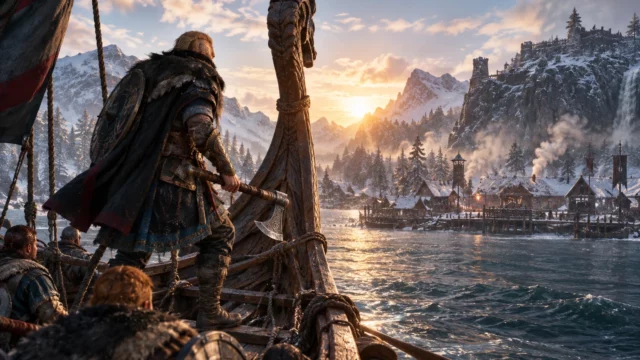
Assassin’s Creed is approaching its 20th anniversary with a surprisingly different set of priorities. Rather than filling its calendar with modern versions of older adventures, Ubisoft wants to build new worlds while giving existing games more reasons to stay relevant.
The Assassin’s Creed future now revolves around original projects, a renewed relationship with players, and a careful balance between experimentation and familiar series traditions. Ubisoft’s October 29 update makes that direction clearer, even if several major questions remain unanswered.
Why Ubisoft is moving beyond remakes for now
The clearest sign of this change concerns remakes. Ubisoft has confirmed that no additional Assassin’s Creed remake is currently in active development. Instead, its studios are working on upcoming installments, including unannounced projects built around fresh locations and stories.
That decision comes shortly after Assassin’s Creed Black Flag Resynced demonstrated considerable commercial appeal. Developed by Ubisoft Singapore, the remake launched on July 9, 2026, for PS5, Xbox Series X|S and PC. It exceeded three million copies sold by mid-July.
However, strong sales have not automatically produced another remake announcement. Reconstructing older gameplay systems requires significant development resources, particularly when modern expectations differ from those surrounding the original releases.
Ubisoft has not abandoned its classics permanently. The company remains interested in revisiting them eventually. For now, though, the Assassin’s Creed future appears to favor expanding the universe rather than repeatedly rebuilding its past.
Black Flag and Valhalla show another way to preserve older games
There is an important distinction between developing a new remake and continuing to support an existing release.
Following its original Black Flag Resynced reveal, Ubisoft has now reached the final planned major content update for the remake. It introduces New Game+, Nightmare Mode, additional finishers, trinkets and customization features. Players can also unlock Blackbeard’s outfit, Edward’s London clothing and new Jackdaw customization options.
Although substantial content additions are ending, Ubisoft will continue releasing quality-of-life improvements over the coming months. That makes this update a closing chapter for major additions, not an immediate end to support.
Meanwhile, Assassin’s Creed Valhalla is getting an unexpected second opportunity to attract returning players. Having surpassed 40 million players, the Viking adventure receives New Game+ on November 5, 2026.
This feature allows players to restart Eivor’s journey while retaining much of their existing progression. Dedicated scaling should provide a more suitable challenge for experienced characters.
The update also introduces an optional progression system combining Gear, Runes and Masteries into Eivor’s overall Power. New runes, achievements and a stash system accompany the changes.
Additionally, Mithril becomes a resource for improving Divine Gear and strengthening runes. Every equipment piece can reach Divine quality, while a Master Assassin outfit inspired by Naoe from Assassin’s Creed Shadows joins the rewards.
Ubisoft will explain the remaining details in its patch notes. Valhalla remains available on PS5, PS4, Xbox Series X|S, Xbox One and PC.
For players, these two updates offer a practical alternative to buying another remake: returning to an adventure they already own with new progression options.
Assassin’s Creed future depends on Hexe and Invictus
The most interesting test of Ubisoft’s direction may come from two games that are still taking shape.
Codename Hexe promises a darker Assassin’s Creed experience. Development is progressing steadily, although Ubisoft acknowledges that considerable work remains. Its next major public update is scheduled for 2027, with no release date confirmed.
Codename Invictus represents a different challenge. This multiplayer project recently welcomed hundreds of participants into a private prototype test.
Players responded positively to parkour, vertical environments, teamplay and the opportunity to control different Assassin’s Creed characters. However, their feedback also highlighted something important: the experience needed a stronger connection to the franchise’s defining gameplay principles.
Consequently, Ubisoft is adjusting Invictus rather than treating those early impressions as a finished design. The publisher also cautions that circulating information about the project may no longer reflect its current state.
The contrast is revealing. Hexe explores a darker direction, while Invictus attempts to bring familiar Assassin mechanics into a multiplayer experience. Neither needs to follow the same formula to belong to the same universe.
That flexibility could become an advantage, provided Ubisoft maintains the identity that connects these different experiences.
The 2027 anniversary could test Ubisoft’s new strategy
The broader transformation extends beyond individual releases.
Earlier in 2026, Ubisoft established a new leadership group under Martin Schelling. Its stated priorities include improving consistency, protecting the franchise’s identity and establishing a clearer creative direction.
A March community survey attracted thousands of responses. Players emphasized three concerns: preserving recognizable Assassin’s Creed mechanics, respecting established lore and communicating more regularly.
Ubisoft has now opened another survey and is preparing private workshops involving community members and content creators. These initiatives matter because the publisher is attempting to address criticism before its upcoming projects reach players.
Meanwhile, the live-action Assassin’s Creed Netflix series is approaching the end of production in Rome. Composer Hannah Peel has joined the adaptation, although Netflix has not announced a premiere date.
All these developments lead toward 2027, the franchise’s 20th anniversary. Since the original Assassin’s Creed debuted in November 2007, the celebration will mark two decades of historical adventures.
Ubisoft is preparing reveals, rewards and community events throughout the anniversary year. However, it has not confirmed which games will feature in those announcements.
That distinction matters. A year filled with celebrations does not necessarily mean every project will receive a release date.
The Assassin’s Creed future ultimately rests on whether Ubisoft can turn its promises into games that feel both fresh and unmistakably part of the series. Black Flag Resynced proves nostalgia still has an audience. The more interesting question is whether Hexe, Invictus and the unannounced projects can create equally strong memories for the next generation of players.
Source: Ubisoft’s official Assassin’s Creed Fall 2026 update.

Creator of the website, Pokemon trainer by nature. Trying to report on everything related to the world of video games, series and movies. Yu-Gi-Oh is my weakness, collecting cards since the dawn of time.