A guard hears a footstep. Another notices a missing patrol. Suddenly, a perfectly planned robbery becomes a desperate search for somewhere dark to hide. That unpredictability made Thief special in 1998, and it remains the strongest argument for bringing Garrett back. The newly detailed Thief Remastered upgrades aim to make that experience easier to enjoy without turning it into a conventional action game.
Atari has confirmed a December 3, 2026 release for Thief: The Dark Project Remastered. Developed by Nightdive Studios and Eidos-Montréal, the revival combines Looking Glass Studios’ original adventure with modern technical improvements. However, its biggest attraction may be something that has barely aged: the freedom to survive through observation rather than violence.
Why Thief’s stealth design still feels different
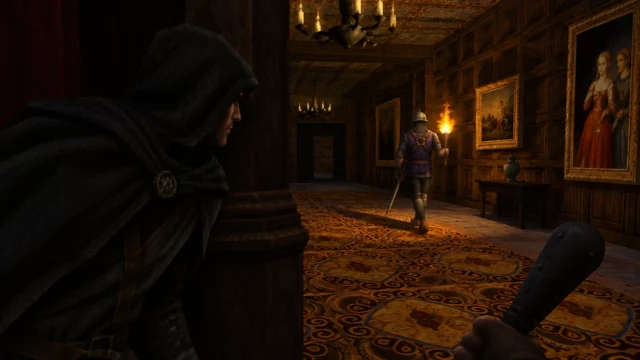
Most first-person games in the late 1990s encouraged players to shoot whatever stood in their way. Thief approached the same perspective from almost the opposite direction. Instead of rewarding aggression, it made players study their surroundings, listen carefully and avoid drawing attention.
Light and sound were not simply atmospheric effects. They determined whether Garrett could remain unnoticed. A noisy surface could betray his position, while a dark corner offered protection. Guards reacted to suspicious noises, communicated with one another and raised alarms when something went wrong. Consequently, every room could become a small tactical puzzle.
Garrett’s background also fits this approach. Once an orphan taken in by the Keepers, an ancient organization devoted to preserving balance, he eventually becomes a master thief operating outside their authority. His blackjack can silently incapacitate unsuspecting enemies, while specialized arrows provide ways to distract guards, manipulate the environment or reach otherwise inaccessible locations. A sword remains available, although fighting openly is rarely the safest solution.
Crucially, missions are built around sprawling, interconnected environments rather than heavily scripted encounters. Players can experiment with routes, timing and equipment. That emphasis on reactive enemies also connects with the questions explored in Silent Hill Townfall’s stealth and difficulty overhaul, where enemy awareness and player freedom shape the experience.
Thief Remastered upgrades focus on removing friction
Nightdive Studios is using its KEX Engine to update the original game for current hardware. The remaster supports resolutions up to 4K and frame rates reaching 120 FPS, alongside improved textures, character models and animations. Small adjustments to the original level layouts are also planned.
Nevertheless, sharper visuals are only part of the restoration. A new weapon and item wheel should make Garrett’s equipment easier to manage, particularly with a controller. Modern controller support includes rumble and motion or gyro controls, while trophies and achievements provide additional incentives to revisit difficult objectives.
Another practical improvement is the mission selector. Players will be able to replay completed assignments without progressing through the entire adventure again. This matters because Thief’s three difficulty settings can change mission objectives, not merely the amount of damage enemies inflict. Revisiting a familiar location can therefore create a substantially different challenge.
Nightdive is also adding built-in support for community-created campaigns, with Atari’s published information specifically identifying PC support. That is especially valuable for a game whose intricate environments encourage experimentation. Meanwhile, a behind-the-scenes vault will preserve development material for players interested in how the original was made.
The important distinction is between modernizing an interface and redesigning a game’s identity. Better controls can reduce unnecessary frustration, but the tension should still come from judging distances, interpreting sounds and deciding when to move. If that balance holds, these improvements could make the original design more approachable without removing its demanding character.
Thief Gold makes this more than a visual restoration
Anyone expecting only the 1998 release with improved graphics will receive a more complete package. Thief: The Dark Project Remastered includes the original 12 large missions together with the additional content introduced in 1999’s Thief: Gold.
That expanded edition adds three story missions and five enemy types. In total, the package brings together 15 missions before considering community-made adventures. This is important for newcomers because they will not need to track down a separate historical release to experience the expanded version.
It also gives returning players a reason to revisit Garrett’s journey beyond improved presentation. Additional enemies create new situations to understand, while alternative objectives and maze-like environments encourage different solutions. Rather than racing toward the end, players can approach each assignment as a problem with several possible answers.
There is a broader preservation argument here. A successful remaster should make an influential game accessible while keeping its distinctive decisions intact. As demonstrated by modern discussions around stealth difficulty, accessibility and challenge do not necessarily need to oppose each other. Thief’s mission structure offers a particularly interesting example of how both can coexist.
December release, platforms and which edition to choose
Thief: The Dark Project Remastered launches on December 3, 2026 for PlayStation 5, Xbox Series X|S, Nintendo Switch 2, PlayStation 4, Nintendo Switch and PC. Computer players can choose between Steam, Epic Games Store and GOG. Pre-orders are already open.
The Standard Edition costs $29.99, £24.99 or €29.99. Meanwhile, the Digital Deluxe Edition is priced at $34.99, £28.99 or €34.99. Its extras include a remaster development diary featuring game artwork, the soundtrack and a preview of the Thief: The Dark Project novel.
For players primarily interested in the adventure itself, the Standard Edition contains the essential experience. The Deluxe upgrade is more relevant to fans who want additional historical and creative material. Physical editions for PS5 and Nintendo Switch 2 will also be distributed by Clear River Games.
Those considering a console copy can follow Battle4Play’s PlayStation 5 coverage or Nintendo Switch news for further platform developments. Official product information is available through Atari’s Thief Remastered page.
Ultimately, the Thief Remastered upgrades will be judged by more than resolution, frame rate or convenience. Garrett’s adventure remains fascinating because it trusts players to think, listen and improvise. Nearly three decades later, that philosophy still feels unusually confident. Will modern audiences embrace a stealth game where avoiding a fight can be more satisfying than winning one?

Creator of the website, Pokemon trainer by nature. Trying to report on everything related to the world of video games, series and movies. Yu-Gi-Oh is my weakness, collecting cards since the dawn of time.