



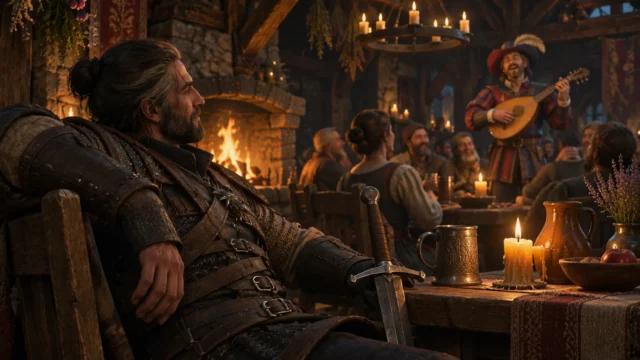
Sometimes the hardest part of returning to a role-playing game isn’t defeating a monster. It’s remembering which equipment needs repairing, deciding what to discard and resisting the urge to investigate every icon on the map. The Witcher 3: Wild Hunt – Remastered addresses that kind of mental workload with Bard’s Ballad, a cognitive accessibility preset designed to make room for the story when time and energy are running low.
CD PROJEKT RED has explained the thinking behind this feature, which has already earned an affectionate nickname inside the studio: “a tired parent mode.” Yet its purpose extends far beyond parents. It offers a different way to experience an enormous RPG without feeling responsible for every little task.
The Witcher 3 lets players spend less energy managing their adventure
Imagine finally finding an uninterrupted hour after a demanding day. You load your save, ready to continue Geralt’s journey. Almost immediately, your weapon breaks. Now you need to find a replacement or arrange a repair. Then your inventory fills up, leaving you to choose what to sell, dismantle or abandon.
For some players, those decisions are an enjoyable part of role-playing. They make equipment and resources feel meaningful. However, someone hoping to unwind with a good story might experience the same systems as a series of interruptions.
That distinction sits at the heart of Bard’s Ballad. According to the developer commentary published on CD PROJEKT RED’s official forums on November 2, 2026, the preset gives players greater control over how they use their time and mental resources.
Rather than asking everyone to enjoy identical levels of complexity, the feature allows selected RPG mechanics to be disabled. Crucially, these options are individual settings as well as part of a convenient preset. Players can therefore adjust particular distractions without necessarily changing everything else.
Bard’s Ballad changes the small mechanics that can interrupt a story
The preset is not simply another difficulty setting. Its focus is cognitive accessibility, which means reducing demands on attention, memory and decision-making. Some changes address practical inconveniences, while others help players concentrate on their original goal.
Here is what Bard’s Ballad changes or allows players to adjust:
- Item durability: Players can turn off this mechanic to avoid dealing with weapon wear and repairs.
- Item weight: An optional setting removes the burden of managing carrying weight.
- Herb markers: Herbs can be hidden from the minimap to reduce visual distractions and the temptation to collect everything.
- Corpse markers: Players can stop corpses from appearing on the minimap, making it easier to ignore optional looting.
- Individual customization: The relevant settings can be adjusted separately instead of applying every change.
- One-step configuration: Enabling Bard’s Ballad applies multiple accessibility settings together, saving additional menu navigation and decisions.
Those minimap adjustments deserve particular attention. A small marker might seem harmless, but it can also feel like an unfinished obligation. Should you collect that herb? Are you missing something important by walking past a corpse? Such questions can repeatedly pull attention away from the narrative.
By removing selected prompts, Bard’s Ballad helps distinguish what players want to do from what the interface encourages them to do. The world remains something to explore, rather than a checklist that constantly demands completion.
The Witcher 3 offers this flexibility to tired parents and many other players
Although the studio’s informal nickname is memorable, CD PROJEKT RED has made clear that Bard’s Ballad is not reserved for one lifestyle or medical condition. Its intended audience is considerably broader.
The feature is designed for people including:
- Players who have difficulty concentrating, including people with ADHD.
- People experiencing cognitive fatigue, including fatigue associated with conditions such as depression.
- Parents with limited opportunities to enjoy uninterrupted gaming sessions.
- Anyone feeling mentally tired, distracted or overwhelmed after a busy day.
- Story-focused players who prefer narrative exploration over repetitive inventory and resource management.
- Anyone who simply enjoys playing with fewer competing demands on their attention.
Importantly, players do not need a diagnosis or a particular reason to use these options. Accessibility settings can also be everyday preferences, just as someone might choose subtitles or a more forgiving combat difficulty.
Bard’s Ballad is disabled by default. Players can enable it through the Accessibility tab or when beginning a new playthrough on the Just the Story difficulty. This approach preserves the existing mechanics for those who enjoy them while making an alternative configuration easier to select.
Other developers are exploring related ideas from different directions. For example, Stranger Than Heaven’s difficulty assists focus on reducing combat barriers. Bard’s Ballad tackles a different problem: the smaller responsibilities that can gradually consume a player’s attention even when combat itself is manageable.
A changing gaming audience explains why these options matter more now
CD PROJEKT RED points to a simple reality: the gaming audience has changed since 2015. More people play video games, their circumstances are increasingly varied, and more players are balancing their hobby with parenthood. Meanwhile, notifications, advertising and endless feeds compete for attention throughout everyday life.
Consequently, an RPG that respects limited mental energy can offer something valuable without sacrificing the systems enjoyed by other players. The important distinction is choice. Someone might want demanding resource management on Saturday morning but prefer an uninterrupted story on a tiring weekday evening.
There is also a wider conversation about making these preferences easier to discover. As Battle4Play recently covered, accessibility filters in Nintendo and Xbox stores are helping players identify useful features before choosing a game. Bard’s Ballad illustrates why detailed explanations matter: a general difficulty label cannot fully describe how mentally demanding an adventure might feel.
Even the preset’s name reflects that philosophy. Rather than presenting accessibility as a technical exception, Bard’s Ballad evokes the comfort of listening to a storyteller and briefly forgetting everyday worries. It is an invitation to enjoy the tale without carrying every responsibility along for the journey.
Ultimately, The Witcher 3 offers a useful reminder that accessibility is not always about making challenges easier. Sometimes it means letting players decide which challenges deserve their limited attention. And when the real world has already been exhausting enough, that freedom can make returning to Geralt’s adventure considerably more inviting.

Creator of the website, Pokemon trainer by nature. Trying to report on everything related to the world of video games, series and movies. Yu-Gi-Oh is my weakness, collecting cards since the dawn of time.


