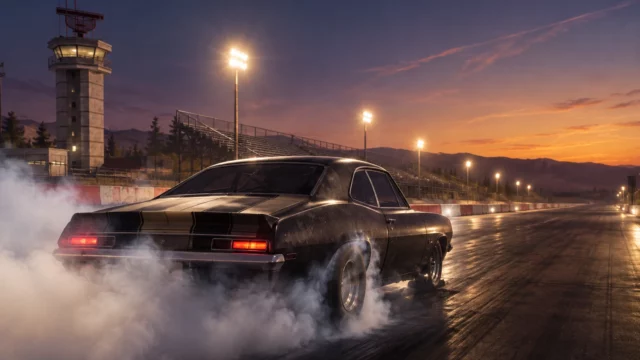
The end of a licensing agreement can make a video game disappear from sale, even when nothing is technically wrong with it. That is exactly what the upcoming Street Outlaws delisting demonstrates. Two racing games are approaching their final weeks on digital storefronts, leaving players with an important distinction to consider: buying a game and keeping access to one are not the same thing.
Publisher GameMill Entertainment has set December 31, 2026, as the end of digital sales for Street Outlaws: The List and Street Outlaws 2: Winner Takes All. However, the deadline does not mean existing owners will lose their games.
Street Outlaws delisting creates a deadline for digital buyers
The removal affects PlayStation Store, Xbox, Nintendo eShop and Steam. Consequently, anyone interested in purchasing either title digitally has until the end of December to make a decision.
Street Outlaws: The List originally arrived in 2019 for PS4, Xbox One, Nintendo Switch and PC. Its 2021 sequel, Winner Takes All, expanded the franchise with another console release, including a native PS5 version alongside PS4, Xbox and Switch editions.
Both titles were developed by the Netherlands-based Team6 Game Studios, which is no longer operating. GameMill Entertainment handled publishing duties.
The publisher explained the situation in an October 29 notice: its licensing agreement for the Street Outlaws games has concluded. As a result, it can no longer continue selling them once the remaining sales period ends.
Importantly, GameMill’s official Steam announcements reassure existing purchasers that their games will remain in their libraries and continue to be playable.
That means this is a sales removal rather than a confirmed shutdown of gameplay access. It is a meaningful difference, particularly for anyone worried about losing a previously purchased title.
Why physical PS5 copies could become more important
Digital stores are not the only way these racing games reached players. Both received physical console editions, creating an alternative for anyone who misses the December deadline.
Winner Takes All has a native PS5 disc release. Meanwhile, the PS4 disc of The List can run on a backward-compatible PS5 equipped with a disc drive. Naturally, neither option works on a digital-only PS5 without a compatible disc drive.
However, there is another complication. GameMill will not be able to manufacture new copies after its license expires. Existing retail inventory may still circulate, but fresh production will stop.
Therefore, physical availability will increasingly depend on remaining stock and second-hand sellers. That does not automatically mean prices will rise. Demand, condition and the number of copies already in circulation will determine their eventual value.
For collectors, the situation highlights an important distinction between physical ownership and digital availability. A disc can remain obtainable through resale even when a publisher no longer has permission to distribute new copies.
It is also worth remembering that physical ownership does not guarantee every online feature will remain supported indefinitely. GameMill’s current announcement concerns sales and existing access, not a separate promise about future online services.
This preservation question extends beyond Street Outlaws. As we previously explored with limited-time Gran Turismo 7 collector rewards, racing games can create opportunities that are not permanently available to newcomers.
A forgotten racing series reveals a familiar licensing problem
The unusual part of this story is not the popularity of the games. Neither Street Outlaws release became a particularly celebrated racing title.
By late October 2026, The List had a 3.44-star average on PlayStation Store, while Winner Takes All stood at 3.04 stars. Both figures came from hundreds of user ratings, suggesting a mixed reception rather than overwhelming enthusiasm.
Yet their disappearance still matters. The games represent a particular moment in licensed entertainment, when Discovery Channel’s Street Outlaws reality series was adapted into interactive drag racing.
The television show, which began in 2013, followed Oklahoma City’s underground racing culture and its famous List ranking of ten leading cars. In the games, players build, tune and customize vehicles before competing to climb that hierarchy.
Unlike conventional circuit racers, their identity revolves around short drag races, vehicle preparation and the appeal of the television franchise.
That licensed identity is also what makes their future complicated. When permission to use an entertainment property expires, publishers may have to withdraw the associated products. Several NASCAR games faced similar removals at the end of 2024.
This is why the Street Outlaws delisting deserves attention beyond its review scores. A game’s cultural or historical relevance is not always reflected in its ratings, and a title does not need to be critically acclaimed to be worth preserving.
For readers following new releases instead, our coverage of the latest PS5 hardware options also illustrates how platform choices can affect what players are able to use or purchase.
Ultimately, the Street Outlaws delisting leaves a clear decision for interested buyers: secure a digital copy before December 31, or rely on whatever physical copies remain afterward. Existing owners can continue playing, but future newcomers will have fewer options. And that raises a broader question: how many licensed racing games will remain accessible to new players a decade from now?

Creator of the website, Pokemon trainer by nature. Trying to report on everything related to the world of video games, series and movies. Yu-Gi-Oh is my weakness, collecting cards since the dawn of time.