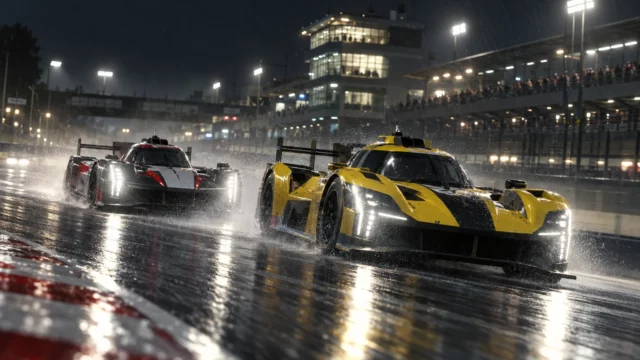
Forza Motorsport has spent more than two decades representing the serious side of Xbox racing. Now, however, its future looks increasingly difficult to predict. The departure of a key creative leader, combined with a major studio merger, raises an uncomfortable question: does Xbox still have room for a dedicated circuit-racing franchise alongside Forza Horizon?
The Forza Motorsport future debate has gained fresh relevance following confirmation that Dan Greenawalt, founder and longtime director of Turn 10 Studios, is retiring from Microsoft after 27 years. His decision arrives at a particularly sensitive moment for Xbox’s racing division.
Forza Motorsport future faces a new leadership challenge
According to an internal memo from Playground Games studio head Trevor Williams, published by The Verge, Greenawalt has decided to retire from Microsoft. His departure follows the integration of Turn 10 Studios into Playground Games, bringing two historically separate Xbox development teams under the same organization.
Greenawalt was far more than a familiar executive. He helped establish Forza as one of Microsoft’s most recognizable gaming franchises and became closely associated with its technical ambitions. His appearances during Xbox’s E3 presentations also made him a recognizable figure among racing enthusiasts.
The timing is especially important. The restructuring has already changed how Microsoft’s racing teams operate, while Greenawalt’s retirement removes one of the people most closely connected to Motorsport’s original identity. Microsoft has not announced a permanent replacement for his responsibilities or a new Forza Motorsport installment.
Why Turn 10 and Playground Games were never interchangeable
Although both developers contributed to the Forza brand, their games traditionally served different audiences. Turn 10 focused on circuit racing, precision driving and vehicle handling. Playground Games, meanwhile, built Forza Horizon around exploration, open roads and a more accessible driving experience.
That distinction became part of Xbox’s racing identity. Players looking for structured competitions could choose Motorsport, while those interested in open-world adventures had Horizon. The two approaches complemented each other without needing to deliver identical experiences.
The original Forza Motorsport arrived on Xbox in 2005, establishing a foundation that continued across multiple console generations. By contrast, Forza Horizon introduced a different approach to driving entertainment, emphasizing freedom and variety rather than traditional circuit competition.
Consequently, the merger raises a strategic question rather than simply an organizational one. Can one combined development structure preserve two very different interpretations of racing? That matters to players who value Motorsport’s simulation-focused identity.
A 2023 reboot now carries unexpected significance
Released in 2023, Forza Motorsport represented an attempt to modernize the established circuit-racing formula. Its emphasis on track competition distinguished it from the more arcade-oriented, open-world Horizon games.
Yet the situation surrounding the franchise has changed considerably since that release. Turn 10 has now been absorbed into Playground Games, and the executive who helped create Motorsport is preparing to leave Microsoft.
This does not automatically mean another Motorsport game will never happen. Nevertheless, it creates uncertainty about whether dedicated track racing will remain a separate development priority within Xbox.
For racing enthusiasts, that distinction is significant. Motorsport and Horizon may share a brand, but they answer different needs. A larger Horizon project would not necessarily replace the experience offered by a traditional racing simulator.
As Microsoft’s gaming portfolio continues evolving, fans can follow broader developments across PC gaming and multiplatform releases, where racing games remain part of a competitive market.
Xbox restructuring changes more than studio names
Greenawalt’s retirement comes amid substantial changes across Microsoft’s gaming business. According to Eurogamer, this year’s Xbox restructuring involved approximately 3,200 layoffs and four studio closures. Turn 10’s integration into Playground Games forms part of that wider reorganization.
The combined teams are expected to collaborate on the Forza and Fable franchises. That arrangement brings several major projects under one development organization, potentially encouraging shared expertise and more coordinated production.
However, a unified structure does not guarantee that every franchise will receive the same level of attention. Resource allocation, leadership decisions and future project announcements will ultimately reveal how Microsoft intends to balance its different properties.
There is also a historical dimension to Greenawalt’s departure. Before Forza Motorsport launched, he helped ship Project Gotham Racing on the original Xbox in 2001. His career therefore spans much of Microsoft’s history in console racing games.
In his internal message, Trevor Williams acknowledged Greenawalt’s leadership and contributions on behalf of both development teams. The memo presents his retirement as a personal decision, rather than establishing a direct causal connection with the merger.
Meanwhile, the consequences of Xbox’s cuts have extended beyond Microsoft’s internal studios. Another example is Romero Games’ shooter, which found a new publisher after Xbox cancelled its original publishing deal, illustrating how the restructuring has also affected projects outside the company’s own development teams.
For now, the Forza Motorsport future remains an open question. Greenawalt’s departure closes an important chapter in Xbox history, but it does not confirm the end of the racing series. What matters next is whether Microsoft’s combined development teams continue supporting dedicated circuit racing alongside Horizon and Fable. Will Motorsport eventually return with a clear identity, or will Xbox’s racing priorities move in another direction?
Source: The Verge, via Eurogamer.

Creator of the website, Pokemon trainer by nature. Trying to report on everything related to the world of video games, series and movies. Yu-Gi-Oh is my weakness, collecting cards since the dawn of time.