



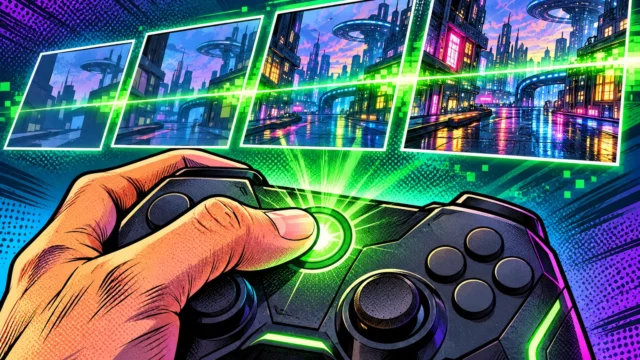
Choosing between sharper graphics and smoother gameplay is a familiar compromise on PlayStation. However, a newly published Sony graphics patent explores a different approach: allowing visual settings to change while a game is running, without forcing players to return to an options menu. The proposal combines a dedicated controller button with technology that could adjust graphics automatically from one frame to the next.
There is an important distinction. Sony has not announced this technology as a consumer feature, nor has it confirmed a new controller or PlayStation 6 implementation. For now, the concept exists in a patent, although its approach raises an interesting question about how future games might handle visual quality.
Why the Sony graphics patent challenges fixed quality modes
Most PlayStation 5 games that offer multiple graphics presets ask players to choose between quality and performance. One option generally prioritizes visual detail, while another favors smoother gameplay. Changing that preference usually means opening a menu, making a selection and returning to the action.
Meanwhile, dynamic resolution scaling already helps games maintain stable performance by adjusting rendering resolution when necessary. Nevertheless, resolution is only one part of visual presentation. Texture quality, filtering, shaders and anti-aliasing also influence how a game looks.
The Sony graphics patent considers a more flexible arrangement. Instead of treating graphics presets as settings that remain fixed until the player opens a menu, the proposed system could move between different configurations during gameplay.
That distinction is particularly interesting when compared with existing improvements. For example, Battle4Play recently covered how Assassin’s Creed Valhalla improved its PS5 Pro graphics through upgraded image reconstruction. Sony’s patented concept addresses a separate issue: how rendering settings themselves might change while someone is playing.
How the Sony graphics patent would make switching smoother
One part of the proposal involves a dedicated controller control. Pressing this button would send a signal requesting a move from the current graphics quality mode to another available mode.
However, the renderer would not immediately replace every setting with its new value. Instead, it would interpolate graphics parameters over a period of time, passing through intermediate values until the requested configuration is reached.
Imagine moving from a visually demanding preset toward one designed to favor performance. Rather than treating the change as a single abrupt transition, the proposed system would gradually adjust relevant rendering values. The patent describes the process, although it does not establish how noticeable those transitions would be in an actual commercial game.
This approach could make manual graphics selection more convenient. After all, very few games currently allow players to switch visual modes instantly through a dedicated control. Some remasters provide more flexible options, but menu-based selection remains the familiar arrangement.
Crucially, the patent does not confirm that any existing DualSense controller will receive this button. Sony’s official DualSense controller page describes the current product, not an implementation of the patented graphics-switching system.
Adaptive Visual Quality goes beyond a controller button
The more technically ambitious element is a system called Adaptive Visual Quality. Unlike the manual button, this mechanism would evaluate what happens on screen and use that information to determine rendering settings for the following frame.
According to the patent details reported by Wccftech, the system compares two consecutive frames pixel by pixel. It examines differences in brightness and color, then produces a numerical score between 0.0 and 1.0.
A score of 0.0 represents no change between the compared frames. At the opposite extreme, 1.0 represents complete change. The resulting value is checked against a table of thresholds specific to the game.
That comparison would help determine settings for the next frame, including texture resolution, texture filtering, shader level and anti-aliasing. Consequently, the system could modify several aspects of image quality rather than relying exclusively on dynamic resolution scaling.
The interesting distinction is that automatic adjustments and manual selection would serve different purposes. Adaptive Visual Quality would respond to changes detected between frames, while the controller button would let players request a different graphics mode themselves.
However, the patent does not demonstrate how reliably this approach would perform in a finished game. It also provides no confirmed consumer implementation. Therefore, improvements to frame rates, image quality or responsiveness should not be presented as established results.
Could the Sony graphics patent appear on PlayStation 6?
The possible connection to Sony’s next console comes from speculation rather than an announcement. In its November 23, 2026 report, Wccftech discussed the Sony patent and its potential relevance to PlayStation 6, following its discovery by Patentlyze.
Wccftech suggested that the proposed controller control could make sense on future hardware, potentially alongside PlayStation Spectral Super Resolution (PSSR), Sony’s upscaling technology.
That possibility is worth examining, but the technologies should not be confused. PSSR concerns image reconstruction, whereas Adaptive Visual Quality describes decisions about rendering settings. They address different parts of the graphics pipeline, and Sony has not confirmed plans to combine them.
The patent also fits into a broader pattern of Sony exploring ideas that may never become products. Another recent example is Sony’s proposed gameplay fingerprint technology, which examines player behavior for identification purposes. Both filings illustrate possible directions for research, not confirmed commercial plans.
The graphics patent was published on November 19, 2026, before Patentlyze brought it to wider attention and Wccftech reported on it four days later. No PlayStation 6 feature, release plan or compatible controller has been announced in connection with this filing.
Ultimately, the most compelling aspect of the Sony graphics patent is not the possibility of another controller button. It is the idea that choosing between visual quality and performance might eventually become a more fluid process. Whether Sony ever brings that concept to PlayStation hardware remains entirely uncertain.

A Fortnite player since the very first storm: I jump off the Battle Bus with a plan (that rarely survives the landing), build faster than I think and never miss a live event on the island. Here I bring you every new season, collab and secret before the storm closes in.