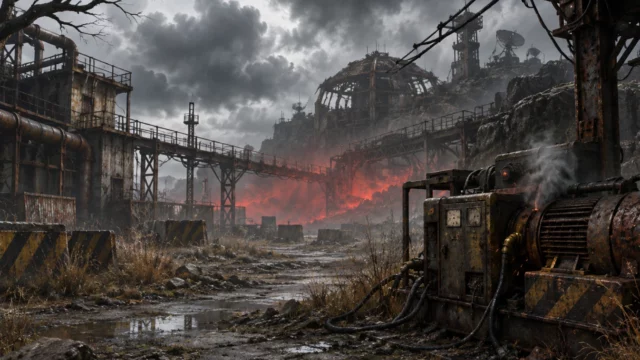
Buying an unfinished game always involves some uncertainty. However, the PIONER server shutdown highlights a much bigger risk: when an online world depends entirely on its developer, losing financial support can make that world disappear. For players who paid $29.99 for GFA Games’ ambitious shooter, the promised journey will now end without reaching its intended destination.
GFA Games has confirmed that development is over, future updates are canceled and PIONER’s servers will be switched off. Yet the announcement leaves two important questions unanswered: when will players lose access, and will anyone receive a refund?
PIONER server shutdown puts its online world at risk
PIONER entered Steam Early Access on December 16, 2025, offering a post-apocalyptic multiplayer experience that combined exploration, survival mechanics and first-person combat. Unlike a traditional single-player adventure, its identity depended on a persistent online environment where players could complete PvE missions and enter dangerous PvP areas.
There was plenty of ambition behind the project. Hundreds of weapons, crafting systems, resource management and a narrative-driven world were intended to give players reasons to return. Its atmosphere invited comparisons with STALKER and Metro, while its competitive elements recalled Escape from Tarkov.
That combination also made PIONER expensive to maintain. Online infrastructure, technical support and continued content development require resources beyond the initial release. Now, according to the official PIONER announcement from GFA Games, those resources are no longer available. No exact server shutdown date has been announced.
Why PIONER server shutdown became unavoidable
The studio’s financial difficulties did not appear overnight. Following a troubled Early Access launch, PIONER struggled with technical problems and declining player activity. As interest weakened, maintaining an ambitious multiplayer project became increasingly difficult.
Throughout recent months, GFA Games attempted to secure additional funding. Discussions involved existing partners, potential investors and other parties that might have helped preserve both the game and its development team. Unfortunately, those negotiations did not produce an agreement.
CEO Aleksandr Nikitin acknowledged the disappointment surrounding the decision. He explained that PIONER represented years of work and a world the team had hoped to support for much longer. He also apologized to customers expecting further improvements and thanked developers, players, streamers, content creators and community members who reported problems.
The situation illustrates a difficult reality for smaller online developers. Even an interesting concept needs a sustainable audience and enough money to support continuous development. For comparison, Battle4Play recently examined how Incursion Red River attracted renewed attention through a substantial PvE update. That example demonstrates how important continued improvements can be for an Early Access shooter, although a temporary rise in players does not guarantee long-term financial stability.
A 2026 roadmap that players will never experience
One particularly disappointing aspect is the timing. In February 2026, GFA Games presented a content roadmap outlining its plans for the rest of the year. That announcement suggested the studio still intended to expand PIONER and address its unfinished systems.
Those plans will now remain incomplete. Players who supported the project expecting additional missions, refinements and a more developed multiplayer experience will not receive the future content originally envisioned.
This also distinguishes PIONER from games that can survive after official support ends. A standalone adventure may remain playable without updates. An online-only experience, however, can lose its core functionality once the infrastructure disappears. Consequently, the end of development and the closure of servers are two separate problems for customers.
There is a broader contrast with other hardcore shooters. Battle4Play has also covered Fragmentary Order’s paid early testing program, where players can purchase access before a finished release. Such models help developers involve their communities earlier, but they also expose buyers to uncertainty about how much of the original vision will eventually materialize.
What happens to PIONER purchases and player progress?
For existing customers, the immediate concern is not simply the absence of new content. It is the possibility of losing access to something they already purchased. GFA Games has confirmed that servers will close, but the available announcement does not establish a final operating date.
There is also no confirmed refund program. Players should therefore avoid assuming that compensation will automatically be offered. Steam has its own refund procedures, although eligibility depends on the circumstances and applicable consumer protections.
Until further information appears, affected players may want to preserve purchase receipts, monitor official announcements and document their account progress. These precautions do not guarantee compensation or continued access, but they may prove useful if additional instructions are published.
The closure also removes another option from an already competitive survival-shooter market. Players interested in dangerous exploration and hostile environments can still look toward alternatives such as STALKER 2. Battle4Play’s STALKER 2 Cost of Hope exploration guide offers a closer look at another post-apocalyptic experience, although its structure differs considerably from PIONER’s MMO ambitions.
Ultimately, the PIONER server shutdown is more than the cancellation of another unfinished shooter. It raises an uncomfortable question about ownership in an increasingly connected industry: what does buying a game really guarantee when its existence depends on servers that may eventually disappear?

A Fortnite player since the very first storm: I jump off the Battle Bus with a plan (that rarely survives the landing), build faster than I think and never miss a live event on the island. Here I bring you every new season, collab and secret before the storm closes in.