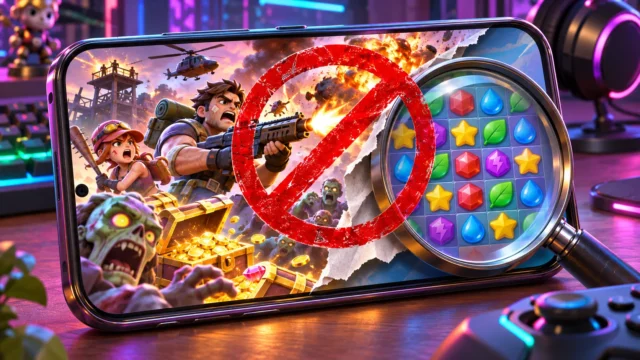
A mobile game advertisement can show real mechanics and still give players the wrong idea about what they are downloading. That distinction is at the heart of a new UK crackdown on misleading mobile game ads, with four titles facing advertising bans following investigations by the Advertising Standards Authority (ASA).
Published on November 4, 2026, the rulings concern Farm Heroes Saga, Pixel Flow!, Dark War Survival and Idle Zombie Miner: Gold Tycoon. Although their advertisements used different techniques, they shared a central problem: the experience being promoted did not accurately reflect the games themselves.
Mobile game ads can mislead players even when they include disclaimers
Perhaps the clearest example involves King’s Farm Heroes Saga. One of the two Facebook advertisements reviewed by the ASA featured a familiar match-three puzzle, but surrounded it with a dramatic scenario that players would not encounter in the actual game.
As matching tiles disappeared, nails holding up a hatch started to fall while a saw moved towards a cow. That setup created the impression that solving puzzles would directly decide the outcome of the scene.
King acknowledged that those elements were absent from Farm Heroes Saga. However, the company argued that the advertisements still represented its central match-three mechanic.
The video also carried warnings including “Not in-game footage” and “Not actual gameplay”. Nevertheless, the ASA concluded that these disclaimers did not correct the overall impression created by the advertisement. Instead, they contradicted what viewers were being shown.
As explained in the official ASA ruling concerning King, that advertisement was misleading and must not appear again in its current form. The second ad, which opened with an animated farming intro before showing ordinary match-three gameplay, was not found in breach.
This distinction matters beyond one puzzle game. Showing a genuine mechanic does not automatically make an advertisement representative if the surrounding scenarios suggest gameplay that does not exist.
Pixel Flow! advertised a puzzle mode that players will never find
The investigation also covered Pixel Flow!, associated with Scopely and Loom Games. One of its two Facebook advertisements opened with a pipe-rotating puzzle that guided a line of pigs across a river, a mode that does not exist in the game. The second ad, which began with a short character introduction, was not found to be misleading.
In reality, Pixel Flow! revolves around one mechanic: launching characters known as “Piggy” onto a conveyor belt with the correct timing and order to clear pixel art.
The difference is significant. An advertisement suggesting several types of challenges can create expectations of variety that the actual product does not meet.
Dark War Survival presented story scenes as playable action
Meanwhile, Dark War Survival took a different approach. Three Google advertisements from Omnilojo presented non-interactive story sequences as though players could control them. They also exaggerated the game’s graphical quality.
Additionally, the advertisements displayed laurels bearing the phrases “2026 Game Creative” and “2026 Survival Game”. Those decorations suggested awards that Dark War Survival had not won.
The ASA’s official Dark War Survival ruling therefore illustrates how misleading presentation can extend beyond gameplay mechanics to visual quality and implied recognition.
Idle Zombie Miner turned a rare bonus stage into its main attraction
Idle Zombie Miner: Gold Tycoon offers another revealing example. A Facebook advertisement and its app store listing emphasized driving an excavator, making that activity appear central to the experience.
Yet excavator gameplay was only a bonus stage. It appeared in four of the game’s 194 mines and lasted approximately 60 seconds.
Unlike the invented puzzle in Pixel Flow!, this activity actually existed. The issue was how prominently it was presented compared with its limited role in the complete game.
The UK rulings expose a wider problem with mobile game ads
These decisions were not isolated cases. The ASA identified the advertisements for investigation through intelligence gathered as part of broader work addressing misleading gameplay in mobile game advertising.
The advertisements under examination were seen on April 28, 2026, several months before the November rulings.
Together, the cases reveal three distinct problems: inventing playable scenarios, presenting passive sequences as interactive content, and exaggerating the importance of minor features.
For players, each can create a different type of disappointment. Someone attracted by a rescue puzzle may discover a conventional match-three game. Another person expecting cinematic survival gameplay may encounter a substantially different experience. Meanwhile, a feature promoted as a central attraction might barely appear.
The broader question is how clearly digital storefronts and promotional material communicate what a game actually offers.
That concern connects with other efforts to help players make informed decisions. For example, itch.io’s AI filtering options for indie game discovery approach transparency from another direction, allowing users to make more informed choices about the content they want to find.
Although these are separate issues, both underline the value of accurate information before a player commits time to a game.
Banned mobile game ads do not mean the games have been removed
It is important to distinguish an advertising restriction from a ban on the games themselves. The ASA decisions concern misleading promotional material, not a prohibition on downloading or playing the four titles.
Furthermore, the UK regulator does not have independent legal powers to impose penalties. However, advertisers that fail to comply can be referred to Trading Standards.
The immediate lesson for mobile publishers is therefore about how games are represented. A promotional video can be imaginative, but its overall impression still matters when viewers are deciding what to install.
This becomes especially relevant as mobile gaming continues to include experiences far beyond short puzzle sessions. For instance, Darkest Dungeon II’s planned arrival on iOS and Android in 2027 highlights the range of games reaching phones and tablets.
Different genres may require different marketing approaches, but players should still be able to recognize the experience they are being offered.
Ultimately, these rulings draw attention to an essential distinction in mobile game ads: attracting attention is not the same as accurately representing a product. Whether a trailer features an invented puzzle or a rarely encountered bonus stage, the important question remains the same.
Will players actually experience what convinced them to download the game?

Creator of the website, Pokemon trainer by nature. Trying to report on everything related to the world of video games, series and movies. Yu-Gi-Oh is my weakness, collecting cards since the dawn of time.