Image: TinyToad
Three days after release, KORRIDOR is already changing how players approach its demanding catacombs. Korridor Descent Mode introduces another starting point, while a substantial balance patch makes early encounters less punishing.
Developer TinyToad released both updates on November 21, 2026, following feedback about repetitive progression and difficult opening hours. The developer says 30,000 games have been played since launch.
Korridor Descent Mode offers a different way into the catacombs
Starting from the beginning is no longer the only way to approach certain areas. The new mode allows players to begin directly in the Moat of Toulouse, bringing the available starting levels to three.
However, this shortcut requires some exploration first. Players must enter Toulouse at least once, then look around in front of its door to unlock the option.
Descent runs also begin with an extra rune and additional enemies.
In its official November 21 announcement, TinyToad describes Korridor Descent Mode as a small first step toward improving progression.
The update also introduces an option to display rune effects on gates.
Korridor Descent Mode arrives alongside easier early battles
Progression was only part of the problem. According to TinyToad, statistics from the previous 24 hours showed more defeats than intended.
The accompanying balance patch, called “Less Pain, More Blasting!”, therefore reduces several enemy health values. Meanwhile, several runes receive buffs.
- Priest: Level 1 health decreases by 40 points.
- Troll: Level 1 health decreases by 100 points.
- Cannibal Grunts, Centaurs and Abominations: Health decreases across every level.
- Haste, Noise and Radius: Fire rate rises by 5%, from 75/70/65 to 80/75/70.
- Focus: Focus damage increases from 10 to 15.
- Pierce: Weight decreases from 100 to 90.
Not every encounter becomes easier, though. Lance Grunts, Cardinal Trolls and Monks now have more health in Cluny. Additionally, Anagni becomes tougher from level 2 onward.
The latest fixes also address shops and controls
Beyond combat, the November 21 patch includes several practical improvements. Gamepad users can now give gems to shopkeepers.
Simon’s attack telegraph also displays correctly. Furthermore, additional leaderboard protections help prevent buggy high scores from appearing in the rankings.
A subsequent hotfix arrived later that same day. It corrected a bug preventing shop rerolls and repaired interface text in Russian, Turkish, Chinese, Japanese and Korean.
TinyToad is also investigating a Steam Cloud synchronization error that can reset progress when switching devices for the first time. Players are advised to back up their save files.
Korridor turns familiar mobile shooter ads into a strategic challenge
Released on November 18, 2026, KORRIDOR is an independent Windows PC action game developed by TinyToad and published by TARK.
Its unusual premise comes from mobile shooter advertisements. TinyToad says it turns those ads into a “deeply strategic genre” with roguelike and bullet heaven elements.
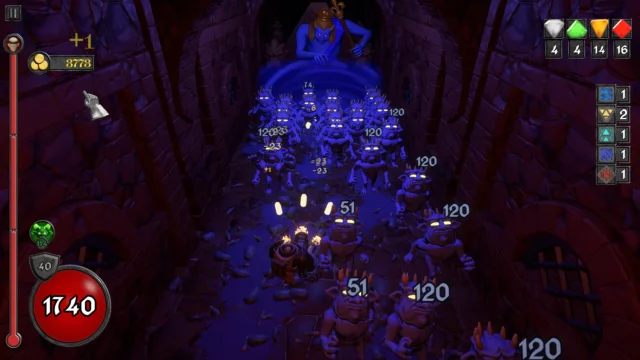
Players advance through corridors filled with demons and monsters. Every 15 seconds, another item becomes available, allowing each build to develop throughout the run.
Bullet heaven is the genre popularized by Vampire Survivors, whose creator, independent studio poncle, has grown to around 40 people.
Players also encounter Demon Rushes, six boss fights and an endless mode with a leaderboard. A custom 45-minute electro-metal soundtrack accompanies the action.
Medieval locations give the repeated runs their own identity
KORRIDOR also incorporates historical details into its environments and progression. Locations include Anagni, Cluny and the Moat of Toulouse.
Between levels, shops feature real historical figures and trivia from the High Middle Ages. Meanwhile, a Picture Book gradually fills as players uncover secrets throughout the catacombs.
TinyToad estimates between 20 and 45 hours to beat the game. The studio also states that all graphical and audio assets were human-made, without generative AI.
KORRIDOR costs $7.99, or €7.79 in Spain. Its 40% launch discount reduces those prices to $4.79 and €4.67, respectively.
Available languages include English, French, Japanese, Korean, Brazilian Portuguese, Russian, Simplified Chinese and Turkish.

A Fortnite player since the very first storm: I jump off the Battle Bus with a plan (that rarely survives the landing), build faster than I think and never miss a live event on the island. Here I bring you every new season, collab and secret before the storm closes in.