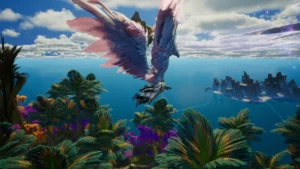
Some anniversaries celebrate a game’s success. Others invite a closer look at the person who made it possible. The Kirby Air Riders anniversary belongs to both categories, arriving as Masahiro Sakurai reflects on how much longer he might continue creating video games. Yet his recent words are not a retirement announcement. Instead, they offer a rare opportunity to consider what this Nintendo Switch 2 exclusive represents in a career spanning several generations of consoles.
Released on November 20, 2025, Kirby Air Riders brought back a racing concept that had been absent for more than two decades. One year later, its director has acknowledged the milestone with a brief personal message. Meanwhile, another anniversary connected to his career makes the timing especially meaningful.
Kirby Air Riders anniversary highlights a different kind of sequel
When Nintendo released Kirby Air Riders, it was reviving an idea first explored in 2003. The original Kirby Air Ride appeared on GameCube, combining accessible racing controls with an unusual approach to competitive play. Its successor arrived 22 years later as a Nintendo Switch 2 exclusive, rather than another installment in a regularly updated series.
Published by Nintendo and developed by Sora Ltd. alongside Bandai Namco Studios, the new game reunited Sakurai with a franchise he helped establish. That connection gave the project a significance beyond nostalgia. It was an opportunity to revisit an earlier design philosophy using a new generation of hardware.
Importantly, Kirby Air Riders launched with its planned content included from day one. Nintendo subsequently released several updates, while the final two figures in its accompanying amiibo line recently became available. These developments have extended the game’s first-year story without turning its original release into an incomplete package awaiting major content additions.
Its anniversary also arrives during Nintendo’s holiday shopping season. As detailed in Battle4Play’s coverage of Nintendo’s Black Friday offers for Switch 2 games, Kirby Air Riders is among the physical titles included in the company’s US promotions. Consequently, its first birthday coincides with another opportunity for players to discover the racing game.
Why the Kirby Air Riders anniversary carries personal meaning
On November 20, 2026, Sakurai marked the game’s first birthday through his official X account. His anniversary message included an image and a short reflection in Japanese. He noted how quickly the year had passed before expressing uncertainty about how much more he would be able to create.
That final thought deserves attention, although it should not be separated from its context. Sakurai has not announced his retirement, confirmed a final game or revealed another project. His message expresses uncertainty about the future, not a definitive decision to stop working.
The distinction matters because Sakurai previously described himself as semi-retired before returning to direct Kirby Air Riders. His career has therefore already demonstrated that stepping away from regular development responsibilities does not necessarily mean abandoning creative work permanently.
For fans, the anniversary offers two perspectives at once. It celebrates the return of a GameCube-era concept, while also encouraging appreciation for the director’s continued involvement in game development. Neither observation requires assuming that Kirby Air Riders will be his final title.
Sakurai’s retirement comments reveal what guides his decisions
The anniversary message also follows remarks discussed during the Famitsu magazine 40th anniversary festival. According to reports covered by Nintendo Life and other gaming publications, Sakurai revisited an earlier column addressing the possibility of retirement.
His reasoning involves two important conditions: whether people still want the games he can create, and whether he remains capable of delivering work that meets those expectations. Rather than identifying a particular retirement date, he described a decision influenced by demand and his own ability to continue producing worthwhile results.
He has also questioned how long his motivation might last. Nevertheless, his reported position remains that he is currently working at full throttle. That makes it especially important to distinguish a creator reflecting on his career from someone formally announcing its conclusion.
These considerations connect with other recent discussions about his development philosophy. In Battle4Play’s examination of Sakurai’s approach to generative AI, the director’s comments highlighted the importance of creative judgment and practical production limitations. Both subjects illustrate his continuing interest in how games are made, not simply which projects reach store shelves.
Two Nintendo anniversaries underline Sakurai’s lasting influence
There is another remarkable coincidence surrounding this particular weekend. On November 21, 2026, Super Smash Bros. Melee reached its 25th anniversary. The GameCube fighting game originally launched in Japan on November 21, 2001, placing its milestone just one day after Kirby Air Riders celebrated its first year.
Although the two games belong to different genres, they share a director whose design choices helped distinguish them from their competitors. Melee became an important chapter in Nintendo’s crossover fighting series, while Kirby Air Ride explored a racing formula built around accessibility and unconventional mechanics.
The connection becomes more interesting when considering Sakurai’s broader creative history. Battle4Play recently explored why the original Super Smash Bros. was difficult to explain, including the challenge of communicating unfamiliar gameplay systems. That willingness to approach established genres differently is also relevant when examining his racing projects.
However, the two anniversaries should not be treated as evidence of a hidden announcement. Neither Nintendo nor Sakurai has confirmed a new Smash Bros. installment, another Kirby racing sequel or any other future production in connection with these celebrations.
Instead, their shared timing provides a useful reminder of how far his work stretches across Nintendo’s history. One anniversary looks back 25 years; the other marks a recent return to an idea from the same console generation.
Ultimately, the Kirby Air Riders anniversary is about more than counting twelve months since launch. It connects an unusual sequel, a long creative career and two generations of Nintendo history. Sakurai’s next professional decision remains unknown, but his latest reflections give fans a reason to appreciate the games already here without treating an uncertain future as a farewell.

A Fortnite player since the very first storm: I jump off the Battle Bus with a plan (that rarely survives the landing), build faster than I think and never miss a live event on the island. Here I bring you every new season, collab and secret before the storm closes in.