What if the hardest part of a dungeon crawler happened before your party even entered the dungeon? Dungeon Automata builds its entire adventure around that idea. Instead of issuing commands during every encounter, you create the logic that determines how your characters behave. Now, this unusual RPG finally has a firm PC launch date: January 26, 2027, on Steam.
Known as Algolemeth in Japan, Dungeon Automata comes from Japanese developer Medium-Rare Games, with Kakehashi Games and Raw Fury handling publishing. Its combination of classic JRPG presentation, programmable golems and automated exploration makes preparation just as important as combat.
Dungeon Automata turns every dungeon run into a programming puzzle
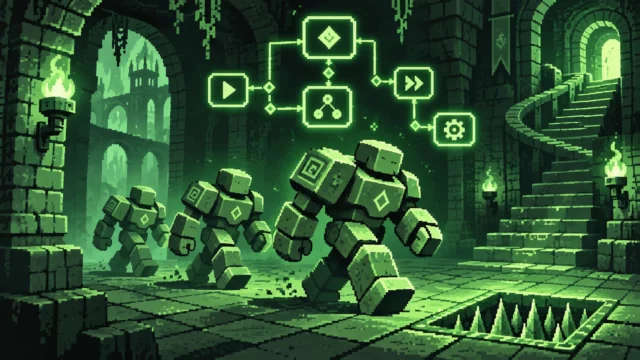
Most dungeon crawlers ask players to react to enemies as they appear. Here, the challenge begins much earlier. You assemble a party of artificial warriors and connect visual programming nodes to determine their actions. Once those golems enter the dungeon, they explore and fight automatically. You cannot intervene during their expedition.
That restriction changes how mistakes work. If your party struggles against a particular enemy or fails to handle a dangerous situation, the solution involves reviewing its behavior and adjusting your programming. Consequently, progress depends on understanding patterns rather than simply repeating battles.
The developers call this approach “autologic,” combining automatic battles with logic-based decision-making. Its emphasis on experimentation may appeal to players who enjoy refining strategies, much like the careful adjustments behind the major Slay the Spire 2 beta changes, although the two games use very different systems.
Dungeon Automata offers more than automatic combat
The adventure takes place in Syntaxia, a fantasy world threatened by monsters appearing around the Tower of Corruption. To confront this danger, players use alchemy to create golems capable of navigating the tower’s labyrinth and eventually reaching its summit.
Importantly, each level is hand-designed rather than procedurally generated. Challenges range from straightforward traps to complicated boss encounters. This makes understanding individual obstacles essential when developing reliable strategies.
Here are the main gameplay features confirmed for the PC release:
- Visual node programming: Connect nodes to establish how individual golems behave during exploration and combat.
- Automatic expeditions: Send your programmed party into the dungeon and observe the results without direct intervention.
- Enemy analysis: Study hostile behavior and improve your party’s logic through trial and error.
- Handcrafted challenges: Overcome tower floors featuring traps, different situations and increasingly demanding enemies.
- Upgradeable abilities: Collect catalysts that strengthen the physical capabilities of your golems.
- Expanded programming options: Discover additional nodes that unlock new actions and logic sequences.
- Custom golem construction: Use collected parts to create distinctive party members suited to your preferred strategies.
The interesting distinction is that stronger characters alone may not solve every problem. Better instructions can be equally valuable. Therefore, the game encourages players to think about how individual decisions affect an entire expedition.
The January release follows a longer development period than expected
Medium-Rare Games confirmed the new date on November 12, 2026, alongside a fresh video presented during The Raw Fury Unshowcase. The announcement also explained why the original 2026 release plan had changed.
Iizuka, representing the Japanese studio, thanked players who shared feedback on the free demo. Incorporating those suggestions required more development time than anticipated, preventing the team from finishing the game within 2026. He apologized for the additional wait and explained that development had reached its final polishing stage.
Dungeon Automata also has an interesting origin. Iizuka began developing it in 2021 after imagining a dungeon RPG where players could automate more than battles. His concept extended programmable behavior to exploration and the journey back from a dungeon, placing responsibility for the entire expedition in the player’s hands.
Players interested in testing that philosophy do not need to wait until January. The free demo remains available through the official Steam store page.
Its monochrome pixel art comes with music from Yuzo Koshiro
Beyond the programming mechanics, Dungeon Automata embraces a deliberately nostalgic presentation. Its hand-drawn, monochrome 8-bit pixel art recalls older Japanese dungeon RPGs, while the soundtrack comes from Yuzo Koshiro, a composer particularly associated with synthesizer music in the style of the Sega Genesis, also known as the Mega Drive.
The project has already received recognition within the Japanese indie scene. It earned a nomination for the Excellence in Game Design Award at BitSummit Let’s GO!! 2023 and won the second GYAAR Studio Indie Game Contest.
Its emphasis on planning also provides an interesting contrast with other indie games built around repeated attempts. For example, Dome Keeper’s upcoming PS5 and Switch release on December 14 brings another distinctive resource-management experience to console players. Here, however, success comes from refining autonomous behavior before the next expedition begins.
Dungeon Automata has modest minimum PC requirements
The game is confirmed for single-player on PC through Steam. It also offers full Xbox and PlayStation controller support, alongside seven languages, including English, Japanese, French, German and Spanish.
Its published minimum system requirements are relatively accessible, particularly regarding memory and storage:
- Operating system: Windows 10
- Processor: Intel Core i5-3330 or AMD FX-4300
- Memory: 4 GB RAM
- Graphics: NVIDIA GeForce GT 730 or AMD Radeon R7 250X
- DirectX: Version 11
- Storage: 5 GB of available space
For the recommended configuration, the developers list Windows 11, an Intel Core i5-4460 or AMD FX-8320 processor, 8 GB RAM and an NVIDIA GeForce GTX 660 Ti or AMD Radeon R9 270 graphics card. DirectX 11 and 5 GB of storage remain necessary.
These specifications suggest that demanding hardware is not the main obstacle to entry. Instead, the real challenge will be learning how to build dependable instructions and improve them when an expedition goes wrong.
Dungeon Automata arrives on January 26, 2027, offering an unusual alternative to traditional dungeon crawling. With a free demo already available, curious players can explore its programming-focused design before launch. The big question is whether you can create a party clever enough to conquer a dungeon without needing your help.

Creator of the website, Pokemon trainer by nature. Trying to report on everything related to the world of video games, series and movies. Yu-Gi-Oh is my weakness, collecting cards since the dawn of time.