



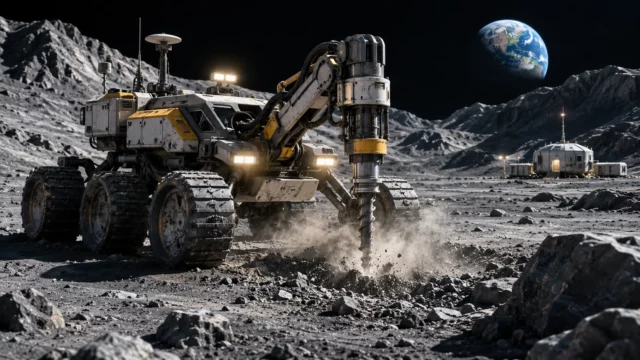
Imagine spotting a valuable mineral deposit on the Moon, hitting the brakes and realizing your rover is still moving because it hasn’t received the command yet. That frustrating moment is exactly what MOONWRIGHT wants to turn into a skill. This upcoming PC lunar mining simulator puts 1.3 seconds of communication delay between every decision and its execution.
Independent developer Oleg Fedorov is creating and publishing the single-player game alone, with a Steam release planned for Q4 2026. Its store page went live on November 12, 2026. Rather than making you an astronaut, the game places you in a chair on Earth, managing a remote mining operation with three monitors, borrowed equipment and bills that refuse to wait.
MOONWRIGHT makes a 1.3-second delay its biggest challenge
Most driving games reward quick reactions. Here, reacting quickly is not enough. Commands take 1.3 seconds to reach your lunar rover, while the images returning to your monitors are also 1.3 seconds old. Consequently, what you see is never quite what is happening at that moment.
That changes how you approach even a simple mineral deposit. You need to anticipate your stopping distance, brake before reaching your target and make small steering corrections instead of relying on continuous adjustments. Precision comes from planning ahead, not reacting at the last second.
Furthermore, the rover cannot independently complete your work. You drive, investigate and drill manually. Radar pulses gradually reveal unexplored terrain, while approaching a contact allows you to analyze what lies beneath the surface. Only then can you decide whether drilling is worth the time and energy.
This creates an interesting distinction from conventional mining games. Discovering resources is only half the job. The other half involves controlling a machine whose delayed responses can turn a straightforward maneuver into an expensive mistake.
A lunar gold rush becomes a race against weekly payments
The premise of MOONWRIGHT begins with a new Gold Rush on the Moon. You have purchased a small base, rented a second-hand mining rover and paid to transport it to the lunar surface. Unfortunately, establishing your one-person company is only the beginning of your financial problems.
Every week, $1,350 is due, alongside the rover rental cost. Finding valuable material does not immediately improve your bank balance, either. Extracted ore must be collected by a shuttle, and arranging that transportation costs money. Miss three payments and the bank repossesses everything.
There are eight real lunar resources to discover, ranging from practically worthless regolith to ice hidden in shadowed craters and potentially valuable helium-3. Their market prices change daily, so an attractive deposit today might not offer the same return tomorrow.
Unlike the historical entertainment business in Cinema Theater Tycoon and its century-spanning management simulation, this business operates under immediate pressure. Each trip needs to justify its costs, and every mistake threatens your ability to make the next payment.
The Moon itself could be your most expensive opponent
Your 2 km mining claim sits in the Taurus-Littrow valley, the location of the Apollo 17 landing. However, you do not begin with a fully revealed map. Instead, your own radar surveys gradually establish where useful deposits might be hiding.
The environment also follows an unusually demanding schedule. A lunar day lasts roughly one month, divided into approximately two weeks of sunlight and two weeks of darkness. The Sun and Earth occupy positions based on their real locations, while temperatures can climb to +111 °C at lunar noon and fall to -180 °C before dawn.
In MOONWRIGHT, these conditions directly affect your equipment. In daylight, excessive heat can overheat the drill. During darkness, cold reduces battery capacity, and the rover consumes additional energy to keep itself warm.
Battery charge, cargo space and mechanical wear are limited. Running out of power far from base means paying the Company to tow your rover home. Even after returning safely, recharging takes hours. Therefore, planning an expedition involves more than selecting the richest mineral deposit.
MOONWRIGHT combines hands-on mining with upgrades and missions
Although its central loop revolves around surveying, drilling and selling resources, the simulation includes progression systems that should give players reasons to improve their operation. Five upgrade trees cover different aspects of the business, while seven rover components can deteriorate, fail and require repairs.
The official Steam listing also details additional missions, a three-monitor control station and time compression for handling lengthy periods of travel, charging or waiting.
Here are the main features announced for MOONWRIGHT:
- Delayed remote driving: Control a lunar rover with 1.3 seconds of communication delay in each direction.
- Manual mining: Survey unexplored ground with radar, analyze contacts and operate the drill yourself.
- Eight lunar resources: Discover materials ranging from regolith to water ice and helium-3, with daily market price changes.
- Financial survival: Manage weekly debt, rover rental fees, shuttle collection costs and the risk of repossession.
- Five upgrade trees: Improve drive and power, drill and cargo, sensors, automation, and base logistics.
- Equipment maintenance: Monitor seven rover parts that experience wear, breakdowns and repairs.
- Three additional missions: Photograph the Apollo 15 landing site, retrieve ice from Shackleton crater and rescue a missing rover.
- Three-monitor operator console: Follow rover activity while managing finances, maintenance and improvements.
- Adjustable time compression: Accelerate simulation time from x1 to x1800.
- Progression rewards: Earn 38 in-game awards alongside Steam achievements.
One especially interesting design choice is the separation between operator skill and equipment progression. Better technology may expand what your company can accomplish, but the core driving and drilling tasks still demand attention.
The planned Steam release has clear PC requirements
MOONWRIGHT is scheduled to launch on Windows PC in Q4 2026, although an exact release date and price have not been announced. Oleg Fedorov is handling both development and publishing.
The announced minimum specifications call for a dedicated graphics card and DirectX 12 support.
Minimum PC system requirements
- Operating system: Windows 10, 64-bit.
- Processor: Four-core Intel Core i5-8400 or AMD Ryzen 5 2600.
- Memory: 8 GB RAM.
- Graphics: NVIDIA GeForce GTX 1060 6 GB or AMD Radeon RX 580 8 GB.
- DirectX: Version 12.
- Storage: 4 GB of available space.
For the recommended configuration, the developer lists Windows 11, an Intel Core i5-12400 or AMD Ryzen 5 5600, 16 GB RAM and an NVIDIA GeForce RTX 3060 or AMD Radeon RX 6600 XT.
The game lists six supported languages, including English with voice support, French, German and Japanese. Its Steam disclosure also states that AI was used for text translations, tutorial voice-over and background music.
Meanwhile, indie fans looking ahead to December can also follow Tinker Islands and its upcoming Steam Early Access launch, which offers a much more relaxed approach to gathering resources and exploring unfamiliar territory.
Ultimately, MOONWRIGHT stands out because its biggest obstacle is not necessarily finding something valuable. It is getting a distant machine to do exactly what you intended, without wasting the time, electricity or money needed to keep your company alive. If that balance works, a simple journey across the lunar surface could become a surprisingly tense management challenge.

Creator of the website, Pokemon trainer by nature. Trying to report on everything related to the world of video games, series and movies. Yu-Gi-Oh is my weakness, collecting cards since the dawn of time.

