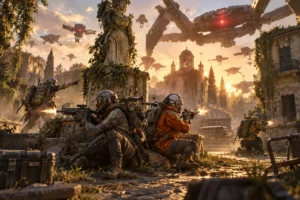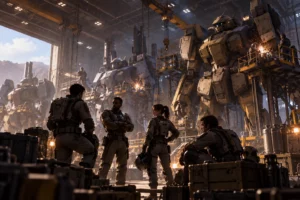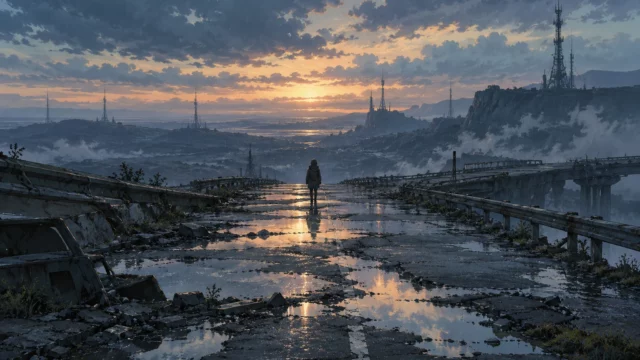
Death Stranding Isolations is turning humanity’s greatest achievement into a troubling question: what if reconnecting everyone makes isolation even worse?
Kojima Productions has unveiled the first teaser for its upcoming animated series, arriving on Disney+ and other Disney services in 2027. However, this isn’t another retelling of Sam’s journey. Instead, it follows people living with the consequences of a world supposedly brought together.
Announced in 2025, the project now has a clearer identity. Its traditional hand-drawn animation and original storyline promise a different perspective on an already unsettling universe.
Death Stranding Isolations explores the cost of reconnecting America
At first glance, rebuilding connections sounds like an unquestionable victory. Yet Death Stranding Isolations challenges that assumption by examining what happens afterward.
The story unfolds in North America shortly after Sam reconnects the continent through the Chiral Network. While that achievement brings people closer technologically, it also creates unexpected consequences.
For one young girl, human contact offers little comfort. Having survived a catastrophe that shattered society, she has grown accustomed to being alone. Eventually, solitude becomes something she actively protects.
That choice creates the series’ central tension. A connected world doesn’t automatically produce meaningful relationships. Moreover, someone who fears connection may experience progress very differently from someone seeking it.
The Death Stranding itself began with catastrophic explosions when the dead crossed into the living world. Against that background, isolation becomes more than a personal preference. It can also represent survival, grief, and resistance to change.
Why Death Stranding Isolations follows people beyond Sam and Bridges
Rather than placing another familiar hero at its center, the animated story introduces characters who have chosen different paths.
Among them is an elderly figure whose mysterious ability allows him to forge bonds between people in ways nobody fully understands. Another is a female soldier caught in an endless pattern of conflict and destruction. Meanwhile, a young boy struggles with anger toward life’s apparent absurdity.
Their experiences suggest several competing responses to the same broken world. Some seek relationships, others remain trapped by violence, and some reject the circumstances surrounding them.
Chance encounters eventually disrupt the young protagonist’s solitude. As a result, she enters an unfamiliar reality where avoiding others may no longer be possible.
Importantly, this approach gives the series room to examine the Death Stranding universe without repeating its games. Its central conflict appears emotional rather than geographical: how can people connect when they no longer trust connection?
That distinction could become the adaptation’s defining strength. Instead of relying entirely on recognition, the story invites viewers to understand its world through unfamiliar lives.
Hand-drawn animation gives the Disney+ series another identity
Visual presentation is another important part of this reveal. Kojima Productions has confirmed that the project uses traditional hand-drawn 2D animation.
That creative choice separates the series from the games’ visual presentation. Furthermore, it offers another way to communicate the universe’s strange landscapes, unsettling atmosphere, and intimate character moments.
Director Takayuki Sano leads the project, while novelist Tow Ubukata handles series composition and screenplay. Ubukata, known for Mardock Scramble, received the Nihon SF Taisho Award in 2003.
Original character designs come from Ilya Kuvshinov. Meanwhile, E&H production handles animation, bringing experience from Ninja Kamui, Bullet/Bullet, and the Magic Knight Rayearth television series.
Hideo Kojima serves as executive producer, with Kojima Productions overseeing production.
Sano has also emphasized the responsibility involved. He believes entertainment can lift audiences’ spirits, something he associates with Kojima’s creations. Consequently, he approached this adaptation with a strong sense of duty.
For viewers, the important question isn’t whether animation can imitate the games. It’s whether this different artistic language can make their underlying themes feel personal.
A disturbing teaser sets expectations for the 2027 release
The first trailer offers a particularly grim introduction through its brief tagline: “My mom became a crater.”
Those words capture the collision between personal tragedy and extraordinary catastrophe. Rather than explaining every mystery, the line immediately establishes the emotional damage beneath this fictional world’s supernatural events.
Viewers can watch the official Death Stranding Isolations teaser to experience its initial presentation.
Its arrival also adds another example to the conversation surrounding video game adaptations. Battle4Play has previously covered the PUBG live-action Netflix series involving Donald Glover, another adaptation bringing a popular video game universe to television.
Meanwhile, our coverage of One Piece and Netflix’s evolving release strategy highlights another question surrounding streaming adaptations: how should established fictional worlds develop for television audiences?
In this case, the answer begins with an independent narrative rather than a familiar adventure recreated scene by scene.
Death Stranding Isolations is scheduled for 2027, although an exact premiere date hasn’t been announced. For now, its most intriguing promise is simple: rebuilding a network may be easier than rebuilding human trust.

Creator of the website, Pokemon trainer by nature. Trying to report on everything related to the world of video games, series and movies. Yu-Gi-Oh is my weakness, collecting cards since the dawn of time.