



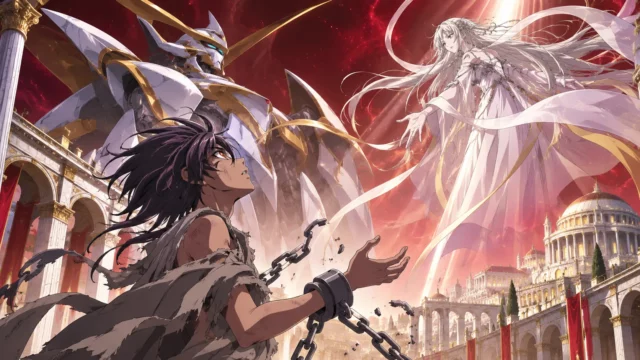
Code Geass is putting an unlikely pair at the center of its next anime. Instead of leading with a familiar hero or a spectacular robot battle, Code Geass: Star Chaser Aspal introduces a boy trapped in slavery and a mysterious woman who survives without a body. Their meeting takes place in an empire devastated by political oppression and war, but the creative team is asking a surprisingly personal question. What does it mean to find happiness?
Sunrise revealed the new story, principal characters, first Agalmata, main cast and production staff on November 5, 2026. Known in Japan as Code Geass: Hoshi Oi no Aspal, the project now has a clearer identity beyond its announcement. Its central mystery is not simply who will win a conflict, but what kind of future its two leads might be able to pursue.
Code Geass introduces an empire where freedom is already lost
The story begins in 606 of the Divine Era, during the reign of Emperor Phokas. Citizens of the Roman Empire face harsh rule while repeated wars against neighboring nations continue to damage their lives. This is not a peaceful setting waiting for a crisis. For ordinary people, suffering has already become part of everyday existence.
Among those people is Aspal, a slave boy living in Neapolis. His circumstances place him far from the privileges of imperial power. Then he encounters Zoé, a mysterious woman who remains alive despite existing only as a severed head. Their meeting marks the beginning of the new narrative.
Several details establish the world without revealing where the plot will ultimately go.
- Era: The year 606 of the Divine Era.
- Empire: The Roman Empire, ruled by Emperor Phokas.
- Political situation: Oppressive government and continuing wars with neighboring countries.
- Starting location: Neapolis, the city where Aspal lives as a slave.
- Main protagonist: Aspal, a young boy living without freedom.
- Central mystery: Zoé, a woman who survives as a severed head.
- Story catalyst: The encounter between Aspal and Zoé.
- New mechanical element: Agalmata, the robots introduced for this anime.
The unusual pairing creates an immediate contrast. Aspal has a body but lacks control over his life, while Zoé possesses an extraordinary form of survival. Whether their relationship changes either character’s circumstances remains unknown. Nevertheless, this contrast gives the premise a human question to explore alongside its larger political conflict.
Code Geass puts the search for happiness at its emotional center
Director Kazuya Nomura, known for Run with the Wind and Moriarty the Patriot, has explained that the team seriously approached the theme of what happiness means through Aspal. That comment offers an important clue about the intended emotional direction, even though it does not reveal the outcome of the story.
For a protagonist living under oppression, happiness may seem like a distant possibility rather than an everyday expectation. This makes the question particularly compelling. Will Aspal define it through freedom, personal relationships or something the audience has not yet discovered? Those are possibilities raised by the premise, not confirmed plot developments.
Series composition writer Mado Nozaki, whose credits include KADO: The Right Answer, has described working on the project as a true adventure. Meanwhile, Ivan Shibata said he initially struggled to believe he had secured the leading role. His approach to playing Aspal is shaped by the hope that the character will find his own happiness.
Hibiku Yamamura, who voices Zoé, has highlighted the character’s striking appearance, describing her design as divine and beautiful. That reaction reinforces how much of Zoé’s initial appeal comes from her visual identity and unexplained existence.
These comments suggest that the emotional journey will be as important to watch as the wider conflict. They do not, however, establish how the series will resolve its mysteries.
Chronos gives the new Agalmata machines their first name
Alongside the story and character information, Sunrise has introduced Chronos, the first Agalmata revealed for Star Chaser Aspal. Agalmata is the name used for the robots in this production, establishing a mechanical identity that viewers can already associate with the new anime.
For now, the announcement leaves several important questions unanswered. No confirmed explanation has been provided here about Chronos’s pilot, abilities or role in the conflict. Consequently, its reveal should be treated as an introduction rather than evidence of a particular battle system or narrative twist.
Mecha fans have another major name to follow through Battle4Play’s coverage of Gundam Battle Operation 3 and its team-based robot combat. Although that project is a video game rather than an anime, it offers a useful contrast. Gundam’s appeal in that announcement is explained through combat mechanics, whereas Chronos currently invites curiosity through its design and the unanswered questions surrounding it.
The distinction matters. A robot reveal can generate excitement without telling us how central the machine will be to the characters’ decisions. For Star Chaser Aspal, that relationship is still something to discover.
The original creators return alongside a new production team
Although the story introduces unfamiliar protagonists and a different imperial setting, the creative foundation retains an important connection to the franchise’s origins. Ichiro Okouchi and Goro Taniguchi, the creators of the original Code Geass, are credited with the original story. Sunrise is responsible for the original work, planning and animation production.
The main cast and creative team confirmed through the official Code Geass: Star Chaser Aspal website are as follows.
- Original work and planning: Sunrise.
- Original story: Ichiro Okouchi and Goro Taniguchi.
- Director: Kazuya Nomura (Run with the Wind, Moriarty the Patriot).
- Series composition: Mado Nozaki (KADO: The Right Answer).
- Character design: Rolua.
- Agalmata design: Yoshi.
- Music: Taro Iwashiro.
- Sound director: Kisuke Koizumi.
- Animation production: Sunrise.
- Production: Bandai Namco Filmworks and Project CODE GEASS.
- Aspal’s voice actor: Ivan Shibata.
- Zoé’s voice actor: Hibiku Yamamura.
With these names confirmed, the project has moved beyond a premise alone. Viewers can now identify the people responsible for its writing, direction, characters, machines and sound. Still, a recognizable creative pedigree is not a substitute for seeing how those elements work together on screen.
No specific premiere date or streaming platform has been detailed in the information covered here. That uncertainty is worth keeping separate from the confirmed cast and production announcements. A similar distinction matters when following other upcoming adaptations, including the Omniscient Reader anime and questions surrounding its release timing.
Ultimately, the most intriguing part of this new Code Geass project may not be Chronos or the Roman Empire itself. It is the decision to frame a story of war and oppression around a slave boy’s chance at happiness. With Aspal and Zoé now introduced, the next major question is how their extraordinary encounter will challenge the world around them.

Creator of the website, Pokemon trainer by nature. Trying to report on everything related to the world of video games, series and movies. Yu-Gi-Oh is my weakness, collecting cards since the dawn of time.

