



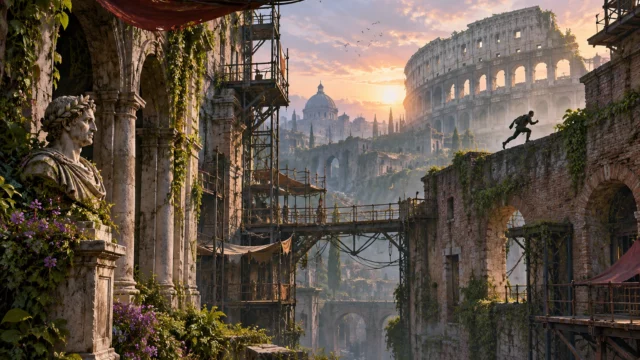
Boars in Rome parkour is built around a simple but appealing idea: reaching the finish line should depend on how creatively you move, not on following a single prescribed route. Team Boars is developing a first-person PC adventure where the remains of Rome become a playground of walls, rooftops and unexpected shortcuts. Better still, players can request access to its Steam playtest before a release date has even been announced.
Boars in Rome parkour makes momentum your biggest advantage
Rather than treating movement as a way to travel between objectives, Boars in Rome makes traversal the main attraction. Running, jumping, sliding, wallrunning, vaulting and swinging from lampposts can be combined to navigate environments at different speeds.
However, the interesting detail is how momentum connects those actions. A well-timed jump can feed into a longer slide, while maintaining speed can help extend a swing or wallrun. Consequently, learning how movements interact may become just as important as learning the layout of a level.
The developer has described its inspiration as a meeting point between Mirror’s Edge and Counter-Strike surf maps. That combination suggests two complementary ideas: expressive first-person parkour and the satisfaction of preserving speed through carefully chosen trajectories.
Unlike an adventure that relies entirely on scripted climbing sequences, this design encourages experimentation. A route that looks awkward on an initial attempt could become a satisfying shortcut once a player understands the movement system.
Why Boars in Rome parkour could reward replaying linear levels
Boars in Rome is not presented as a conventional open-world game. Its levels have destinations, but the journey between starting point and finish is deliberately flexible. Players can approach obstacles in different ways instead of following one fixed path.
That distinction matters. Linear level design can provide a clear objective without removing freedom, especially when movement itself offers several possible solutions. One player might prioritize reaching the exit quickly. Another might experiment with longer chains of jumps, swings and wallruns.
As a result, replayability could come from improving a route rather than unlocking another area. Finding a cleaner landing or carrying more speed through a difficult section may offer its own sense of progression. Whether that remains satisfying across the full adventure will depend on the finished level design.
There is an interesting contrast with other games using movement as a major attraction. For example, Snow Panic’s multiplayer ski racing places speed within a competitive winter-sports setting. Team Boars instead focuses on solo traversal through an atmospheric, abandoned city.
An abandoned Rome gives every shortcut a different backdrop
The game’s setting also has a purpose beyond looking unusual. Its story begins after humanity has abandoned Earth, with the protagonist having been selected for a new life beyond the planet. Following a period frozen in time, they awaken to discover a world where automated machinery continues operating while vegetation gradually takes over.
Rome provides the setting for that mystery. Classical monuments stand beside enormous futuristic structures, while ruined districts and preserved historical spaces create contrasting environments. Brutalist architecture adds another layer to a city that no longer belongs entirely to its former inhabitants.
This is a different use of Rome from the historical adventures players might normally associate with the location. While rumors about an Assassin’s Creed game set in ancient Rome explore the possibility of revisiting the city’s past, Boars in Rome imagines what might remain after humanity has moved on.
The atmosphere also complements its movement mechanics. A monument can serve as a visual landmark, while surrounding structures provide potential paths forward. In that sense, architecture is both scenery and part of the challenge.
Rock Paper Shotgun has also highlighted the game’s distinctive visual influences, drawing comparisons with VHOLUME, Dishonored and Half-Life 2. Those references help illustrate its atmosphere, although Team Boars is pursuing its own setting and movement-focused identity.
How to join the Boars in Rome Steam playtest
Boars in Rome is being developed and self-published by Team Boars for PC. Its Steam page is already available, although the studio has not announced a release date.
Interested players can visit the official Boars in Rome Steam page and request access to the playtest. The developer has previously offered immediate access, although Steam currently displays an access-request option, so availability should be checked directly. The game can also be added to a wishlist.
For players who enjoy mastering movement systems, the playtest offers an opportunity to examine how the mechanics work together before launch. It is also a chance to provide feedback while development continues.
Ultimately, Boars in Rome parkour has an appealing challenge ahead: making the journey through each level more memorable than reaching its destination. If Team Boars can turn creative movement into lasting replay value, this ruined version of Rome could become a particularly interesting place to get lost on purpose.

Creator of the website, Pokemon trainer by nature. Trying to report on everything related to the world of video games, series and movies. Yu-Gi-Oh is my weakness, collecting cards since the dawn of time.


