



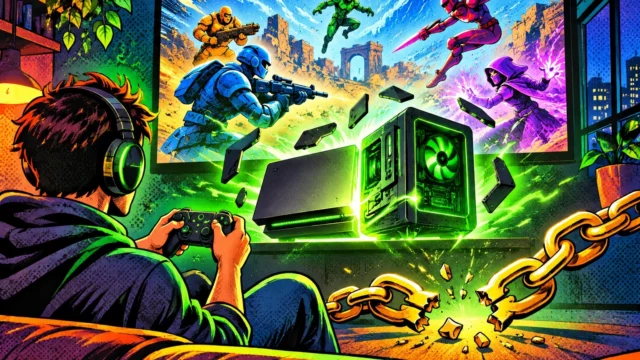
What if the biggest question surrounding Microsoft’s next Xbox isn’t how powerful it will be, but whether players will still have to pay to play online? A new report has raised doubts about Xbox Helix multiplayer and a proposed change that could have challenged one of console gaming’s longest-running subscription practices.
According to journalist Jez Corden at Windows Central’s November 23 report, Microsoft’s original plans included removing paid online multiplayer entirely. However, changes in Xbox leadership and rising hardware costs may make that approach difficult to preserve. Microsoft has not confirmed any change to multiplayer subscriptions for Helix.
Why Xbox Helix multiplayer could become a costly decision
For more than two decades, paid online access has been part of Xbox’s console business. Xbox Live helped popularize the model in 2002, before PlayStation and Nintendo introduced comparable requirements years later. Today, online console multiplayer remains among the benefits offered through Xbox Game Pass.
Removing that requirement would therefore involve more than adjusting a subscription. It would change how Microsoft earns money from console owners. Corden estimates that paid multiplayer generates hundreds of millions of dollars annually, potentially billions. Those figures are his estimates, not confirmed financial disclosures from Microsoft.
Furthermore, this revenue question affects the value of a console subscription. As Battle4Play previously covered in its earlier Project Helix report on console and PC gaming, Microsoft’s next-generation hardware is already associated with the idea of bringing different gaming environments together. Whether that flexibility extends to free online multiplayer remains unknown.
The original Xbox Helix multiplayer plan followed PC rules
The reported proposal becomes easier to understand when looking at Helix’s earlier identity. Sources familiar with Microsoft’s plans told Corden that the project began under Phil Spencer and Sarah Bond as a console-PC hybrid. It reportedly used another codename until summer 2026.
Rather than functioning exclusively as a conventional console, the original concept resembled a gaming PC capable of running Xbox console titles. Players would encounter a full-screen, controller-focused interface similar to those used by Xbox Ally handhelds. However, they could also leave that interface, access the Windows desktop and install other applications or storefronts, including Steam.
That flexibility created a practical problem for paid online access. According to Corden, Microsoft had already accounted for removing the multiplayer paywall from the project’s financial planning. An open PC-style environment would be difficult to reconcile with a console-specific charge for online gaming.
Consequently, free multiplayer was reportedly part of the original hardware philosophy, rather than an isolated promotional benefit. The trade-off was a more expensive device, with profitability depending primarily on its purchase price, much like a PC or laptop.
A console-first strategy may change the financial equation
Those early plans were reportedly prepared before AI-driven demand for memory pushed RAM prices sharply higher. This matters because hardware costs were already central to the proposed business model. A more expensive machine becomes harder to position when subscription revenue is also removed.
Meanwhile, Xbox now operates under leadership headed by Asha Sharma, with Matt Booty overseeing games. According to Windows Central, the language surrounding Helix has shifted toward a more traditional console, emphasizing a console-first interface while retaining the ability to play PC games.
That distinction could be significant. A console that also supports PC games does not necessarily follow the same commercial model as a fully open gaming PC. Nevertheless, the revised messaging does not establish which storefronts, applications or multiplayer payment rules will ultimately be supported.
Corden also points to pressure from Microsoft CEO Satya Nadella for Xbox to remain profitable. Combined with higher component costs, this makes abandoning an established revenue stream harder to imagine. However, that is the journalist’s assessment, not confirmation that Microsoft has rejected the earlier proposal.
Steam access raises another question for Xbox’s future
Online subscriptions are only one part of the reported tension. Corden also refers to internal Microsoft analyses suggesting that many Xbox Ally users choose Steam by default when that storefront is available.
For players, access to different PC stores would offer greater freedom. For Microsoft, however, it could make attracting users to its own ecosystem more challenging. This creates a dilemma: an open device may be appealing precisely because customers are not required to remain inside Xbox’s services.
Recent strategic decisions provide another point of contrast. Xbox has returned to timed exclusivity for certain games, including Forza Horizon 6. That approach places renewed emphasis on reasons to choose Xbox, even as Helix is described as retaining PC gaming capabilities. Meanwhile, Battle4Play has also covered Forza Horizon 6 and its reported rewards and permanent cars, another topic connected to the franchise’s future.
Still, none of these developments proves that Steam support or free multiplayer has been cancelled. The important distinction is between reported internal considerations and features Microsoft has actually committed to delivering.
For now, Xbox Helix multiplayer remains an unanswered question. Microsoft has not commented on Windows Central’s report, and there is no official release date, price or subscription model for the next-generation device. Whether Helix ultimately prioritizes PC-style freedom or a more familiar console business model could determine how different it feels from previous Xbox hardware.

A Fortnite player since the very first storm: I jump off the Battle Bus with a plan (that rarely survives the landing), build faster than I think and never miss a live event on the island. Here I bring you every new season, collab and secret before the storm closes in.