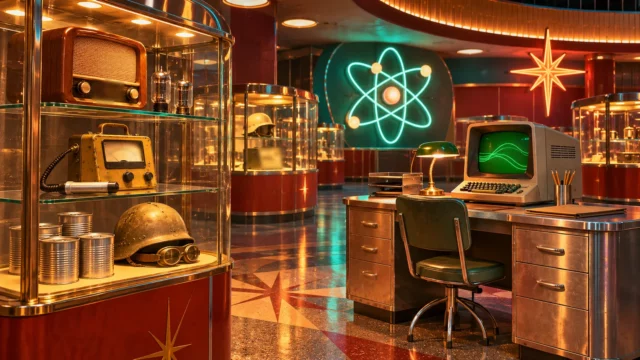
Fallout has always made the end of the world strangely fascinating. Now, one Las Vegas museum lets visitors explore that fascination beyond a screen. The World of Fallout exhibit has doubled in size, bringing new interactive experiences, television costumes and cleverly concealed references.
The expansion opened over the weekend of November 14–15, 2026, at the National Atomic Testing Museum. Two additional galleries now connect Bethesda’s fictional wasteland with genuine artifacts from America’s nuclear past. However, some of its most interesting details are easy to overlook.
World of Fallout now offers more reasons to explore every corner
Originally opened in November 2025, World of Fallout has grown considerably just one year later. Rather than simply displaying recognizable props, its new spaces encourage visitors to investigate their surroundings.
According to Xbox Wire’s official coverage of the expansion, several additions recreate familiar experiences from Bethesda’s RPGs.
The most notable new attractions and discoveries include:
- Two new galleries: Additional exhibition spaces featuring recreated objects, historical materials and television memorabilia.
- Overseer’s Desk: Interactive terminals with hacking challenges and unusual stories from the Nevada Test Site.
- Fallout Finds: A museum-wide scavenger hunt involving hidden themed objects and scannable QR codes.
- New Vegas landmarks: Neon replicas of the New Vegas sign and the Lucky 38 casino sign.
- Mister Handy: A full-size fan-built robot whose eyes react when visitors approach too closely.
- Season 2 costumes: Actual on-camera outfits from Prime Video’s Fallout adaptation.
- Hidden collectibles: Historical artifacts and supply caches concealed inside drawers and cabinets.
- Secret references: Photographs, music memorabilia and a familiar name from Fallout 3.
These additions give the exhibition a playful quality. Instead of walking past every display, visitors have reasons to inspect cabinets, study photographs and try the terminals.
The new interactive exhibits reward curiosity like a Fallout game
Exploration has always been central to Fallout. Players search abandoned buildings, investigate terminals and discover stories through objects left behind. The expanded museum translates that familiar approach into a physical setting.
At the Overseer’s Desk, visitors can attempt to hack terminals. Successful attempts reveal unusual real-life anecdotes connected to the Nevada Test Site. Xbox even suggests failing on purpose to see the warning that appears.
Meanwhile, Fallout Finds extends the experience beyond the dedicated galleries. Participants search for themed items throughout the museum and scan their QR codes.
Another highlight is the life-size Mister Handy created by fan fabricator Dragonfoot3D. The same creator also produced Deathclaw and terminal replicas for the exhibition.
Unlike interactive displays, this robot must remain untouched. Its threatening eye reactions provide a memorable reminder when someone gets too close.
World of Fallout connects New Vegas nostalgia with real nuclear history
Las Vegas is a particularly appropriate setting for this exhibition. Fallout’s fictional universe draws heavily from Atomic Age optimism, Cold War anxiety and midcentury American culture.
That relationship becomes clearer when authentic historical objects appear beside their fictional counterparts. Vintage posters and pulp books demonstrate how closely Fallout’s exaggerated visual language resembles genuine period material.
Furthermore, World of Fallout celebrates the franchise’s connection to Nevada through recognizable landmarks.
Replicas of the New Vegas and Lucky 38 casino signs feature classic Las Vegas neon. Students and staff from the University of Nevada, Las Vegas helped create them through its Entertainment Engineering and Design program.
These details make the setting more meaningful than a conventional collection of gaming memorabilia. Visitors can compare the historical influences behind Fallout with the imaginative world those influences helped create.
The exhibition also arrives during continued interest in Bethesda’s universe. That broader appeal is reflected in Fallout 76’s growth beyond 25 million players, alongside the franchise’s expansion into television.
Several hidden Easter eggs connect Bethesda, Fallout 3 and the television series
Some of the smallest objects in World of Fallout carry its most interesting stories. They connect real historical figures, Bethesda’s developers and details from different corners of the franchise.
One photograph bears the autograph of Edward Teller, widely known as the father of the hydrogen bomb. It was given to Troy Wade, one of the museum’s founders.
Elsewhere, a discreet photograph features Bethesda staff members who helped make the exhibition possible.
A more unusual connection involves singer Perry Como. His sheet music appears beside a vial that once contained radium paint manufactured in Canonsburg, Pennsylvania.
Como was born in Canonsburg, which also housed nuclear material processing facilities during the 1940s and 1950s. His songs feature in the Prime Video series, including its Season 1 opening and Season 2 finale.
Finally, observant Fallout 3 fans may recognize GARY spelled out using blocks. This references Vault 108 and its infamous cloning experiment involving multiple hostile inhabitants named Gary.
None of these discoveries requires a new game release. Instead, they reward familiarity with Fallout’s history, humor and storytelling traditions.
The expanded World of Fallout is open now at the National Atomic Testing Museum in Las Vegas. Its greatest attraction may be the opportunity to explore familiar fiction through genuine history.

A Fortnite player since the very first storm: I jump off the Battle Bus with a plan (that rarely survives the landing), build faster than I think and never miss a live event on the island. Here I bring you every new season, collab and secret before the storm closes in.