For fans of old-school role-playing games, 2027 is shaping up to offer another journey worth watching. Threads of Time Switch versions are now confirmed for both Nintendo Switch 2 and the original Switch, giving players two more ways to experience Riyo Games’ time-spanning adventure.
However, its arrival on Nintendo hardware is only part of the story. Behind the nostalgic artwork lies an ambitious RPG built around changing eras, coordinated attacks and a mysterious threat to history itself. The real question is whether those ideas can give the game an identity beyond its obvious classic inspirations.
Why the Threads of Time Switch announcement matters
During the Nintendo Indie World showcase on October 28, 2026, a new trailer confirmed that Threads of Time will launch on Nintendo Switch 2 and Nintendo Switch in summer 2027. Xbox Series X|S and PC players will also receive the game during that release window, with Steam listed as its PC storefront.
This is a meaningful expansion of the original announcement. Riyo Games first introduced Threads of Time in September 2024, around Tokyo Game Show, when Xbox Series X|S and PC were its confirmed destinations. Nintendo players were not part of that initial platform lineup. Now, both generations of Switch hardware are included.
That decision could be particularly welcome for fans who associate portable gaming with lengthy, story-driven RPGs. Having the option to play a turn-based adventure away from a television is appealing in its own right. Furthermore, support for the original Switch means the announced Nintendo release is not limited to owners of newer hardware.
There are still important unanswered questions. Neither an exact launch date nor a price has been revealed. Likewise, no PlayStation 5 version has been announced. Players should also wait for technical details before drawing conclusions about performance or visual differences between the two Nintendo systems.
A time-travel RPG with more to prove than nostalgia
It is easy to understand why Threads of Time attracts comparisons with Chrono Trigger. Both games use time travel as a central idea, while their colorful characters and traditional RPG foundations evoke a familiar era of Japanese-inspired adventures. Nevertheless, Threads of Time is an independent project, not an official sequel or continuation of Square’s classic.
Its premise sends a party of heroes across radically different periods. One destination takes players into a prehistoric world inhabited by dinosaurs. Another explores a distant future dominated by machines. Alternate realms add further variety, suggesting that the adventure will not be restricted to a straightforward journey through Earth’s history.
At the center of the narrative is the ancient Order of the Time Knights. The heroes must work to restore this organization while confronting a conspiracy capable of tearing apart the timeline. Because party members originate from different eras, their contrasting backgrounds could become one of the story’s most interesting ingredients.
For Battle4Play, the more intriguing possibility is how these different periods might influence the adventure itself. Time travel can offer more than a change of scenery: it creates opportunities for contrasting cultures, unexpected character relationships and consequences that connect distant historical moments. How extensively Threads of Time explores those possibilities remains to be seen.
Team combos and Unreal Engine 5 could define its identity
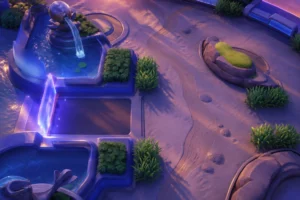
Although its visual direction celebrates traditional pixel art, Threads of Time uses Unreal Engine 5 to build a 2.5D world. Hand-crafted 2D characters appear within environments designed to create a greater sense of depth, while anime-style cutscenes provide another way to present dramatic story moments.
This combination is important because the game does not have to choose between a nostalgic appearance and contemporary presentation. Instead, it can preserve expressive sprite-based characters while using modern technology to give its locations a distinct atmosphere. The prehistoric landscapes, futuristic machinery and alternate dimensions should offer very different visual opportunities.
Combat could be equally important. Battles follow a turn-based structure, but players will also have access to team combo attacks and time-manipulation abilities designed to break enemy defenses. Consequently, victory may depend on how effectively party members coordinate their actions rather than simply choosing the strongest individual attack.
The time-based mechanics are especially promising because they connect the combat system to the game’s central theme. However, the full extent of these abilities has not been detailed. It would be premature to assume that players can rewind entire encounters or freely alter turn order without further confirmation.
Meanwhile, Threads of Time joins a growing selection of indie adventures scheduled for 2027. Another project worth following is Witchbrook, which has confirmed its January 2027 release. Although its magical life-simulation approach is very different, both titles demonstrate how distinctive art direction can help smaller productions attract attention across several platforms.
Developed by Riyo Games and published by Balor Games, Threads of Time currently targets summer 2027 on Nintendo Switch 2, Nintendo Switch, Xbox Series X|S and PC. Further information can be found on the official Threads of Time Steam page.
Ultimately, the Threads of Time Switch announcement makes this retro-inspired RPG accessible to a broader Nintendo audience. Yet its lasting appeal will depend on something more ambitious: whether its time-travel story and tactical battles can create memorable moments of their own. Could this become one of 2027’s standout turn-based adventures?

Creator of the website, Pokemon trainer by nature. Trying to report on everything related to the world of video games, series and movies. Yu-Gi-Oh is my weakness, collecting cards since the dawn of time.