



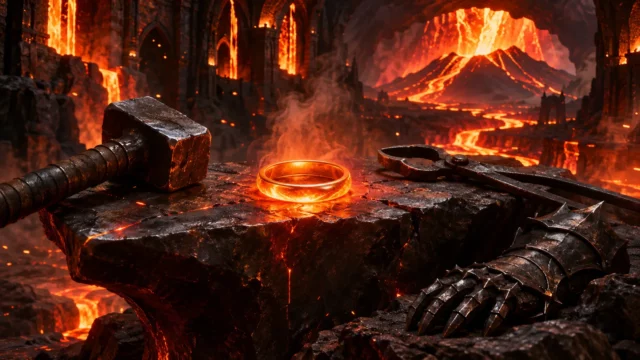
For Sauron, creating the One Ring is the moment that changes everything. For the people making The Rings of Power Season 3, bringing that moment to television has been an extraordinary challenge. What audiences will see in Mount Doom began as four pages of writing and developed into a sequence that required three years of preparation.
The result is a major centerpiece of the new season, with Charlie Vickers portraying Sauron as he forges Tolkien’s most infamous artifact. However, the scale of the production is only part of the story. Every costume change, injury and flash of magic had to serve a moment that viewers already know will have enormous consequences for the story.
The Rings of Power Season 3 arrives with four episodes on November 11
Prime Video will release four episodes of The Lord of the Rings: The Rings of Power Season 3 on November 11, 2026. The premiere arrives with an important advantage for the series: a fourth season had already been confirmed when the streaming service announced the date.
Meanwhile, promotional trailers have offered glimpses of Sauron forging the One Ring in the fires of Mount Doom. Although the artifact’s importance is familiar to Tolkien fans, the television adaptation now has to show how its creation becomes a defining moment in Sauron’s journey.
Here are the confirmed details ahead of the premiere:
- Release date: November 11, 2026.
- Streaming platform: Prime Video.
- Premiere episodes: Four episodes will be available together.
- Major story event: Sauron forges the One Ring inside Mount Doom.
- Star of the sequence: Charlie Vickers as Sauron.
- Future of the series: Prime Video has already renewed the show for Season 4.
- Production milestone: The One Ring sequence required approximately three years of development and preparation.
The Rings of Power turned the One Ring’s forging into a three-year production challenge
The most revealing detail about the One Ring sequence is not its visual scale. It is how early the creative team began planning it.
In Fay Watson’s exclusive interview with GamesRadar+, co-creator and co-showrunner Patrick McKay explains that the sequence effectively took three years to make. McKay, who leads the series alongside JD Payne, describes a process that began with approximately four pages of prose detailing Sauron’s experience.
Those pages provided a foundation rather than a finished visual blueprint. Department heads subsequently developed ideas for costumes, accumulating injuries and the magical elements involved. Consequently, the sequence became a coordinated effort across multiple creative disciplines.
The production details reveal how that work developed:
- Script: The original description covered roughly four pages of prose explaining what Sauron experiences during the forging.
- Costumes: Multiple garments were developed to deteriorate progressively throughout the sequence.
- Physical injuries: The creative departments planned how visible damage would accumulate as events unfolded.
- Magic: Department heads also decided what kind of magic would be shown on screen.
- Performance: Charlie Vickers’ portrayal became a central element of the finished sequence.
- Ring design: Prop masters John Hajdukiewicz and Tina Jones refined the artifact’s physical proportions while preserving its recognizable appearance.
- Editing and post-production: The final stage lasted 52 weeks and was completed only days before the November 8 interview was published.
McKay describes Vickers’ performance as “amazing” and “captivating.” He also calls the forging the most complex sequence the show has ever done, adding that it is something audiences have never seen before.
That distinction matters because the sequence cannot rely on spectacle alone. Viewers already understand the One Ring’s significance. The creative challenge is to make its creation feel like a physical and emotional ordeal rather than simply the manufacture of a powerful object.
The One Ring was made slightly bigger so it would not look insignificant next to the gauntlet
One of the production’s most interesting decisions involved an object that could barely be changed. The One Ring already has an unmistakable screen identity thanks to Peter Jackson’s films, leaving the prop department with limited room for experimentation.
Prop masters John Hajdukiewicz and Tina Jones approached the design with that recognition in mind. Jones explains that they could not change the design because it had to be instantly recognizable to anyone who had seen those movies.
Nevertheless, preserving its identity did not mean reproducing every dimension exactly. Hajdukiewicz reveals that the production made the ring slightly larger and more rounded. At the original dimensions, it looked insignificant next to the gauntlet.
The adjustment was intended to give the object a greater sense of weight. That is a small change with a clear visual purpose: the ring must remain familiar while appearing substantial enough to match the imposing figure holding it.
It also illustrates the unusual balance facing this adaptation. The design must honor an established cinematic image, yet it has to function convincingly within a different production’s costumes, framing and physical proportions.
Prime Video has a major fantasy premiere before its next wave of series
The November 11 launch places The Rings of Power at the beginning of a busy period for Prime Video’s scripted programming. While Sauron’s story continues, other productions are preparing to reach audiences over the following two months.
For example, Maxton Hall returns for its third and final season in December, bringing Ruby and James’ story toward its conclusion. Its focus is entirely different, but both shows give the platform recognizable returning characters during the closing weeks of 2026.
Looking further ahead, Criminal will debut on Prime Video in January 2027, as one of the platform’s biggest series for the start of the year.
For Tolkien fans, however, the immediate attraction is much more specific. Season 3 will finally depict an event whose consequences extend far beyond the character performing it. The One Ring is not simply another magical artifact in Middle-earth. Its creation is fundamental to understanding Sauron’s ambitions and the danger associated with his power.
That is why the production’s emphasis on costume deterioration, accumulating injuries and physical weight is particularly interesting. These details suggest an effort to communicate the cost and intensity of the forging through what audiences can actually see.
The Rings of Power Season 3 therefore faces a distinctive test when its first four episodes arrive on November 11. The story’s destination is familiar, but its interpretation remains the show’s own. After three years of preparation and 52 weeks of post-production, the question is whether Sauron’s most important creation can feel as momentous on screen as it does within Tolkien’s mythology.

Creator of the website, Pokemon trainer by nature. Trying to report on everything related to the world of video games, series and movies. Yu-Gi-Oh is my weakness, collecting cards since the dawn of time.

