



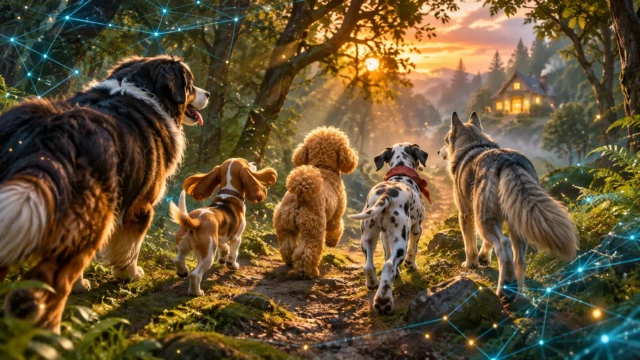
Can a family movie use artificial intelligence without making its technology the main attraction? Storm Dogs, a new talking-dog adventure directed by The Lion King co-director Rob Minkoff, could provide an interesting test. Its creators want audiences to enjoy a story about a lost child and a group of unlikely animal heroes, even though much of what appears on screen will be generated using AI.
The project also comes with considerable baggage. Producer Eline van der Velden is responsible for Tilly Norwood, the controversial AI-generated “actress” that attracted backlash earlier this year. However, Storm Dogs is taking a different approach, combining generated characters with human performances. Whether that distinction will satisfy skeptical viewers remains an open question.
Storm Dogs puts a lost toddler and talking animals at the center of its story
The premise is deliberately straightforward. A toddler becomes lost in the woods, and a mismatched group of dogs sets out to help the child find a way home. Rather than building a complicated science-fiction story around artificial intelligence, the filmmakers are using the technology to tell a familiar kind of family adventure.
According to The Hollywood Reporter’s November 10 exclusive, Particle 6, the production company founded by Dutch-born, London-based producer Eline van der Velden, is developing the hybrid live-action and animated feature with Minkoff directing.
Minkoff brings considerable experience with family entertainment. Alongside co-directing Disney’s The Lion King, he directed the first two Stuart Little movies and the 2014 animated feature Mr. Peabody & Sherman. His involvement is especially relevant because those films required audiences to connect emotionally with animal characters, whether animated or digitally created.
Key facts outline a hybrid production with human voices
Here are the key confirmed details about Storm Dogs:
- Story: A group of talking dogs helps a toddler who has become lost in the woods return home.
- Format: A family film combining live-action footage with animated and AI-generated imagery.
- Director: Rob Minkoff, co-director of The Lion King and director of the first two Stuart Little films.
- Production company: Particle 6, founded by Eline van der Velden.
- AI-generated characters: The toddler and multiple dog breeds will be created using generative technology.
- Human involvement: Voice actors will perform the characters, while adult performers will appear in selected live-action scenes.
- Production tools: A custom tool assembled from existing AI models, alongside Blender for 3D animation.
- Current progress: A two-and-a-half-minute proof of concept has been prepared for selected public events and industry presentations.
- Financing: A private donor backing Particle 6 is funding the project.
- Distribution: The filmmakers intend to approach studios later. No distributor has been announced.
- Production timeline: Minkoff estimates that completing the movie will take approximately one year.
Importantly, that production estimate is not a confirmed release date. Likewise, the filmmakers have not announced a voice cast or a production budget.
Storm Dogs will test whether AI can keep animal characters believable
The biggest technical challenge may not be making a dog talk. It could be making audiences believe they are watching the same dog throughout an entire movie.
Van der Velden argues that talking animals have remained difficult to portray convincingly, even with traditional animation and computer-generated imagery. She also points to the practical complications of filming real dogs alongside very young children. In her view, Storm Dogs offers a situation where artificial intelligence addresses specific production problems rather than being introduced simply because it is available.
Minkoff shares that reasoning. Having worked on productions involving children and animals, he understands the logistical demands. He also sees an advantage in avoiding the need to put animals through a film shoot.
However, the director acknowledges a significant limitation. Maintaining visual consistency between shots, particularly during close-ups, could prove difficult. If a dog’s appearance changes subtly between scenes, viewers may notice the technology instead of concentrating on the story.
That distinction matters in a family adventure. Characters need recognizable faces, expressions and personalities. Furthermore, emotional scenes depend on continuity. A convincing individual image is useful, but a feature-length film requires those images to work together as performances.
The production’s combination of AI generation, Blender and human voice acting suggests that traditional filmmaking skills will still play an important role. Human performers will supply voices, while selected live-action scenes will feature adult actors. Consequently, describing the project as entirely AI-made would misrepresent its stated approach.
The filmmakers see an opportunity for cheaper independent animation
Beyond its unusual characters, Storm Dogs represents a possible experiment in how smaller production companies finance family entertainment. Its backers believe generative tools could reduce expenses enough to make independent animated features more achievable.
That argument is worth examining carefully. Lower production costs could, in principle, allow filmmakers to develop projects that might otherwise struggle to attract financing. However, the actual savings on Storm Dogs cannot yet be evaluated because no budget or detailed cost comparison has been disclosed.
There is also a difference between generating footage efficiently and delivering a finished film. Story development, directing, editing, sound, voice performances and visual consistency remain essential. If generated material requires extensive corrections, some of the anticipated efficiency gains could become harder to achieve.
Storm Dogs leaves several open questions about its approach
The creators’ arguments and the questions their approach raises can be summarized as follows:
- More convincing talking animals: The filmmakers believe AI could overcome limitations they associate with previous techniques. Will the characters remain convincing across a complete feature?
- Fewer filming complications: Generating dogs and a toddler could avoid difficult shoots involving animals and young children. How effectively will generated performances convey emotion?
- Potentially lower costs: Supporters see an opportunity for independently financed family animation. Will those savings remain substantial after editing and visual corrections?
- Human creative participation: Voice actors, adult performers and filmmakers remain involved. How will audiences evaluate the balance between generated imagery and human work?
- Technology that stays unnoticed: Minkoff wants viewers to focus on the movie rather than its production methods. Can AI-generated characters maintain that illusion?
- Audience skepticism: Van der Velden recognizes the concerns surrounding generative filmmaking. Will viewers judge this project differently from previous AI controversies?
Minkoff has compared the current moment to the early development of computer animation, when new techniques were still finding their place in filmmaking. His preference is for audiences not to notice how Storm Dogs was produced.
That comparison offers an interesting perspective, although it does not establish that generative AI will follow the same path as earlier animation technologies. Its creative, economic and ethical questions remain distinct.
Tilly Norwood’s controversy makes this more than a technical experiment
Storm Dogs cannot be separated entirely from its producer’s previous work. Van der Velden created Tilly Norwood, an AI-generated performer whose September press tour prompted substantial controversy and backlash.
She is also producing Misaligned, a science-fiction feature involving that character. Nevertheless, Minkoff has explicitly distanced himself from Tilly Norwood. He says he is neither involved with nor endorses that project, making his participation in Storm Dogs a separate professional decision.
The distinction is important because these productions raise different questions. A synthetic actress invites debate about the representation and potential replacement of human performers. A film centered on generated dogs and a toddler introduces another set of considerations, particularly when real actors provide voices and appear in live-action sequences.
Still, broader concerns about AI filmmaking are unlikely to disappear. Battle4Play recently covered the controversy surrounding the heavily AI-generated Return of the Living Dead sequel, where performers criticized the finished production and the differences between the movie and their original expectations.
That situation is not directly equivalent to Storm Dogs, and there is no basis for assuming similar disputes will occur. However, it demonstrates why creative involvement, production transparency and expectations can become important parts of the conversation.
Other entertainment companies have chosen a contrasting direction. In gaming, Jackbox Games has emphasized human creativity over generative AI for its writing, comedy and artwork. Its position illustrates how studios can draw different boundaries around the technology depending on the work they produce.
Van der Velden says she understands the skepticism surrounding AI. For Storm Dogs, however, the strongest response to those concerns may ultimately be the finished movie rather than another argument about technological potential.
The next milestone will show whether the concept can become a feature
For now, Storm Dogs remains a developing production rather than a movie with a confirmed theatrical release. Its two-and-a-half-minute proof of concept is intended for selected public presentations and potential industry partners. Studio distribution will be pursued later.
That short demonstration may help communicate the visual approach, but it cannot settle every question about a full-length film. Maintaining character continuity, sustaining emotional performances and delivering a coherent story will require considerably more than a successful collection of individual scenes.
The most revealing aspect of Storm Dogs is therefore not simply that Rob Minkoff is directing an AI-assisted family film. It is the attempt to make artificial intelligence serve a recognizable storytelling goal while keeping human performers involved.
If the project succeeds creatively, it could offer a practical example of how generative tools might support smaller family productions. If its visual limitations become distracting, the movie may instead demonstrate why traditional animation techniques remain valuable. Either way, its eventual reception will depend on what audiences see on screen, not just the technology used to create it.

Creator of the website, Pokemon trainer by nature. Trying to report on everything related to the world of video games, series and movies. Yu-Gi-Oh is my weakness, collecting cards since the dawn of time.


