



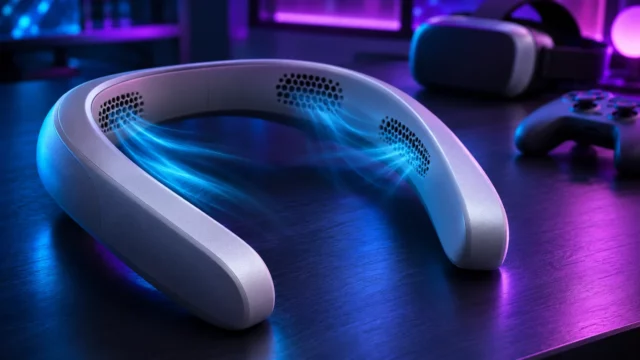
Feeling an enemy approaching from behind could become part of the gaming experience without relying on visual or audio clues. The Sony neckband patent explores this possibility through a wearable device that directs airflow at the neck, face or head.
Rather than simply recreating wind, the accessory would adapt its airflow to events unfolding inside virtual environments. Direction, intensity and frequency could communicate information about surroundings, movement and potential threats.
The Sony neckband patent turns airflow into a gameplay cue
The most interesting aspect of this invention is how airflow could provide information about events outside the player’s view. Tense adventure games could benefit from this extra layer of sensory feedback.
The patent application published by the US Patent and Trademark Office describes an escape game. In it, a character tries to flee from a house.
These examples illustrate how directional airflow could complement traditional gameplay mechanics:
- Opening doors: Air blows from the front, recreating wind entering from an adjoining room when a door opens.
- Enemies moving in darkness: Airflow shifts from the front to the right side and then the back.
- Threats approaching from behind: Air pulses become stronger and more frequent as an enemy gets closer.
- Movement and vehicles: Airflow grows with speed when characters walk, run or travel by car or roller coaster.
Consequently, airflow could serve a purpose beyond environmental realism. Players might recognize the direction of nearby threats without needing to see them directly.
The Sony neckband patent describes eight independently positioned air blowers
Sony Interactive Entertainment envisions a curved housing that rests around the user’s neck. Several openings along its inner surface allow air to reach the neck, face or head.
The main configuration features eight air blowers distributed at similar intervals around the neckband. Their placement covers the front, sides and back, enabling airflow to originate from different directions.
Furthermore, these components can incorporate a piezoelectric element that vibrates a diaphragm at ultrasonic frequencies. This mechanism allows high-speed airflow and immediate responses to changes within a gaming scene.
An external apparatus running the game sends control signals to the wearable device. Although wired connections are possible, Sony’s proposal favors wireless communication to avoid inconvenient cables.
The wearable device could work without a virtual reality headset
Although virtual reality features prominently in the application, its potential uses extend beyond fully immersive environments. Sony also considers VR goggles, augmented reality glasses and smart glasses.
Interestingly, the document covers gaming sessions without any headset. Players could experience the proposed airflow effects while viewing games on a television, computer or mobile device.
This matters because the Sony neckband patent would not tie physical feedback to virtual reality. Instead, developers could potentially introduce another sensory element into conventional gaming experiences.
However, the application does not confirm compatibility with any specific commercial gaming platform.
Sony has not confirmed plans to release the gaming accessory
Based in Tokyo, Sony Interactive Entertainment Inc. filed application US 2026/0357800 A1 on April 30, 2026.
Officially titled “Wearable device and method of controlling air blowing device”, it builds on a May 9, 2025 provisional application. Its publication followed on November 12, 2026.
The proposal represents another exploration of unconventional gaming technology. Separately, another Sony patent filing involves player identification through gameplay patterns.
Nevertheless, a patent application does not guarantee commercial development. Sony has not announced a gaming accessory featuring this technology.
For now, the Sony neckband patent introduces an intriguing possibility for video game immersion. Airflow could eventually become a way to experience virtual environments while also communicating important gameplay information.

A Fortnite player since the very first storm: I jump off the Battle Bus with a plan (that rarely survives the landing), build faster than I think and never miss a live event on the island. Here I bring you every new season, collab and secret before the storm closes in.

