



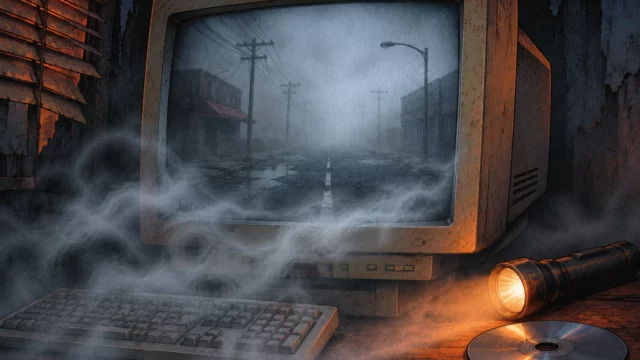
The Silent Hill PC port is now available for free, allowing players to run the original 1999 PlayStation game natively across Windows, Linux and Mac computers. Known as Silent Hill PC, this unofficial open-source engine introduces ray tracing, HDR and extensive mod support. However, players must supply their own disc image of the original game.
Announced on Reddit on November 24, 2026, the project was developed from scratch and released as open-source software (GPL version 3 or later). Rather than relying on emulation, its creator reconstructed the game’s behaviour using community decompilation work as a reference.
Silent Hill PC port expands the original graphics options
Players can choose between three rendering backends: Vulkan, OpenGL 3.3 and SDL3 GPU. Additionally, several graphics presets accommodate different visual preferences, from the original presentation to more advanced rendering techniques.
Using Vulkan unlocks ray tracing for shadows, bounce lighting and reflections on compatible graphics cards, alongside HDR, temporal anti-aliasing and volumetric fog. Experimental AI texture and model upscaling using Real-ESRGAN is also included.
Despite these additions, the engine retains the characteristic darkness, fog and flashlight of Silent Hill. Widescreen support, windowed mode and borderless fullscreen provide further display options.
Other improvements include near-instant loading, a configurable frame rate set to 60 FPS by default and customisable keyboard, mouse and controller inputs. Players can also restore the original loading pace. Furthermore, the interface supports 13 languages, including Spanish.
Silent Hill PC port includes dedicated modding tools
Beyond graphical upgrades, the project supports modifications through data files and sandboxed Lua scripts. Creators can replace textures, character models, audio, text and videos without restricting themselves to cosmetic changes.
In fact, the engine lets mod authors add fresh items, weapons, events and characters. Built-in tools range from a free-roaming camera and a map inspector to a Lua script editor, viewers for models and textures, and a developer console.
System requirements and current development limits
According to the official Silent Hill PC GitHub repository, the engine runs on Windows 10 and 11 (64-bit), on 64-bit Linux distributions with glibc version 2.39 onwards, and on macOS 13.3 or later. It also needs a graphics card that supports either Vulkan or OpenGL 3.3, although ray tracing is unavailable on macOS.
Only the American NTSC v1.1 release (SLUS-007.07) is supported. The initial import takes around 30 seconds to several minutes and requires approximately 2 GB of storage. AI upscaling can occupy an additional 2 GB.
Although all 43 maps already load, development remains ongoing. The goal is a near one-to-one recreation of the original, from its camera and controls to its puzzles, enemies, items and story. Linux is the primary development platform, while Windows builds undergo testing through Wine. Reports from native Windows installations are therefore welcome.
As Wccftech reports, this project is separate from SH1PC, another native port based on decompiled code. Silent Hill PC is a non-commercial fan initiative with no affiliation with Konami, which owns the franchise.
Among the latest fan projects featured in our PC news section, the Silent Hill PC port combines classic gameplay with optional modern features. Would you revisit the original adventure with enhanced graphics or preserve its PlayStation appearance?

A Fortnite player since the very first storm: I jump off the Battle Bus with a plan (that rarely survives the landing), build faster than I think and never miss a live event on the island. Here I bring you every new season, collab and secret before the storm closes in.


