



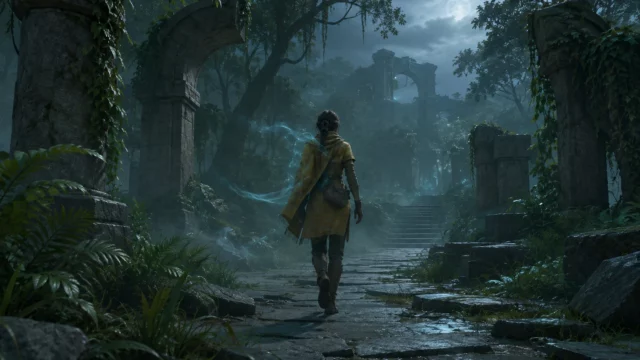
A game can disappear from a publisher’s future plans long before its financial consequences are fully settled. The Reflector Entertainment closure illustrates that uncomfortable reality. Bandai Namco has confirmed it will dissolve the Montreal developer behind Unknown 9: Awakening, with an estimated extraordinary loss of €21 million attached to the decision.
What makes this case particularly revealing is the gap between Reflector’s ambitions and its financial position. The studio was acquired to expand Bandai Namco’s development capabilities. Six years later, its parent company has concluded that continuing the business is no longer a sufficiently viable option.
Reflector Entertainment closure exposes a costly investment
On November 10, 2026, Bandai Namco Holdings announced that its board had approved ending Reflector Entertainment’s operations, followed by its dissolution and liquidation. This is a confirmed corporate decision, not a rumored restructuring or an unannounced project cancellation.
According to the official Bandai Namco Holdings announcement, the group reviewed Reflector’s future business plans, the additional funding required and its prospects for profitability. After considering those factors, management decided against maintaining the subsidiary.
The estimated €21 million loss, equivalent to approximately ¥3.5 billion, is expected to affect consolidated financial results for the third quarter, covering nine months of the fiscal year ending March 31, 2027, and potentially subsequent periods. However, the figure and accounting timetable remain provisional.
Why Unknown 9: Awakening could not secure Reflector’s future
Reflector Entertainment was established on December 29, 2015, and acquired by Bandai Namco in September 2020. Led by CEO Hervé Hoerdt, the Canadian developer was intended to contribute to the group’s console game development business. It eventually became wholly owned by Bandai Namco Entertainment Europe.
Its only released game, Unknown 9: Awakening, arrived on October 18, 2024, for PS5, Xbox Series X|S, PS4, Xbox One and PC. The third-person action-adventure received a largely disappointing critical response. Moreover, plans for Reflector to contribute to established Bandai Namco properties never materialized into another released project.
That distinction matters. A studio acquired to strengthen a publisher’s development network ultimately produced just one commercial release under its new owner. Meanwhile, its potential role supporting existing franchises did not develop into a visible second source of output.
For readers discovering the title following this announcement, its official Steam listing provides information about the PC version. However, Bandai Namco has not announced whether the dissolution will affect the game’s future availability on digital storefronts.
Reflector Entertainment closure: what the financial figures reveal
The studio’s published accounts offer a clearer explanation of the business pressures than its release history alone. Reflector recorded approximately CAD 47.8 million in net sales during the fiscal year ending March 2025, which included the launch of Unknown 9: Awakening.
However, that same period produced a net loss attributable to the parent company’s owners of approximately CAD 28.4 million. During the following fiscal year, ending March 2026, net sales dropped to around CAD 14.7 million, while the corresponding net loss narrowed to approximately CAD 2 million.
By March 31, 2026, Reflector reported negative net assets of approximately CAD 89.5 million. This balance-sheet position provides important context for the decision, although it should not be confused with the separate €21 million extraordinary loss expected from the dissolution.
There is another important limitation: net sales are not equivalent to copies sold or profits generated by Unknown 9. These are company-wide financial figures, so they cannot establish the game’s exact sales performance. Nevertheless, the substantial decline in revenue and deeply negative net assets help explain why further investment required careful scrutiny.
What happens to the studio and its only released game?
Bandai Namco has not provided a specific date for completing the liquidation. Instead, the process will conclude once the necessary procedures under applicable local law have been completed. Consequently, the November 10 announcement should not be mistaken for confirmation that every legal step has already finished.
Several questions also remain unanswered. The official document does not disclose Reflector’s workforce size or explain what will happen to individual employees. Likewise, it contains no decision about removing Unknown 9: Awakening from PlayStation, Xbox or PC stores.
The case also highlights a distinction between development models. Publishers can commission work from specialist teams without owning them, as illustrated by Bandai Namco Studios’ involvement in the Ocarina of Time remake. Reflector represented a different commitment: maintaining an acquired studio and funding its future projects.
For players, the immediate consequence is the confirmed end of Reflector’s business rather than an announced change to an existing game. For the wider industry, the decision illustrates how a publisher can reassess a development investment when expected future returns no longer justify additional spending.
Ultimately, the Reflector Entertainment closure is about more than one poorly received action-adventure. It shows how quickly an ambitious acquisition can become difficult to sustain when its development pipeline fails to establish a convincing financial future. The remaining question is what Bandai Namco will take from that experience when deciding which studios and projects deserve its next investment.

A Fortnite player since the very first storm: I jump off the Battle Bus with a plan (that rarely survives the landing), build faster than I think and never miss a live event on the island. Here I bring you every new season, collab and secret before the storm closes in.


