



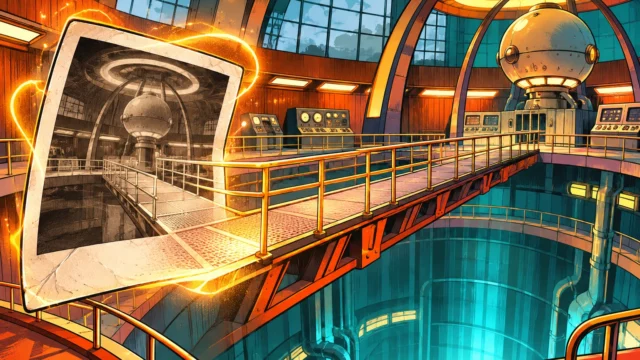
The most interesting thing about the Portal F-Stop prototype isn’t that an abandoned Valve project has resurfaced. It’s how much of the Portal universe was already taking shape inside a game that never reached stores. Long before players explored Aperture Science’s history in Portal 2, Valve had experimented with a very different way of bringing its laboratories to life.
Now, nearly two decades later, a reconstruction assembled from leaked development material offers a rare look at that alternative direction. However, F-Stop remains an unfinished, unofficial prototype, and Valve has not publicly commented on its reported reconstruction.
Aperture Science almost had a completely different identity
Most players associate Portal with sterile testing chambers, white surfaces and the unsettling presence of GLaDOS. F-Stop, however, imagined a different chapter of Aperture Science: a company at the height of its ambition, surrounded by polished offices, wooden interiors and cheerful mid-century design.
Its visual identity also stood apart from the finished Portal games. Valve borrowed the stylized, cel-shaded appearance of Team Fortress 2, creating a brighter environment that contrasted with the increasingly sinister reputation of Aperture Science.
This distinction matters because F-Stop was exploring the company’s personality, not merely another set of testing rooms. Its optimistic corporate setting offered an early foundation for the historical atmosphere that would later become important in Portal 2.
The reconstructed material reportedly includes an early Cave Johnson addressing the player, although without J.K. Simmons’ familiar performance. Personality cores also appear as puzzle companions, revealing another concept that existed before the series established its later identity.
The Portal F-Stop prototype replaced portals with photography
Despite its connection to Portal, F-Stop did not revolve around the portal gun. Instead, Valve designed its puzzles around a camera capable of capturing objects and placing them elsewhere in the environment.
The idea changed the relationship between players and puzzle spaces. Rather than connecting two locations through portals, players could photograph something useful and reposition it to overcome an obstacle.
That distinction is more important than it might initially sound. Portal challenges players to rethink movement and physical space. F-Stop approached environmental puzzles through object manipulation and creative placement, giving familiar rooms a different set of possibilities.
Interestingly, 2023’s Viewfinder later explored a related photographic puzzle concept in a commercially released game. The two projects should not be treated as identical, nor does their resemblance establish a direct development connection. Nevertheless, the comparison helps illustrate why Valve’s abandoned experiment still feels relevant.
F-Stop suggests that Valve was interested in expanding its puzzle vocabulary beyond portals. Even without a finished release, the camera mechanic shows how radically the studio was willing to reconsider its most recognizable ideas.
Why Valve abandoned an experiment it reportedly liked
F-Stop emerged during an unusual creative period following the success of The Orange Box in 2007. Gabe Newell effectively suspended normal development routines for three months while teams participated in an internal initiative known as the Directed Design Experiments.
Five prototypes emerged from that process, including F-Stop. The objective was to investigate new concepts rather than simply continue established franchises.
According to accounts of the project’s development, F-Stop attracted enthusiasm within Valve. However, external playtesting produced a less encouraging response, and the studio eventually shelved the concept.
That contrast highlights an important part of game development. An inventive mechanic does not automatically translate into a satisfying complete experience. A promising prototype must also communicate its rules clearly, support interesting challenges and remain enjoyable beyond its initial novelty.
In F-Stop’s case, cancellation did not mean every idea disappeared. Elements of its worldbuilding eventually surfaced in Portal 2 and Aperture Desk Job. In retrospect, the project looks less like a completely forgotten game and more like an early workshop for Aperture Science’s evolving identity.
What the reconstruction actually reveals about Valve’s history
As reported by PC Gamer on November 1, 2026, citing Kotaku, separate leaks have allowed enthusiasts to reconstruct F-Stop from surviving development material.
Most of its assets reportedly appeared during August’s enormous Steam data leak, commonly called the teraleak. More recently, the Valve Cut Content Team Discord group obtained the missing source code and map source files. The group subsequently became invite-only following increased attention.
Full playthrough recordings have also begun appearing on YouTube, providing a broader look at the prototype’s environments, characters and puzzles.
However, these recordings document an unfinished development project. They should not be confused with footage from a completed Valve product or evidence of an upcoming commercial launch. Similar uncertainty surrounds other gaming reports, including the Persona 1 remake leak and rumors about Bend Studio’s cooperative game.
For anyone interested in gaming history, the greater significance lies in seeing ideas before they became familiar. Cave Johnson, personality cores and Aperture’s retro-futuristic identity did not necessarily emerge fully formed during Portal 2’s production. F-Stop provides a glimpse of earlier creative experimentation.
There is also a wider lesson about preservation. Unreleased prototypes can help explain why celebrated games took their eventual form, although material obtained through unauthorized leaks raises separate questions about ownership and distribution.
Ultimately, the Portal F-Stop prototype is valuable as a window into Valve’s creative decisions, not as an unexpected new Portal release. Its camera puzzles may have been abandoned, but parts of its fictional world survived. Would Portal 2 have felt the same without those early experiments?

Creator of the website, Pokemon trainer by nature. Trying to report on everything related to the world of video games, series and movies. Yu-Gi-Oh is my weakness, collecting cards since the dawn of time.


