Hyrule’s biggest new shortcuts may have nothing to do with the paths Nintendo intended players to follow. Ocarina of Time remake glitches are already changing how speedrunners approach the Nintendo Switch 2 adventure, with discoveries that could eventually cut entire sections from a playthrough. Less than 72 hours after launch, players have found ways to launch Link into the sky, bypass story sequences and even confuse cutscenes designed for his younger self.
Released on November 5, 2026, the remake brings modern movement options, including sprinting, to a game that speedrunners have dissected since its Nintendo 64 debut in 1998. Yet its new physics are creating opportunities that nobody has fully mapped out. The result is a fascinating contrast: Nintendo has rebuilt a familiar adventure, while players are already discovering how to take it apart.
Why Ocarina of Time remake glitches could transform speedruns
The most promising discovery involves super jumps. On November 7, veteran Zelda speedrunner ZFG shared footage of Link being propelled unusually high into the air. Other players have since reproduced the movement in the same location and experimented with it elsewhere, suggesting that the trick is not limited to one isolated accident.
Height matters enormously in a game built around obstacles, locked routes and carefully arranged progression. If runners can launch Link above barriers and land safely, they may reach locations without completing the usual requirements. However, a spectacular jump is not automatically a useful shortcut. It must also be repeatable, save time and leave the adventure in a playable state.
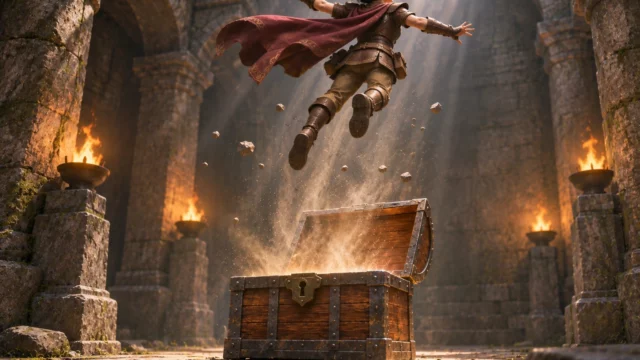
Japanese players have uncovered another potential source of vertical movement: treasure chests that behave like trampolines. Standing on certain chests and performing quick movements, or using a bomb, can send Link toward the ceiling. Meanwhile, a separate technique involving a precisely timed item switch during a Deku Stick jump attack allows him to reach ledges that should normally be inaccessible.
These discoveries suggest that the remake’s movement systems deserve attention beyond conventional combat and exploration. A chest, a jump attack or an ordinary piece of scenery can become a route-building tool when players combine actions in ways the adventure does not anticipate.
The Silver Gauntlets glitch exposes a strange problem with Link’s age
One of the most revealing experiments goes beyond movement. Using a super jump, ZFG managed to open the Silver Gauntlets chest as adult Link, even though that encounter is intended for child Link. The resulting cutscene attempts to place the adult character into a sequence built around his younger model, producing an unmistakably distorted appearance.
Shared in ZFG’s Silver Gauntlets glitch post on X, the footage illustrates an important distinction. The game can apparently be made to trigger a story event with the wrong version of its protagonist, but the cinematic presentation does not adapt cleanly to that situation.
ZFG also raised the possibility of reversing the experiment: bringing child Link into a cutscene intended for his adult counterpart. That reverse scenario has not been achieved, so it remains a hypothetical extension rather than another confirmed discovery.
From a technical perspective, the visible behavior suggests that reaching a scripted event and displaying its characters correctly are not necessarily handled by the same safeguards. It does not establish precisely how the remake’s underlying code works. Nevertheless, it shows why sequence-breaking can reveal problems that ordinary playthroughs never encounter.
That distinction becomes particularly interesting alongside the recently discovered Master Quest references in the remake’s files. The datamine concerns possible unused or future content, whereas these glitches involve behavior players can already trigger. Both stories demonstrate how quickly the Zelda community has begun examining this new version beyond its intended adventure.
Ocarina of Time remake glitches are challenging story progression
Movement exploits become especially valuable when they eliminate mandatory story events. Another speedrunner has demonstrated a way to avoid the Nocturne of Shadow cutscene by using environmental objects to perform an unexpected jump. Instead of following the usual sequence, Link can bypass the cinematic trigger through positioning and movement.
For a casual player, skipping a cutscene may seem like a small convenience. For a speedrunner, however, removing a required interruption can produce a measurable advantage. More importantly, it raises the possibility of reaching later objectives without completing every step that normally leads to them.
There is a difference between bypassing an animation and permanently changing the game’s progression state. Runners will need to investigate whether these skips preserve the necessary flags, unlocks and story conditions. Otherwise, a route that initially saves time could create a dead end much later.
This tension between familiar design and unexpected behavior is particularly striking because the remake has received a strong critical reception. As explored in our analysis of Ocarina of Time’s 37/40 Famitsu score, Nintendo’s new interpretation arrives with enormous expectations attached to the 1998 classic. Speedrunners, meanwhile, are judging an entirely different quality: how efficiently its rules can be bent without losing control of the run.
Rolling still beats sprinting, but the fastest route remains unknown
Not every speedrunning improvement requires a dramatic exploit. The remake introduces sprinting, yet early movement tests indicate that rolling remains faster. One YouTube creator has demonstrated that chaining a targeted hop into a roll provides a slight advantage over sprinting, while a Reddit player has shown how a quick attack can cancel the rolling animation.
These differences may appear insignificant over a few seconds. Across a complete run, though, repeated movement optimizations can accumulate into meaningful time savings. That is why runners investigate both spectacular sequence breaks and seemingly minor animation tricks.
The early benchmark also gives these experiments context. According to HowLongToBeat, an average player needs roughly 20 hours to complete the adventure. Speedrunner Gymnast86 has already shared a personal best of just under four and a half hours, achieved largely through route knowledge rather than an extensive collection of skips.
Consequently, that early time should not be mistaken for the remake’s ultimate speedrunning potential. New routes will need testing, and different discoveries may prove useful in different categories. A difficult super jump could save minutes but introduce considerable risk, while a reliable movement optimization might become standard even if it saves only seconds.
Should You Try These Tricks on Your Main Save?
There is also a practical warning for anyone experimenting outside dedicated speedrunning attempts. Trying these tricks on your main save could disrupt the intended order of the adventure. Some may trigger events unexpectedly or leave progression conditions in an unusual state. Using a separate save is the safer choice, particularly while their consequences remain poorly understood.
The first three days have already given Ocarina of Time remake glitches an identity beyond entertaining visual mistakes. Players are testing where movement, story progression and cinematic scripting stop agreeing with one another. After 28 years of studying the original, the community has a fresh version of Hyrule to investigate. The question now is not simply how high Link can jump, but how much of his adventure he can leave behind.

Creator of the website, Pokemon trainer by nature. Trying to report on everything related to the world of video games, series and movies. Yu-Gi-Oh is my weakness, collecting cards since the dawn of time.