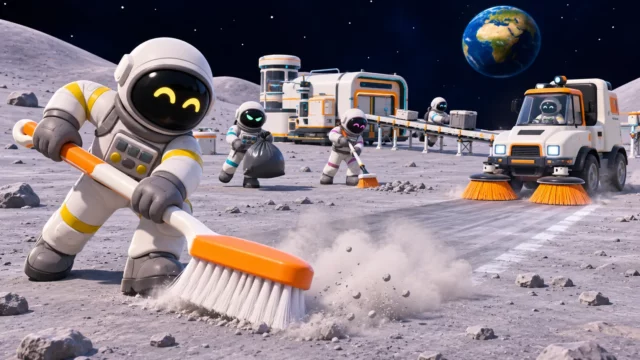
Some of Steam’s most entertaining cooperative games turn ordinary work into something unexpectedly addictive. Moon Sweepers takes that idea to an absurd extreme: cleaning an entire celestial body with equipment that barely belongs in a bathroom. Yet its appeal goes far beyond removing dust. This unusual Moon Sweepers co-op game gradually transforms a ridiculous assignment into a surprisingly elaborate industrial operation.
Developed by the two-person team DragDrop Games, the PC title arrived on Steam on October 23, 2026. Just one week later, its creators announced 600,000 players and a peak of 70,000 concurrent users. Those figures are remarkable for such a small production, although the player milestone should not be confused with confirmed copies sold.
Moon Sweepers makes cooperation rewarding without requiring combat
Instead of fighting monsters or conquering territory, players work for the fictional Lunar Surface Department. Its mission is straightforward: remove the enormous amount of dust covering the Moon. Unfortunately, its budget apparently stretches no further than a single toothbrush.
That deliberately terrible starting point creates the game’s central joke. Players collect lunar dust, deliver it to storage facilities and sell shipments to finance better equipment. Gradually, an almost impossible manual task becomes manageable through upgrades, increased carrying capacity and specialized cleaning vehicles.
Up to 16 players can cooperate online, dividing the lunar surface into different work areas or cleaning together. Solo play is also supported. The interesting part is that cooperation doesn’t depend on combat encounters or complicated character classes. Progress comes from organizing labor, investing resources and watching a once-dirty landscape change.
There’s a broader appeal here. Other peaceful multiplayer experiences, such as Loftia’s community-focused MMO without combat, also explore how shared objectives can replace traditional battles. Moon Sweepers approaches that idea through productivity, humor and an increasingly ambitious cleaning operation.
A Moon Sweepers co-op game can become a complete factory simulator
The toothbrush might attract attention, but automation is what gives Moon Sweepers its longer-term identity. As players earn money and expand their operations, they can establish additional depots and build infrastructure that changes how resources move across the Moon.
Conveyor belts connect different facilities, while splitters and mergers help distribute collected materials. Processing equipment, including the stone press, transforms resources into more valuable products. Consequently, cleaning is no longer just about gathering as much dust as possible. Players must also consider where to process it and how to keep production moving efficiently.
The cleaning robot J.O.O.N.A.S. adds another important step by collecting dust automatically. Instead of personally handling every patch of terrain, players can concentrate on expanding their facilities and improving the production network.
This shift creates an unusual progression curve. What begins as a repetitive manual job gradually resembles a logistics puzzle, with each improvement making the next expansion more achievable. Fans of industrial management might recognize a similar satisfaction in Soviet Republic’s space-focused production chains, although Moon Sweepers presents its systems in a much more playful setting.
For Battle4Play, that combination is the game’s most interesting quality. Cleaning provides an immediately understandable objective, while factory construction introduces increasingly complex decisions without abandoning the original premise.
A two-person studio is already improving the experience after launch
Reaching hundreds of thousands of players within seven days would be a major moment for almost any independent developer. For DragDrop Games, the scale is especially striking because only two people make up the development team.
In its October 30 Steam announcement, the studio thanked its community for reviews and bug reports, explaining that it had never imagined its little Moon-cleaning project attracting so many people. The announcement confirmed the 600,000-player milestone and 70,000 concurrent-player peak.
However, the launch was not entirely smooth. The developers previously acknowledged crashes, performance problems and multiplayer bugs. Subsequent patches, including versions 1.0.3 through 1.0.5, addressed several practical issues involving saved games, shared multiplayer upgrades and construction.
Building improvements are particularly relevant to a game centered on expanding infrastructure. Players gained more flexible placement options, a move mode and full refunds when changing their layouts. These adjustments reduce the frustration of experimenting with factories, especially when a growing base needs reorganizing.
Importantly, the early audience figures demonstrate considerable interest, not necessarily long-term retention. Maintaining that enthusiasm will depend on whether future improvements keep cooperative sessions enjoyable and give established players meaningful new goals.
The December update could give lunar factories a much bigger purpose
DragDrop Games is already preparing Update 1.1 for December 2026, describing it as the game’s first major content expansion. Rather than concentrating exclusively on additional cleaning equipment, the studio intends to deepen the production systems that emerge later in a playthrough.
Planned additions include new manufacturing machines, expanded production chains, fresh materials and more valuable products. More cleaning tools and upgrades are also expected, alongside improved automation and additional options for building and expanding bases.
The emphasis on later-game progression matters. Once players have replaced manual brushing with vehicles, robots and conveyor networks, another small efficiency improvement may no longer feel especially exciting. More sophisticated production objectives could provide a stronger reason to keep developing a lunar operation.
Of course, these features remain planned additions rather than finished content. Their actual impact will depend on implementation, balance and how naturally they fit into existing factories.
Anyone interested in trying the game can find Moon Sweepers on Steam for PC. It launched at $8.99 and supports more than a dozen interface languages.
Ultimately, the Moon Sweepers co-op game stands out because its smallest task can grow into a massive shared project. Its first week proved that the premise can attract attention. December’s update will offer a clearer indication of whether cleaning the Moon can remain entertaining once the toothbrush is no longer necessary.

Creator of the website, Pokemon trainer by nature. Trying to report on everything related to the world of video games, series and movies. Yu-Gi-Oh is my weakness, collecting cards since the dawn of time.