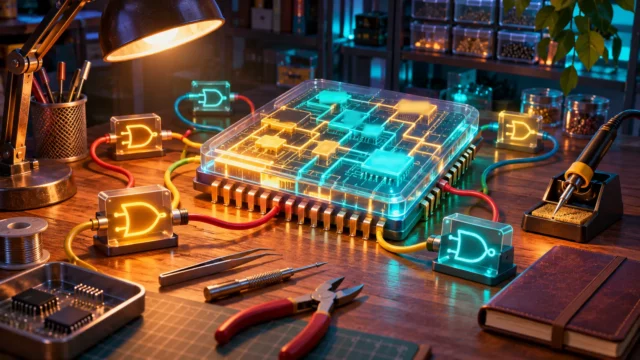
Building a graphics processor from a single logic gate might sound intimidating. However, IT THINKS! – Build Your Own GPU turns that technical challenge into a puzzle game. Developed and published by Catchy, it launches on Steam on November 19, 2026, for Windows, macOS and Linux.
Just four days before release, the studio has introduced native Linux support and simplified its approach to storytelling. Meanwhile, earlier updates have replaced AI-generated creative assets and expanded the game’s accessibility options.
IT THINKS! turns computer architecture into a puzzle game
Rather than assembling a computer from finished components, players begin with a NAND gate featuring two inputs and one output. From there, each successful invention becomes a building block for increasingly sophisticated hardware.
The IT THINKS! campaign features 62 handcrafted contracts across six eras. It takes players from a small workshop to an artificial intelligence laboratory. Working circuits become reusable chips, allowing previous discoveries to contribute directly to future designs.
Throughout this journey, players can:
- Construct logic circuits using NAND gates.
- Develop components capable of performing arithmetic operations.
- Design memory systems and programmable processors.
- Create reusable chips from functional circuits.
- Program hardware using a compact assembly language.
- Execute the same kernel across multiple parallel cores.
- Build hardware capable of matrix multiplication.
- Develop a chip that recognizes shapes drawn by the player.
- Balance circuit area, speed, memory bandwidth, power and parallel efficiency.
- Build every component independently or license existing parts from the factory.
In IT THINKS!, completing a functional circuit is only part of the challenge. Finding a more efficient solution offers another reason to revisit a design.
Fortunately, no electrical engineering experience is necessary. Optional hints and short lessons introduce unfamiliar concepts, while tests allow experienced players to skip topics they already understand.
IT THINKS! now runs natively on Linux and Steam Deck
Until recently, Linux users ran IT THINKS! through Proton, using the Windows version. However, several reported technical problems originated from that compatibility layer.
According to Catchy’s official announcement on Steam, the demo and full game got native Linux builds on November 15.
Consequently, Steam automatically installs the appropriate version on Linux and SteamOS, including Steam Deck. Existing players do not need to change any settings to receive the native build.
The game operates within the Steam Linux Runtime, with Ubuntu 22.04 or newer and SteamOS 3 among the recommended environments.
This development also arrives alongside broader improvements to Linux gaming, including the recent SteamOS 3.10 Preview update.
Nevertheless, this is the first release of the game’s Linux build. The studio encourages players to report problems before launch, alongside details about their Linux distribution and graphics card.
Catchy puts hardware challenges ahead of storytelling
Understanding a complicated circuit is challenging enough without searching through dialogue for instructions. With that in mind, Catchy has reconsidered how its narrator introduces each assignment.
The Master previously appeared at the beginning and end of every contract. However, feedback revealed that many players struggled to identify their actual objectives within these conversations.
The November 15 update introduces several changes:
- Native Linux support: dedicated builds for both the demo and full game.
- Automatic installation: Steam switches Linux and SteamOS players to the native version.
- Clearer contract briefs: instructions directly explain which components players must construct.
- Improved delivery messages: completed assignments explain what was built and where it is used.
- Reduced narrative interruptions: the Master no longer introduces and concludes every contract.
- Updated localization: the revised contract structure covers all 22 supported languages.
Despite these adjustments, the narrator remains part of the experience. He still appears during important moments, including the opening, tests, a launch and the ending. His notebook also remains accessible.
Human creativity becomes part of the game’s identity
Before introducing native Linux support, Catchy addressed another concern raised by its community. Several players questioned the presence of AI-generated assets in a game celebrating the satisfaction of building things independently.
As a result, the studio removed the AI-generated music and artwork in earlier updates. The game now features a human-composed soundtrack and human-made images.
That distinction is particularly interesting given the campaign’s eventual focus on artificial intelligence. Players explore the technology through hardware construction without relying on generated creative assets for its presentation.
Similar considerations appear elsewhere in gaming, including Jackbox Games’ commitment to human creativity.
Additionally, IT THINKS! now offers six interface colour palettes. These include Dark, Paper, High contrast, Amber terminal, Cold blue and Colour-blind friendly.
A customizable palette offers 27 colours and can be shared as text. Players can also choose between five typefaces, including Atkinson Hyperlegible Next and OpenDyslexic.
A free demo opens the door to bigger hardware projects
Outside the campaign, players can experiment with their own inventions through a free construction bench supporting up to 4,000 parts.
Available components include buttons, a keypad, seven-segment displays, a 16×16 lamp matrix, a buzzer and dice. Furthermore, players can share their creations through links that work in a browser without requiring an account.
Daily puzzles, community challenges and 20 achievements provide additional activities beyond the main contracts.
Anyone interested in trying the game can already explore its first act through the free demo. Progress transfers automatically from the Steam demo, while browser players can carry their progress over using a save file.
Ultimately, IT THINKS! makes the process of understanding hardware part of the entertainment. Its appeal lies not only in building a working computer, but also in discovering better ways to build one.

A Fortnite player since the very first storm: I jump off the Battle Bus with a plan (that rarely survives the landing), build faster than I think and never miss a live event on the island. Here I bring you every new season, collab and secret before the storm closes in.