



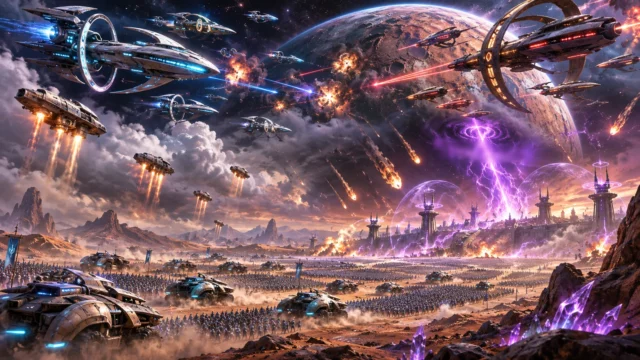
Winning a planetary invasion while managing several space battles could be an ordinary situation in Horu (stylized as HŌRU). This science-fantasy project combines real-time strategy (RTS) with 4X mechanics, taking inspiration from Star Wars: Empire at War. However, its ambitions extend beyond commanding enormous armies.
GlassBeaver, an independent developer based in Berlin, Germany, has launched a Kickstarter campaign to complete development. The upcoming PC game will feature both single-player and multiplayer, with warfare unfolding across an interstellar empire.
Horu wants players to fight wars on multiple fronts
One of the most interesting aspects of this project is how it approaches the relationship between tactical combat and empire management. Rather than focusing exclusively on individual encounters, battles across the empire take place simultaneously.
Players can personally command their forces or delegate military operations to commanders. Consequently, deciding where to concentrate attention could become just as important as assembling a powerful army.
Planetary invasions will involve hundreds of thousands of units, while space battles will feature thousands of ships. Furthermore, the science-fantasy setting allows futuristic military technology to coexist with monsters, battlemages and supernatural abilities.
Space enthusiasts looking for something to experience in the meantime can also explore Star Citizen’s free fly event this November.
These gameplay systems connect combat with empire management
Military superiority represents only one part of the experience. GlassBeaver also wants economic decisions, intelligence operations and magical abilities to influence the outcome of conflicts.
The main gameplay systems planned for Horu include:
- Planetary invasions: Massive ground battles featuring troopers, war machines, cyborgs, battlemages and monsters.
- Space warfare: Large-scale encounters involving thousands of spacecraft.
- Simultaneous battles: Conflicts unfold across the empire, with players choosing between direct control and delegation to commanders.
- Drop zones: Reinforcements land on the battlefield with their orders already assigned.
- Ship boarding: Boarding parties must reach an enemy vessel’s bridge before its self-destruction.
- Magical and tactical abilities: Meteor strikes, lightning, freezing enemies, orbital bombardments and tactical wormholes.
- Espionage: Spy networks enable bribery, misinformation, sabotage and technology theft.
- Interstellar markets: Players can buy up resources or deliberately drive down their market value.
- Physical logistics: Resources remain stored on planets and travel between them aboard merchant ships.
This combination could make economic disruption an interesting alternative to conventional military aggression. After all, manipulating resource prices or sabotaging an opponent may prove valuable even before an invasion begins.
Horu uses a custom engine to achieve its ambitious scale
Handling so many units simultaneously presents a considerable technical challenge. To accommodate these ambitions, GlassBeaver has spent years developing the project, including its own engine written entirely from scratch in C++.
According to the official Kickstarter announcement published on Steam, the trailer was rendered directly within this custom engine. It contains no pre-rendered sequences.
Nevertheless, displaying enormous armies is only part of the challenge. Performance and the ability to manage several simultaneous conflicts will also be important considerations during development.
Independent strategy games continue to explore different approaches to empire building. Another recent example is 9 Kings and its newly released version 1.0, which follows a very different strategic formula.
The Kickstarter campaign will help finance the remaining assets
The crowdfunding campaign is already underway and has a funding target of €20,000. It follows an all-or-nothing model and will conclude on December 12, 2026.
GlassBeaver intends to use the funding to produce the remaining assets necessary for a playable build. These include 3D models, textures, animations, sound effects and original music.
As a result, the campaign should help expand the selection of spacecraft, ground units and animations available within the game.
An early alpha for backers is planned approximately six months after the campaign concludes. This development stage will focus on additional content, testing and optimization.
Meanwhile, the current planned release date is November 2027, although this remains a development target.
Ultimately, Horu could appeal to strategy fans who enjoy managing an empire without sacrificing direct control over its battles. Its biggest challenge will be making that extraordinary scale as enjoyable to command as it is impressive to watch.

A Fortnite player since the very first storm: I jump off the Battle Bus with a plan (that rarely survives the landing), build faster than I think and never miss a live event on the island. Here I bring you every new season, collab and secret before the storm closes in.


