



What happens when the people behind some of gaming’s most recognizable shooters decide to build something without a major publisher? Hidden Horses offers an intriguing answer. Twenty former id Software developers have reunited in an independent, employee-owned studio, and their first game, Danger Pay, is taking aim at the kind of fast, chaotic FPS action that helped define the genre.
There is more to this announcement than another studio emerging from industry layoffs. Instead of scattering across different companies, these developers are preserving years of shared experience. Their next challenge is turning that chemistry into an original shooter where surviving a deadly television game show is the main attraction.
Hidden Horses gives former Doom developers a new beginning after Microsoft’s layoffs
Microsoft’s layoffs across Xbox Game Studios affected developers at id Software, despite the team’s widely praised contributions to the Doom franchise. Months later, some of those former colleagues have returned with a different approach to making games: owning the studio where they work.
According to an exclusive report published by Vertical Slice, the new company currently employs 20 people who previously worked together at id Software. Their professional relationships stretch back more than a decade, giving this new venture an established foundation rather than a team assembled from scratch.
Co-founder and engine programmer Dustin Land explained that years of collaboration helped the developers recognize how much they valued working together. Creating their own company allows them to preserve those relationships while pursuing the old-school shooters they believe deserve more attention.
That distinction matters. Hidden Horses is not simply a collection of former Doom employees. It is a team trying to carry its existing creative and technical collaboration into a company controlled by its workers.
Hidden Horses brings together experienced artists, programmers and designers
One of the most interesting aspects of this new studio is the range of expertise already represented within its 20-person workforce. Building a convincing arena shooter requires more than satisfying gunplay. Enemy behavior, visual feedback, environmental design and engine performance all contribute to how combat feels.
The following seven confirmed team members previously held these positions at id Software:
- Todd Boyce: Former lead VFX artist.
- Dustin Land: Former principal engine programmer and Hidden Horses co-founder.
- Daniel Young: Former senior AI and gameplay engineer.
- Andrew Willis: Former producer.
- Jordan Turner: Former senior technical designer.
- Tim Locke: Former principal technical designer.
- Allison Dombek: Former senior skybox artist.
These backgrounds suggest a team with experience across several important areas of FPS development. Engine programming can support responsive performance, while gameplay engineering and technical design help determine how enemies, weapons and combat encounters interact. Meanwhile, visual effects and environmental artwork can make intense firefights easier to read and more memorable.
Of course, previous experience does not automatically guarantee a successful debut. Nevertheless, keeping an established development team together could help reduce the friction of starting a completely new project. These developers already understand how their colleagues approach technical problems and creative decisions.
Danger Pay turns a deadly television game show into an arena FPS
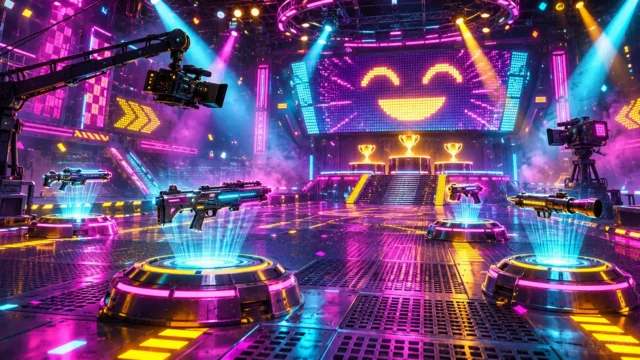
Rather than announcing another military shooter or an enormous open-world production, the studio is starting with something more focused. Danger Pay is a high-octane, single-player FPS built around classic arena-based combat.
Its premise borrows inspiration from Smash TV and The Running Man, two recognizable examples of entertainment built around dangerous spectacle. In this fictional world, contestants face a deadly television game show overseen by a sinister but charming artificial intelligence host.
The combination creates an appealing foundation for a shooter. A television competition provides a natural setting for exaggerated enemies, spectacular weapons and relentless action. Meanwhile, an AI presenter could give the experience a distinctive personality.
Here is everything currently confirmed about Danger Pay:
- Genre: A classic arena-based first-person shooter.
- Player experience: A high-octane, single-player adventure.
- Setting: A deadly television game show.
- Main presenter: A sinister but charming AI host.
- Creative influences: Smash TV and The Running Man.
- Gameplay priorities: Classic FPS action, impressive weapons and unusual enemies.
- Technical ambitions: Strong optimization is one of the project’s stated priorities.
- Funding: A Kickstarter campaign is planned to help finance development, but its details are still being finalized.
For fans of traditional shooters, the emphasis on optimization is particularly worth noting. Arena combat depends heavily on responsive controls and clear visual feedback, especially when multiple enemies demand attention at once.
Employee ownership offers a different response to instability in game development
The timing makes this announcement especially interesting. Major publishers continue to make decisions that can reshape development teams, sometimes regardless of their previous achievements. Yet the people affected do not always leave the industry or abandon the creative partnerships they have established.
For example, Black Forest Games moving toward independence through Third Signal offers another example of experienced developers pursuing greater control over their future. The circumstances and ownership arrangements differ, but both stories raise a similar question about who gets to shape a studio’s long-term direction.
There is a contrasting example on the publisher side, too. Sony’s decision to cancel Fairgame$ after disappointing playtest results shows how even a project backed by a major company can disappear before reaching players. In that case, Haven’s staff were retained, making the outcome different from Microsoft’s layoffs. Still, both situations highlight the uncertainty surrounding game development inside large organizations.
Employee ownership gives the new Doom veterans a different structure, but it does not eliminate financial or commercial challenges. An independent team must still secure funding, manage production and convince players that its game deserves attention.
That is where Danger Pay’s planned Kickstarter becomes important. The campaign could help finance development while giving interested players a clearer opportunity to evaluate the project.
The next test will be whether Danger Pay can deliver its old-school FPS ambitions
For now, the most promising part of this story is not a release window or an ambitious list of features. It is the combination of an experienced development team, a clearly defined genre and a premise that leaves room for personality.
Danger Pay does not need to imitate Doom to attract attention. Its deadly game-show setting already offers a different identity, while the developers’ technical backgrounds give them relevant experience for building fast-paced combat.
Hidden Horses represents an encouraging possibility for developers affected by layoffs: an experienced team can stay together, establish its own company and pursue a creative direction it believes in. Whether Danger Pay becomes the next standout old-school FPS is still an open question, but its unusual premise and the people building it make this one worth following.

Creator of the website, Pokemon trainer by nature. Trying to report on everything related to the world of video games, series and movies. Yu-Gi-Oh is my weakness, collecting cards since the dawn of time.

