


Some of the most intriguing Halo Infinite concept art may belong to a game that players never had the chance to experience. More than 20 environment illustrations have emerged from a cancelled, unnamed project, depicting a world of forgotten machinery, devastated landscapes and unsettling underground spaces. Their possible connection to Project Tatanka, Halo’s abandoned battle royale experiment, has attracted attention. However, neither Microsoft nor Halo Studios has confirmed that these illustrations were created for Tatanka.
Halo Infinite concept art suggests a world shaped by destruction
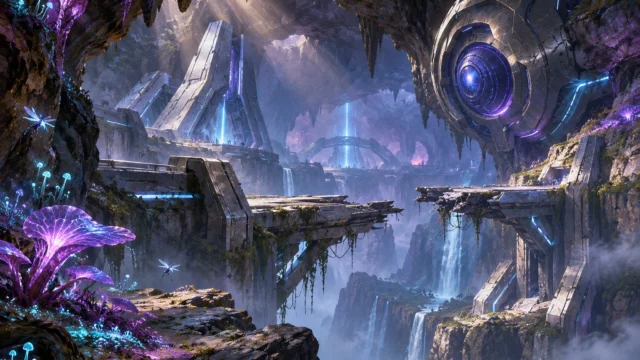
What makes these illustrations interesting isn’t simply their visual quality. It’s how differently each environment approaches the idea of an abandoned world. Some landscapes feature enormous ravines surrounded by mountains, where ancient mechanical remains have gradually disappeared beneath vegetation. Others introduce deserted buildings, damaged structures and artillery pieces that suggest the aftermath of a major conflict.
Then the atmosphere changes completely. Underground chambers feature machinery glowing in blue and purple, alongside unusual alien fauna covering the walls. Elsewhere, broken bridges interrupt rocky terrain, while one particularly striking composition places a red sunrise behind grey, ruined architecture.
These contrasting environments could suggest different regions of a larger playable map. That interpretation would fit an ambitious multiplayer project, although the artwork alone cannot establish its intended scale, gameplay systems or final layout.
Why the Halo Infinite concept art is being connected to Tatanka
The illustrations come from Jason Lavoie, a former senior environment artist at Certain Affinity. His ArtStation collection, titled “Cancelled Project – World Building”, contains more than 20 pieces created during 2020. Crucially, Lavoie never identifies the game.
His professional history provides an interesting clue. According to his LinkedIn profile, he worked at Certain Affinity during that period on an unannounced project for current-generation platforms that was subsequently cancelled. He also explains that his involvement was brief and that development eventually moved to another studio.
Insider Gaming, which discovered the collection, considers Project Tatanka its most likely origin. The publication connects Lavoie’s timeline with earlier reporting from journalist Jez Corden, who indicated that Tatanka began development at Certain Affinity in spring 2020.
Nevertheless, matching dates and development circumstances are supporting clues, not definitive proof. No official statement identifies these designs as Halo Infinite assets or establishes their connection to Tatanka.
The cancelled Halo battle royale had a complicated development
Project Tatanka was reportedly conceived as a battle royale experience for Halo Infinite, incorporating PvPvE elements. That combination would have involved competition between players alongside encounters with computer-controlled enemies. However, its exact gameplay implementation was never publicly demonstrated.
Published reports describe several major revisions before the project evolved into Project Ekur. Development reportedly ended with an internal cancellation in 2024, without either version receiving an official announcement.
In October 2024, a Certain Affinity game director revealed on LinkedIn that he had led a substantial design team working on a cancelled Halo battle royale. He believed the project could have transformed the franchise. His comments reinforce the existence of that cancelled initiative, but they do not authenticate Lavoie’s artwork.
What these abandoned environments tell us about Halo’s possibilities
The most compelling question isn’t whether these locations would have looked impressive during gameplay. It’s how their contrasting environments might have influenced encounters. Open ravines, enclosed caves and ruined settlements offer very different possibilities for movement, visibility and confrontation.
That distinction is especially interesting when compared with Halo Infinite Forge maps showcased at Halo Fest, where environmental design remains central to multiplayer variety. Meanwhile, Halo: Campaign Evolved’s Firefight and cooperative update illustrates another approach to expanding Halo experiences beyond traditional competitive encounters.
Still, concept illustrations cannot tell us whether any proposed locations became playable, survived later revisions or supported specific mechanics.
Ultimately, this Halo Infinite concept art offers a fascinating look at an abandoned creative direction, regardless of its unidentified origin. The Project Tatanka connection remains an informed theory rather than a confirmed discovery. Until further evidence emerges, these images are best appreciated for what they actually reveal: an ambitious collection of environments from a game that never reached players.

A Fortnite player since the very first storm: I jump off the Battle Bus with a plan (that rarely survives the landing), build faster than I think and never miss a live event on the island. Here I bring you every new season, collab and secret before the storm closes in.